
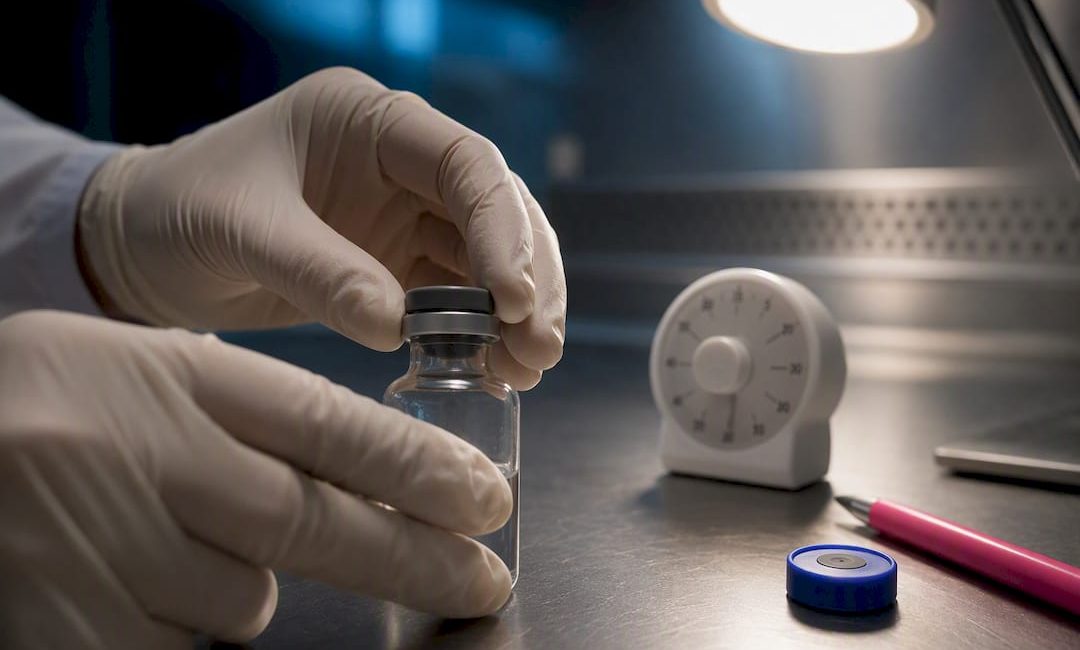
The shelf life after reconstitution is set first by the summary of product characteristics or manufacturer label, and only in their absence should a practitioner assign a documented, validated in-use period. Practical ranges vary widely: some products demand immediate use, others tolerate roughly 8 hours at room temperature, many reconstituted biologics allow 24 hours refrigerated, and certain peptides commonly reach 28 to 30 days refrigerated under correct handling. For licensed practitioners, the European Medicines Agency (EMA), the World Health Organization (WHO), and the NHS Specialist Pharmacy Service (SPS) all set the reference points, with Mirror Pharma serving as a supplier resource for the products themselves.
TL;DR:
- Shelf life after reconstitution varies from immediate use to over 28 days under refrigeration, depending on the product’s formulation and preservative content.
- Regulatory bodies like EMA, WHO, and NHS provide strict guidance, with shelf-life mandates based on validated stability data rather than assumptions or general estimates.
- Visually inspecting for changes is necessary but insufficient; temperature monitoring and proper aseptic technique are essential to maintain product integrity.
- Assigning a beyond-use date requires following manufacturer instructions first, then documenting conservative estimates based on stability data and handling conditions.
- Extending expiration periods beyond official limits demands local validation, not assumptions, and should include proper record-keeping and testing where feasible.
Table of Contents
- What regulatory guidance governs shelf life after reconstitution?
- How long do reconstituted peptides and biologics actually last?
- What shortens or extends stability once a vial is opened?
- How should you assign and label a beyond-use date?
- What should a practitioner check before and after reconstitution?
- Balancing regulatory conservatism with clinical practicality
- Sources
- FAQ
What regulatory guidance governs shelf life after reconstitution?
Three bodies of guidance frame nearly every decision a practitioner or aseptic unit makes about a reconstituted product, and none of them leave much room for guesswork.
The EMA’s scientific guideline, referenced as CPMP/QWP/159/96, requires manufacturers to demonstrate stability for the exact conditions and maximum storage period printed on the label or in the summary of product characteristics. That means the in-use period stated on a product’s packaging is not a marketing suggestion. It is the outcome of formal stability testing, and it takes precedence over any generic rule of thumb a clinic might otherwise apply. If the label says 8 hours at room temperature, that figure was earned through real degradation data, not rounded up for convenience.
The WHO offers a useful illustration of how policy can flex within a regulated framework. Its multi-dose vaccine vial policy permits certain opened vials to remain in use for up to 28 days under strict storage and handling conditions, while other vaccines must be discarded within 6 hours of opening or at the end of an immunisation session. The same institution, applying the same underlying science, arrives at wildly different windows depending on formulation and preservative content.
NHS SPS guidance narrows the focus to injectable medicines used for multiple doses, and its tone is notably cautious. It treats beyond-use dates as safety limits rather than performance targets, warning that preservative loss and repeated needle access both raise microbial contamination risk with every entry into a vial. Its recommendation is to assign the shortest defensible in-use expiry, favouring refrigeration wherever the product allows it.
Where none of these documents cover a specific product, such as an unlicensed special or a compounded preparation, responsibility shifts squarely onto the preparing professional. UK guidance on supply of unlicensed medicinal products makes clear that whoever reconstitutes and labels the item carries the burden of assigning an appropriate, documented shelf life. In practice, this covers:
- Checking the SmPC or manufacturer insert before assuming any standard timeline applies.
- Treating WHO and NHS SPS documents as policy templates, not product-specific answers.
- Recognising that an absent instruction is not permission to improvise. It is a prompt to document a conservative, defensible in-use period.
- Keeping a record of which guidance source informed each beyond-use date, in case of audit or query.
How long do reconstituted peptides and biologics actually last?
Timelines differ sharply by product class, and the differences trace directly back to molecule size, excipients, preservative content, and how the container is sealed.
At the strict end, some reconstituted biologics permit no delay at all. Manufacturer instructions for certain products specify immediate use only, reflecting rapid degradation once the powder meets diluent. A step up from that, some formulations tolerate roughly 8 hours at room temperature or up to 24 hours under refrigeration, a pattern seen in several marketed biologic reconstitution instructions aimed at healthcare professionals. These short windows usually reflect a lack of bacteriostatic preservative and a formulation sensitive to hydrolysis or aggregation once in solution.
Peptides sit at a different point on the spectrum. Industry and clinic practice guides commonly cite 28 to 30 days refrigerated as a practical default for many reconstituted peptides when bacteriostatic water and correct cold-chain handling are used. That figure is a class generalisation rather than a validated constant, and it should never substitute for product-specific SmPC data where such data exist. Some peptide classes, under tightly validated storage conditions, have been reported to remain stable for 45 to 60 days, but that extension depends entirely on documented local testing rather than assumption.
Botulinum toxin preparations offer a well-studied middle case. A peer-reviewed study found that refrigerated storage maintained potency in reconstituted botulinum toxin preparations for up to four weeks, though the authors were explicit that this finding is product-specific and cannot be generalised across every toxin formulation on the market. It demonstrates that extended refrigerated stability is achievable, but only when backed by a study of that exact preparation.
A few structural reasons explain why these timelines diverge so much:
- Molecule size and complexity. Larger biologic molecules tend to be more prone to aggregation and structural change once reconstituted, which shortens safe in-use windows.
- Preservative content. Bacteriostatic water and preservative-containing formulations resist microbial growth for longer than preservative-free equivalents, extending practical shelf life after reconstitution.
- Excipient stability. Buffers and stabilisers included in the original lyophilisate influence how quickly a reconstituted solution degrades chemically, independent of microbial concerns.
- Container closure integrity. A vial designed for single access behaves very differently from one engineered for repeated multi-dose withdrawal.
The common thread across every study and guideline is that published figures describe what has been demonstrated for a specific product under specific conditions. Treat them as reference points for setting conservative local policy, never as a substitute for reading the label first.
What shortens or extends stability once a vial is opened?
Temperature is the single biggest lever, and it cuts in both directions. Storage above the labelled range accelerates chemical degradation and microbial growth, while storage below the intended range, particularly accidental freezing, can physically damage proteins through ice crystal formation, rupturing structures that no amount of subsequent refrigeration will repair. Most reconstituted biologics and peptides carry explicit do-not-freeze instructions for exactly this reason, and a single unnoticed freeze-thaw cycle in transit or storage can silently void an otherwise valid beyond-use date.
Preservative status matters just as much. A bacteriostatic water diluent inhibits microbial proliferation between doses, which is precisely why NHS SPS guidance treats preservative-free multi-dose vials as considerably higher risk than their preserved counterparts. Every needle insertion into a vial, even with correct septum disinfection, introduces a small contamination risk that preservatives are designed to manage, not eliminate. Repeated access over the course of a multi-dose vial’s life gradually erodes that safety margin, which is why SPS recommends assigning the shortest defensible expiry rather than the longest theoretically possible one.
Degradation does not always announce itself. Cloudiness, visible particulates, colour change, or an altered odour are useful red flags, and any one of them should trigger immediate discard regardless of how much time remains on a documented beyond-use date. The harder problem is chemical degradation that produces no visible change at all. A solution can look perfectly clear while having lost a meaningful fraction of its potency, which is why visual inspection is necessary but never sufficient to confirm a product remains fit for use.
Practical verification closes that gap. A short discipline helps:
- Log the reconstitution date, time, and storage location on the vial and in clinic records the moment reconstitution occurs.
- Use a calibrated fridge thermometer or continuous temperature monitor, not an assumption that the fridge is running correctly.
- Record any excursion outside the 2 to 8°C band, however brief, and treat it as grounds for early discard pending clinical judgement.
- For high-value biologics or where an extended in-use period is being considered beyond SmPC limits, arrange potency or sterility testing rather than relying on visual inspection alone.
Pro Tip: Keep a simple excursion log next to the fridge, not buried in a spreadsheet. A five-second note at the moment a temperature alarm sounds is far more likely to happen than a retrospective entry made at the end of a busy clinic day.
How should you assign and label a beyond-use date?
A defensible beyond-use date follows a clear hierarchy, and skipping a step in that hierarchy is where most avoidable risk creeps in.
Start with the SmPC or manufacturer’s reconstitution instructions. If those specify a validated in-use period and storage condition, that figure is the answer, full stop. Where the SmPC is silent or ambiguous, the next port of call is any additional manufacturer stability data, sometimes available on request from the marketing authorisation holder. Only when both of those sources are exhausted should a local aseptic unit consider assigning its own conservative default, and even then, that step should only follow local validation work: container integrity checks, an agreed microbiological sampling plan, and periodic stability spot checks, all recorded formally.
Analysts and EDQM-coordinated position papers have flagged a persistent gap between the stability data generated for marketing authorisation and what actually happens in clinical practice, where hospital units sometimes extend in-use periods beyond SmPC limits under local governance. Where that gap causes repeated waste or operational friction, commissioning a product-specific stability study can be more cost-effective over time than repeatedly discarding partially used, still-viable stock.
Whatever route sets the date, the label on the vial itself needs to carry:
- The exact reconstitution date and time, not just the date.
- The calculated beyond-use date and time, stated with the same precision.
- Storage instructions, including refrigeration requirement and any do-not-freeze warning.
- The preparer’s initials, for accountability and audit trail.
- Preservative status, since preservative-free vials warrant tighter handling than preserved ones.
- Batch or lot number, to allow traceability back to the original manufacturer record.
Aseptic technique underpins every one of those figures holding true. Septum disinfection before each access, minimising the number of times a vial is entered, and using closed-system transfer devices where available all help preserve the microbial integrity that the assigned beyond-use date assumes. A beyond-use date calculated correctly but undermined by poor technique at the point of use is not a real safety margin, it is a number on a label. Where storage or handling conditions are ever in doubt, or where a product has been used well beyond typical class expectations, escalating to sterility or potency testing is the responsible next step rather than assuming the product remains fit for purpose.
What should a practitioner check before and after reconstitution?
Good outcomes here depend less on knowing the theory and more on having a repeatable routine every time stock arrives and every time a vial is opened.
On receipt, check the cold chain before anything else. Confirm the delivery arrived within the expected temperature range, note the batch and lot number against the accompanying paperwork, and inspect packaging for any sign of temperature excursion during transit. Mirror Pharma’s guidance on cold chain storage for licensed practitioners covers the practical steps for maintaining that integrity from delivery through to clinic fridge, and it is worth reading before the first delivery arrives rather than after a problem occurs.
Before reconstituting anything, verify the current SmPC rather than relying on memory or a previous batch’s instructions, since formulations and storage guidance can be updated between orders. A short checklist for the reconstitution step itself:
- Confirm the SmPC’s stated in-use period and storage condition before opening the vial.
- Record the lot number and reconstitution timestamp at the point of preparation, not retrospectively.
- Have sterile needles and appropriate consumables, such as sterile IV film dressings, ready before starting.
- Use extended order cut-off windows to plan deliveries around clinic schedules, avoiding last-minute reconstitution under time pressure that tends to produce shortcuts.
All products discussed here are intended for use by licensed practitioners and qualified aesthetic professionals operating within appropriate clinical governance, not for self-administration or lay use.
Balancing regulatory conservatism with clinical practicality
The instinct to stretch an in-use period to avoid waste is understandable, but SmPC limits exist because someone tested the alternative and found it wanting. Extend them only when your unit has done the validation work to back that decision, not because a colleague’s clinic has been getting away with it. Where the numbers genuinely don’t work for your workflow, commissioning a proper stability study is the honest answer, not quietly ignoring the label.
— Rizwan
This article is general information, not a substitute for advice from a qualified doctor. Consult a qualified healthcare professional about your own circumstances before acting on anything here.
Sources
- Maximum shelf-life for sterile products for human use after first opening or following reconstitution – Scientific guideline
- WHO policy on the use of opened multi-dose vaccine vials (2014 Revision)
- Use of injectable medicines for multiple doses – NHS SPS
- Effect of the refrigerator storage time on the potency of botulinum toxin for human extensor digitorum brevis muscle paralysis
- In‑use storage time of reconstituted medicines — ECA (EDQM position summary)
FAQ
What is the shelf life of reconstituted peptides?
Many reconstituted peptides are commonly stored for 28 to 30 days refrigerated when bacteriostatic water and correct handling are used, though this is a class guideline rather than a fixed rule, and the manufacturer’s own instructions always take precedence where available.
How long does a reconstituted product last at room temperature?
It depends entirely on the formulation. Some products require immediate use, while others, according to manufacturer reconstitution instructions, tolerate around 8 hours at room temperature before requiring refrigeration or discard.
Does a reconstituted product lose potency over time?
Yes, potency typically declines gradually after reconstitution, and the rate depends on temperature, preservative content, and formulation. Peer-reviewed refrigeration studies on botulinum toxin preparations found potency maintained for up to four weeks under refrigeration in that specific case, but this cannot be assumed for every product.
Does a reconstituted product go out of date once opened?
Every reconstituted product carries a beyond-use date distinct from its unopened expiry, determined by the SmPC where available or by a documented, validated local assessment where it is not, following the EMA’s stability demonstration requirements.
