

Mesotherapy cocktails are sterile, multi-ingredient solutions delivered by intradermal or superficial subcutaneous injection to support skin, scalp or localised body treatment goals. For licensed practitioners, the single most important selection rule overrides everything else: choose CE-marked or ISO-certified, pre-formulated vials from a verified supplier, and follow current international consensus guidance rather than in-clinic mixing from bulk ingredients.
Primary indications fall into three groups:
- Skin — hydration, radiance and support for collagen turnover in facial rejuvenation protocols
- Hair/scalp — adjunctive support alongside recognised treatments for hair thinning, typically using polynucleotide or nutrient-based formulations
- Localised body — conservative support for skin quality and texture in cellulite-prone areas, distinct from regulated fat-dissolving injectables
Pre-formulated, certified vials reduce contamination risk and give you a documented, reproducible product for every patient record.
Key Takeaways
Mesotherapy cocktails work best when practitioners pair certified, sterile formulations with protocols grounded in current international consensus guidance rather than anecdotal technique.
| Point | Details |
|---|---|
| Certification comes first | Verify CE marking or ISO certification and batch traceability before stocking any new cocktail. |
| Match formulation to goal | Choose HA-led hydration, peptide complexes or PDRN formulations based on the specific skin, scalp or body indication. |
| Depth and volume are indication-led | Superficial mesoglow sits at 0.5 to 1.5mm; deeper subcutaneous delivery up to 4mm needs specific training and consent. |
| Evidence is uneven | Hydration protocols have stronger practical support than body-contouring or pigmentation claims; counsel patients accordingly. |
| Source from verified suppliers | Mirror Pharma offers CE-certified Cytocare and ARES AA formulations with practitioner verification and reliable delivery windows. |
Table of Contents
- What goes into mesotherapy cocktails: formulation types and active ingredients
- Matching cocktails to skin, scalp and body indications
- Injection technique, depth and session planning in practice
- Certifying product quality and reducing clinical risk
- What the evidence and international consensus actually say
- Clinical notes from the field
- Sourcing certified mesotherapy products through Mirror Pharma
- Sources
- FAQ
What goes into mesotherapy cocktails: formulation types and active ingredients
Most mesotherapy injections on the market fall into two broad architectures: non-crosslinked hyaluronic acid bases and polyrevitalising complexes. The HA base delivers immediate hydration and acts as a carrier; the polyrevitalising complex layers in vitamins, amino acids, coenzymes and antioxidants to support dermal metabolism. NCTF 135HA is often cited in the literature as an exemplar of this multi-ingredient architecture, combining non-crosslinked HA with a large complex of nutritional actives in a single vial.
Beyond the HA backbone, formulations vary widely by active class:
- Peptides — signal collagen and elastin synthesis, used in anti-ageing protocols
- Vitamins and antioxidants (vitamin C, glutathione, coenzyme Q10) — support cellular repair and reduce oxidative stress
- Amino acids — provide building blocks for structural protein synthesis
- Enzymes (hyaluronidase in specific contexts) — modify tissue permeability, used with caution
- Polynucleotides (PDRN) — increasingly used for tissue repair signalling in skin and scalp protocols
A 2019 PubMed review of mesococktails and mesoproducts in aesthetic dermatology found substantial formulation variability across products marketed for lipolysis, pigmentation, skin rejuvenation and hair loss, alongside a genuine scarcity of large-scale trials. That gap means concentration, pH and osmolality control aren’t cosmetic details. They determine whether a product behaves predictably in the dermis or triggers an inflammatory reaction.
Pro Tip: Never trust a cocktail’s stability to guesswork. If the product leaflet specifies a storage temperature range, treat that as a sterility control, not a suggestion.

Ad-hoc compounding from bulk actives might look cost-effective, but it removes every safeguard a certified vial gives you: batch traceability, validated sterility testing and a defensible paper trail if a patient has an adverse reaction.
Matching cocktails to skin, scalp and body indications
Cocktail selection should follow the treatment goal, not the other way around. Three broad categories cover most clinical requests.
- Skin rejuvenation. Hydration-led protocols using non-crosslinked HA suit early-stage dullness and fine lines, while polyrevitalising complexes and peptide-driven formulations target deeper collagen support for more established photoageing. Products like Cytocare 516 Revitacare and Cytocare 532 Revitacare sit at different points on that hydration-to-structural-support spectrum, letting you tailor the vial to skin condition rather than defaulting to one product for every patient.
- Scalp and hair. PDRN-based and nutrient cocktails function as adjunctive support alongside recognised hair loss treatments, not as standalone cures. Set expectations honestly here: response varies by aetiology, and polynucleotide protocols work best as part of a broader plan rather than a single intervention.
- Localised body and cellulite. This is where caution matters most. Conservative cocktails aimed at skin texture and microcirculation are a different category entirely from regulated fat-dissolving agents such as deoxycholic acid. Evidence for cosmetic fat-reduction claims from mesotherapy remains mixed, and practitioners should never extrapolate a regulatory approval for one indication onto an unrelated body-contouring claim.
Many clinics combine mesotherapy cocktails with microneedling, PRP or energy-based devices to improve product distribution and mechanical stimulation. Combination protocols can enhance outcomes, but each added modality brings its own consent and contraindication checklist, so document the rationale for combining rather than defaulting to it.
Injection technique, depth and session planning in practice
Depth and volume decisions depend on both indication and delivery device. Manual syringe technique for superficial mesoglow protocols typically places product at at shallow depths typical for superficial mesoglow protocols(https://dermnetnz.org/topics/mesotherapy), while deeper subcutaneous delivery, up to around 4mm, is reserved for targeted applications and demands specific training and explicit consent.
Practical parameters to build into your protocol:
- Space injection points roughly 1 to 2cm apart, adjusting for treatment area and product viscosity
- Use a small volume per point (commonly 0.05 to 0.1ml) to avoid overloading the dermis and triggering localised swelling
- Many clinics run courses of multiple sessions, often several, depending on the indication (https://dermnetnz.org/topics/mesotherapy), spaced one to three weeks apart initially, moving to quarterly maintenance
- Match your device to the protocol: manual syringe, meso-gun, microneedling/derma-roller and jet systems each distribute product differently, and switching devices mid-course without recalibrating volume can change outcomes
- Photograph baseline and follow-up sessions, record batch numbers in the patient file, and log any deviation from the standard protocol
Adjust cadence to patient response rather than a rigid template. A patient with thin, reactive skin may need longer intervals between sessions than the standard course suggests.
Certifying product quality and reducing clinical risk
Sterility failures in mesotherapy almost always trace back to sourcing, not technique. The international consensus guidelines on safe and evidence-based mesotherapy practice recommend sterile, certified products over in-clinic mixing specifically because compounded solutions carry a materially higher contamination risk than sealed, pre-formulated vials.
Before you stock any new product, verify:
- CE marking or ISO certification status, checked against the manufacturer’s own documentation, not a distributor’s summary
- Batch traceability, so any adverse event can be linked back to a specific production run
- Cold-chain compliance where the product leaflet mandates chilled storage, with logged temperature checks
- Expiry dating and rotation, particularly for multi-dose vials opened across several appointments
Common adverse events include localised infection, hypersensitivity reactions and post-injection nodules. Most resolve with prompt topical or oral treatment, but any suspected infection warrants immediate clinical review rather than a wait-and-see approach. Pre-treatment screening should flag active skin infection, known hypersensitivity to any listed ingredient, pregnancy, and anticoagulant therapy as priority contraindications to review before proceeding.
Statistic callout: The scarcity of large-scale clinical trials for many mesococktail formulations, flagged directly in the 2019 PubMed review, is precisely why product certification and sourcing discipline carry more clinical weight here than in better-studied injectable categories.
What the evidence and international consensus actually say
The 2025 to 2026 international consensus statement pushes mesotherapy away from anecdote and toward standardised terminology, documented safety protocols and certified product use. That’s a meaningful shift for a field that has historically relied heavily on individual clinic experience rather than shared standards.
The consensus draws a clear line between cosmetic-grade formulations and products containing active pharmaceutical ingredients, and it insists these two categories be treated with different regulatory caution. It also stresses that mixed or limited efficacy evidence for some indications, particularly body contouring, should be communicated plainly to patients rather than smoothed over.
Practitioners should read that mixed evidence honestly: HA-based hydration protocols have decent practical support, while lipolytic and pigmentation claims rest on thinner data. Mirror Pharma lists CE-certified formulations, including the Cytocare range and CYTOCARE 715 C Line, as a verified supplier resource for practitioners building evidence-aligned protocols.
Clinical notes from the field
For licensed practitioners: keep a rolling stock check on high-turnover cocktails so you’re never substituting a different formulation mid-course out of necessity. The clinical pearl that saves the most awkward consultations is setting expectations before treatment, not after, particularly for hair and body indications where evidence is thinner. Document every protocol deviation and outcome. It’s the difference between a defensible clinical record and a guess you can’t explain later.
— Rizwan
Sourcing certified mesotherapy products through Mirror Pharma
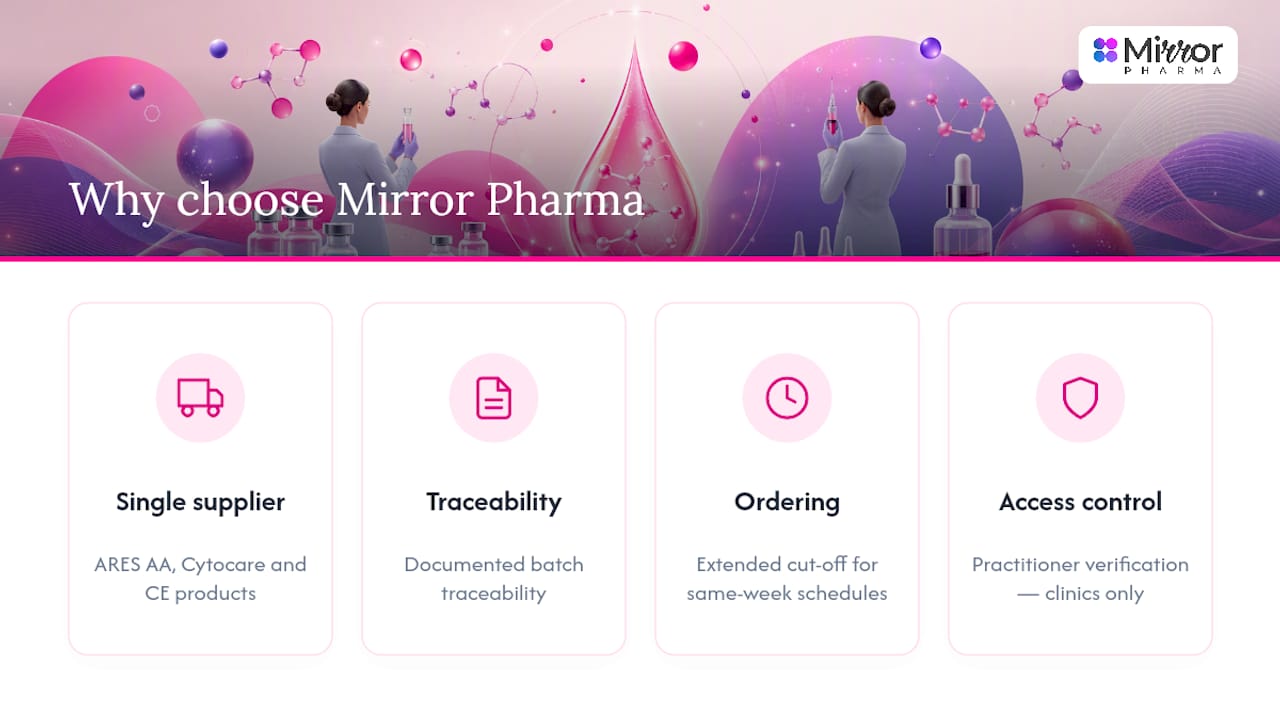
Reliable outcomes start with a reliable supply chain, and that’s where Mirror Pharma fits for licensed practitioners running mesotherapy protocols at volume. Rather than chasing multiple distributors for certified stock, clinics can source ARES AA Anti-age, the Cytocare range and other CE-marked formulations from one verified supplier with documented batch traceability. Mirror Pharma’s extended order cut-off times mean same-week clinic schedules aren’t held hostage to a courier deadline, which matters when you’re booking a patient’s next session before the current vial arrives. Every order runs through practitioner verification, so stock only reaches qualified clinics and training academies, not the general public. Browse the current range at the Mirror Pharma shop and check availability before your next ordering cycle.
Sources
For deeper clinical detail, consult the international consensus guidelines, the PubMed review on mesococktails, and DermNetNZ’s mesotherapy overview.
This article is general information, not a substitute for advice from a qualified doctor. Consult a qualified healthcare professional about your own circumstances before acting on anything here.
- International Consensus Guidelines on the Safe and Evidence-Based Practice of Mesotherapy: A Multidisciplinary Statement
- Mesococktails and mesoproducts in aesthetic dermatology – PubMed
FAQ
What is meso cocktail microneedling?
It combines a mesotherapy cocktail, often HA or peptide-based, with microneedling to mechanically improve product distribution into the dermis rather than relying on injection alone.
Which is better, mesotherapy or polynucleotides?
Neither is universally better; polynucleotides (PDRN) are one active ingredient class used within mesotherapy cocktails, typically chosen for tissue repair signalling in skin and scalp protocols rather than as a competing category.
Does mesotherapy actually work?
Evidence varies by indication: hydration and skin quality protocols have reasonable practical support, while large-scale trials remain scarce for many other claimed uses, so outcomes should be discussed with patients as variable rather than guaranteed.
How many sessions does a typical course require?
Most clinics run multiple sessions, often several, depending on the indication (https://dermnetnz.org/topics/mesotherapy), followed by quarterly maintenance, adjusted to individual patient response.
Why should I avoid mixing my own mesotherapy solutions?
In-clinic compounding removes the sterility validation and batch traceability that certified, pre-formulated vials carry, and international consensus guidance specifically recommends against it for infection-risk reasons.