
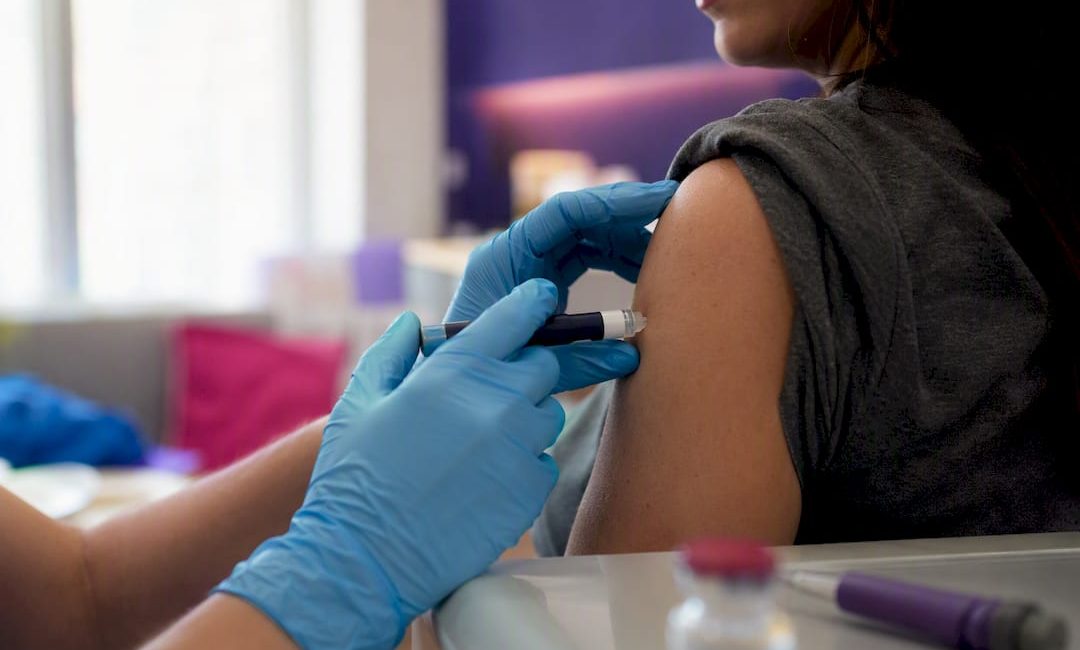
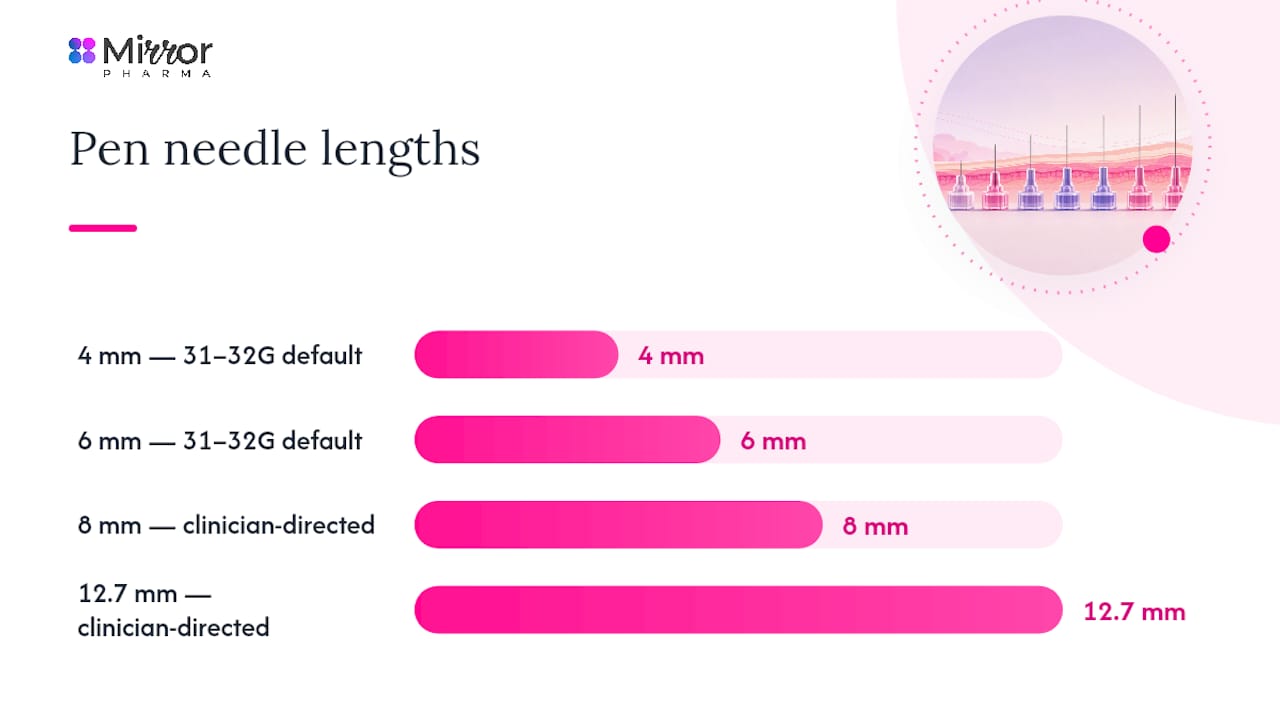
For most adults injecting insulin, the default choice is a 4 mm, 5 mm or 6 mm needle in 31G to 32G. This combination reaches subcutaneous tissue reliably, regardless of body mass index, and causes less pain than older, longer designs. Longer needles, 8 mm and 12.7 mm, still have a place, mostly for specific dosing needs or clinician preference, but they’re no longer the default starting point they once were.
The one rule that matters more than any length or gauge decision is: change the needle after every single injection. A pen needle tip dulls after one use. Reusing it increases pain, raises the risk of microscopic bending, and can affect how accurately the dose is delivered, according to the American Diabetes Association.
Here’s the quick version before we get into the detail:
- 4-6 mm, 31-32G — the starting point for most adults and children, injected at 90° without pinching skin.
- 8 mm — occasionally used, usually with a pinched skin technique.
- 12.7 mm — largely legacy sizing, rarely needed with modern pen devices.
- Single use, every time — never reuse a pen needle, even if it looks fine.
Regional NHS guidance backs this shift towards shorter needles directly, recommending that clinicians support patients switching to shorter lengths, provided the change is properly supervised, according to the NHS North East London ICB position statement.
Key Takeaways
Most adults and children achieve safe, comfortable subcutaneous insulin delivery with a short needle in the 4 to 6 mm range and a gauge between 31 and 32, changed after every single injection.
| Point | Details |
|---|---|
| Default needle choice | Use 4-6 mm length, 31-32G gauge, injected at 90° without pinching for most people. |
| Longer needles still exist | 8 mm and 12.7 mm remain appropriate for specific dosing needs or clinician-directed cases. |
| Change every time | Never reuse a pen needle; reuse causes dulling, increased pain and dose inaccuracy. |
| Hold time matters | Hold the needle in place for 5 to 10 seconds after injecting to prevent leakage. |
| Rotate injection sites | Avoid repeated use of the same small area to prevent lipohypertrophy. |
| Stock practitioner-grade supplies | Mirror Pharma supplies 30G and 32G needles and syringes for clinics managing patient injection needs. |
This article is general information, not a substitute for advice from a qualified doctor. Consult a qualified healthcare professional about your own circumstances before acting on anything here.
Table of Contents
- Needle lengths explained: what each length reaches and when to use them
- Needle gauge explained: how gauge affects pain, flow and dose accuracy
- How to choose the right pen needle size for you: a clinician-aligned checklist
- Injection technique by needle length: angle, pinch, hold time and site rotation
- Special populations and special circumstances
- Troubleshooting: pain, leakage and dose accuracy — causes and fixes
- Sharps disposal and safety considerations
- Evidence and expert guidance supporting the recommendations
- What the evidence actually tells us
- Stocking the right needles and syringes for your clinic
- Sources
- FAQ
Needle lengths explained: what each length reaches and when to use them
Needle length determines whether the insulin is delivered into subcutaneous fat, where it should go, or into muscle, where absorption is less predictable. Skin thickness varies by site and person but is generally quite thin across most adults, so short needles around 4 to 6 mm reach subcutaneous tissue in the vast majority of cases without needing to pinch the skin.
That’s the clinical logic behind the shift away from longer needles over the past decade. Clinical consensus now holds that shorter needles work effectively for subcutaneous delivery across almost all adult and paediatric patients, independent of body mass index. It’s a bigger claim than it sounds, because for years the working assumption was that larger patients needed longer needles to punch through more tissue. The evidence didn’t support that assumption once shorter needles were properly studied.
Here’s how the common lengths compare in practical terms:
| Length | Typical technique | Common use case |
|---|---|---|
| 4 mm | 90° angle, no skin pinch | Most adults and children; first-line choice |
| 5 mm | 90° angle, no skin pinch | Most adults; interchangeable with 4 mm |
| 6 mm | 90° angle, usually no pinch | Adults with more subcutaneous tissue |
| 8 mm | Pinch-up technique often needed | Occasional use; larger-volume doses |
| 12.7 mm | Angled injection, pinch required | Rare; legacy pens, specific clinician direction |
A few practical rules follow from this:
- 4-6 mm needles go in straight, at 90°, without pinching the skin in most people. This is the technique now recommended as standard.
- 8 mm needles usually need a pinched skin fold to avoid intramuscular injection, particularly in leaner patients.
- 12.7 mm needles almost always require pinching and sometimes an angled approach rather than a straight 90° entry.
- Longer needles still get used occasionally: for very large-volume doses where flow characteristics matter, or where a clinician has a specific reason tied to an individual patient’s anatomy.
There’s a reasonable question here: if 4-6 mm needles work for nearly everyone, why do 8 mm and 12.7 mm needles still exist on formularies at all? Mostly inertia. Patients who’ve injected the same way for fifteen years don’t always want to change technique, and switching needle length genuinely does require a short re-learning period. Clinical guidance from NHS North East London ICB explicitly recommends supervised training when patients move to shorter needles, precisely because dropping the pinch technique feels unfamiliar at first even though it’s simpler in practice.
Needle gauge explained: how gauge affects pain, flow and dose accuracy
Gauge numbering runs backwards from what you’d expect: the higher the gauge number, the thinner the needle. A 32G needle is thinner than a 29G needle, not thicker. This trips up more people than any other part of pen needle sizing.
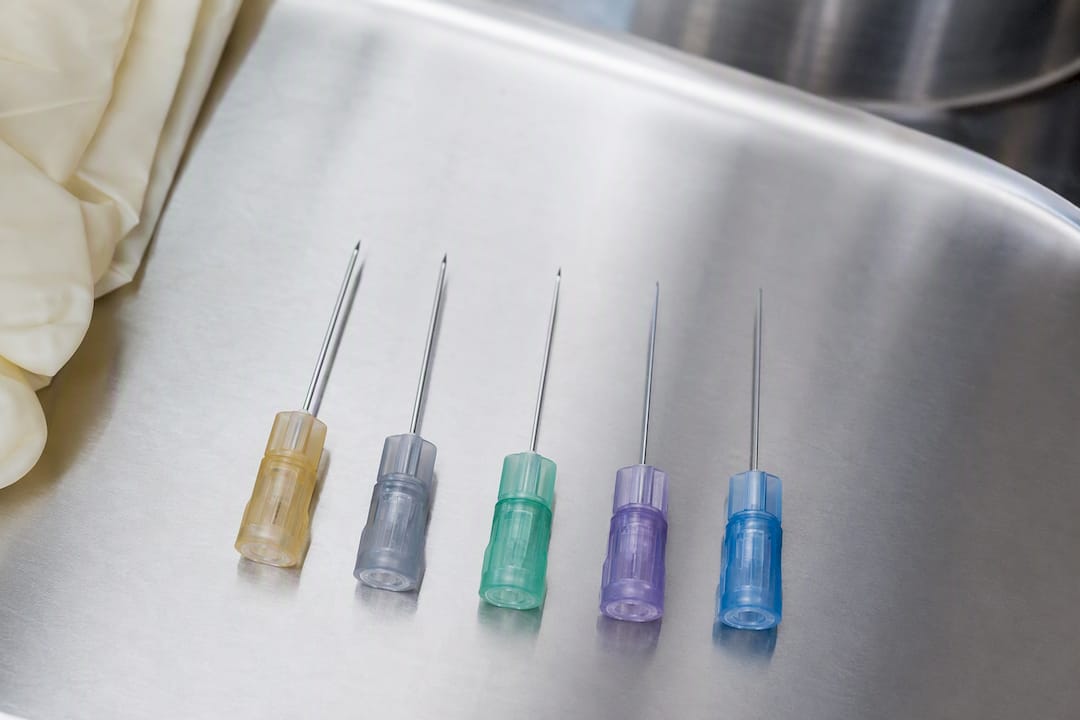
Thinner needles generally hurt less on entry, but they also slow the flow of insulin, which matters more for larger doses. Someone injecting 5 units feels little difference between a 29G and a 32G needle. Someone injecting 60-80 units at once may notice the thinner gauge takes visibly longer to deliver the full dose, increasing the temptation to withdraw the needle too early and lose part of the dose.
Manufacturers have addressed part of this trade-off with thin-wall cannula designs, which keep the internal bore wider relative to the outer needle diameter, maintaining flow rates on higher gauges without sacrificing the thinner, less painful entry point, a design detail confirmed by Facet Medical Technologies.
Pro Tip: If a patient is on a high total daily dose delivered in one injection, consider a slightly lower gauge (30-31G) rather than the thinnest option available, purely to keep injection time manageable and reduce the risk of an incomplete dose.
For context on just how thin these needles have become: peer-reviewed comparison data on 32G versus 34G needles shows measurable differences in patient comfort ratings and safety outcomes between the two, useful evidence when deciding whether the thinnest gauge is worth pursuing for a particular patient, as detailed in this comparison study published via PMC. For most people on standard insulin doses, 31-32G remains the sweet spot between comfort and practical flow speed.
How to choose the right pen needle size for you: a clinician-aligned checklist
Choosing a pen needle size isn’t guesswork, and it shouldn’t be a one-off decision made once and never revisited. Follow this sequence:
- Start with 4-6 mm, 31-32G. This is the default recommendation for the overwhelming majority of adults and children, regardless of body size, and it’s the sensible starting point for anyone new to pen injections or reviewing an existing regimen.
- Assess body habitus honestly. Very thin adults and children may still need a gentle pinch even at 4-6 mm, simply because there’s less subcutaneous tissue to work with. This isn’t about switching to a longer needle; it’s a technique adjustment, not a size change.
- Consider the injection site. The abdomen generally has more subcutaneous fat than the thigh or upper arm. Someone rotating between sites may need slightly different technique (pinch versus no pinch) depending on where they’re injecting that day, even with the same needle length.
- Factor in dose volume. Larger total daily doses delivered in a single injection benefit from a marginally lower gauge to keep delivery time reasonable, as covered above.
- Check manual dexterity. Needle sizing for deltoid injection and other alternative sites sometimes comes up for people who struggle with abdominal or thigh access; a diabetes educator can advise on safe alternative sites and matching needle length.
- Trial and monitor. Any change in needle length or gauge should be trialled for at least a week, watching for comfort, leakage after injection, and any unexpected change in blood glucose control that might suggest inconsistent absorption.
- Bring specific questions to your clinician or diabetes educator, not just “which needle should I use.” Ask whether your current technique still suits a shorter needle, whether your dose volume justifies a particular gauge, and whether any site you’re using needs a different approach.
Pro Tip: Keep a small log for the first week after switching needle length or gauge — note comfort, any bruising, and whether you noticed leakage. That log is far more useful to a diabetes educator than a vague “it feels different.”
Injection technique by needle length: angle, pinch, hold time and site rotation
Technique has to match needle length, or you risk injecting into muscle rather than fat, which changes how quickly insulin gets absorbed.
- For 4-6 mm needles, inject at a straight 90° angle without pinching the skin. This is now the standard technique recommended for most adults and children.
- Very thin adults and most children are the main exception. Even at 4-6 mm, a gentle pinch may be safer to avoid intramuscular injection where subcutaneous tissue is minimal.
- For 8 mm and 12.7 mm needles, pinch the skin into a fold before inserting, and consider a 45° angle rather than straight in, particularly for leaner patients.
- Hold the needle in place for 5 to 10 seconds after pressing the plunger, before withdrawing. This gives the insulin time to disperse and reduces the chance of a droplet leaking back out through the injection site.
- Rotate injection sites systematically. Repeated injections into the same small patch of skin cause lipohypertrophy, a lumpy thickening of fat tissue that actually impairs insulin absorption over time, making blood glucose control less predictable even when the dose itself hasn’t changed.
Guidance from the American Diabetes Association reinforces this combination of angle, hold time and rotation as standard practice regardless of which pen device is in use, since the technique principles apply consistently across insulin pens.
Special populations and special circumstances
Standard advice doesn’t apply uniformly to every patient, and a handful of groups deserve specific mention.
- Children and infants need needle length and technique determined by a paediatric diabetes team, not chosen independently. Supervised technique training matters even more here, since a young child’s subcutaneous tissue layer is thinner and less forgiving of technique errors.
- Very thin adults, including some older patients and those with lower body fat, often benefit from a pinch-up technique even with a 4 mm needle, and may need more personalised guidance than the general default.
- Obese patients are, somewhat counterintuitively, generally well served by short needles too. The clinical consensus supporting 4-6 mm needles applies regardless of BMI, since subcutaneous fat depth doesn’t scale as directly with body weight as many assume, though an individual clinician assessment is still worthwhile if standard technique isn’t working well.
- People using GLP-1 receptor agonist pens for weight management, such as those prescribed for conditions requiring injectable weight-loss medication, often use similarly short needle lengths to standard insulin pens. Product-specific instructions should always take priority over general guidance, since pen designs and pre-attached needles vary by manufacturer.
- Always check the instructions supplied with a specific pen device and confirm anything unusual with a clinician rather than assuming standard insulin guidance applies without exception.
Troubleshooting: pain, leakage and dose accuracy — causes and fixes
Most day-to-day injection problems trace back to one of three causes: a reused needle, wrong technique for the length in use, or a gauge mismatched to dose volume.
- Increasing pain over time with the same needle length almost always points to needle reuse. A dulled tip drags rather than pierces, and reusing needles is directly linked to increased pain and dose inaccuracies, per the American Diabetes Association.
- Leakage after withdrawal usually means the hold time was too short. Extend to a full 10 seconds before removing the needle.
- Bruising or unexpected pain at a specific site often signals it’s time to rotate to a new injection area; the same small patch used repeatedly becomes more sensitive and prone to lipohypertrophy.
- Slow or incomplete delivery on large doses suggests the gauge is too thin for the volume being injected. Try a slightly lower gauge, such as 30-31G instead of 32-34G.
Pro Tip: If leakage keeps happening despite a full hold time, check the injection angle first. A needle inserted slightly off-axis can create a channel that lets insulin track back out along the needle path.
Sharps disposal and safety considerations
Never reuse a pen needle, and never attempt to re-cap it by hand after use. Re-sheathing is one of the most common causes of accidental needle-stick injuries among both patients and carers, which is why many modern pen needles now include safety sheaths or shielding mechanisms specifically designed to discourage manual re-capping.
- Dispose of used needles in a proper sharps bin, never in household waste or general recycling.
- Full sharps bins can usually be returned to a local pharmacy or through a community sharps disposal scheme; check what’s available locally, since collection arrangements vary by area.
- Never attempt to bend, break, or manually re-sheath a used needle before disposal.
- Store your sharps bin somewhere stable and out of reach of children between uses.
Evidence and expert guidance supporting the recommendations
The shift towards 4-6 mm needles as the standard recommendation isn’t a trend; it’s the settled position of the major guidance bodies. Regional NHS position statements explicitly support moving patients to shorter needles, contingent on proper supervised training during the switch. Peer-reviewed comparison data on 32G versus 34G needles gives clinicians a genuine evidence base for choosing among thinner gauges, rather than relying on manufacturer claims alone.
Short, thin needles deliver insulin effectively into subcutaneous tissue while generally causing less pain than longer, thicker alternatives, a conclusion echoed across clinical reviews and patient-reported outcome studies.
That combination, backed by the Diabetes Spectrum clinical review, is why 4-6 mm has become the reasonable default rather than the exception. Mirror Pharma supplies practitioner-grade needles and syringes across these standard gauges to UK clinics and healthcare professionals, alongside the wider aesthetic and wellness product range it stocks for licensed practitioners.
What the evidence actually tells us
The strongest argument for 4-6 mm needles isn’t comfort, though comfort is the headline most articles lead with. It’s that the old justification for longer needles, that larger patients need to punch through more tissue to reach the muscle, was based on outdated anatomical assumptions rather than measured skin thickness data. Once researchers actually measured subcutaneous depth across BMI ranges, the case for defaulting to 8 mm or 12.7 mm needles largely fell apart.
Where I think patient guidance still falls short is technique education during the switch, not the needle recommendation itself. Telling someone to drop the pinch technique after years of habit is a bigger behavioural change than most leaflets acknowledge, and it’s exactly why supervised training during a switch matters as much as the needle choice.
If you take one thing from this: prioritise getting the technique right for whichever length you’re using over chasing the theoretically “best” gauge. A well-executed injection with a slightly thicker needle beats a rushed, badly angled one with the thinnest gauge on the market.
Stocking the right needles and syringes for your clinic
Choosing the right pen needle size is only half the equation for practitioners managing patient supply and clinic stock. Mirror Pharma supplies practitioner-grade needles and syringes across the standard gauge range, including 32G micro needles and syringes for smaller-volume work and 30G options where flow speed on larger doses matters more than the thinnest possible gauge. For clinics also managing injection comfort more broadly, topical anaesthetic options are available too, for licensed practitioners managing patient comfort during procedures.
What sets Mirror Pharma apart for busy clinics is the ordering experience itself: extended order cut-off times mean stock arrives when it’s needed rather than forcing practitioners to guess demand weeks in advance. Whether you’re restocking standard gauges or reviewing options for a specific patient population, browse the full needle and syringe range and place an order before your next cut-off window.
Sources
- Insulin Pens | American Diabetes Association
- A comparison study of patient ratings and safety of 32- and 34-gauge insulin pen needles (PMC)
- Needles for pre-filled and reusable insulin pens: position statement (NHS North East London ICB)
- Short and thin pen needles are effective — Diabetes Spectrum article
FAQ
What size pen needle should I use?
Most adults and children do best with a 4-6 mm needle at 31-32G, injected at 90° without pinching the skin, as clinical consensus now supports this as the default across nearly all body types.
Which is smaller, 31G or 32G?
32G is thinner than 31G. Gauge numbers work in reverse: the higher the number, the finer the needle.
What are 4 mm pen needles used for?
4 mm needles are used for standard insulin injections in most adults and children, reaching subcutaneous fat reliably without needing to pinch the skin first.
Can I use an 8 mm needle for Mounjaro?
Always follow the specific instructions supplied with your GLP-1 pen device, since needle length and technique can vary by product; many weight-management injectables use short needles similar to standard insulin pens, but product-specific guidance should take priority.
How often should I change my pen needle?
Change the needle after every single injection. Reusing it dulls the tip, increases pain, and can affect dose accuracy, according to the American Diabetes Association’s guidance on insulin pen use.