
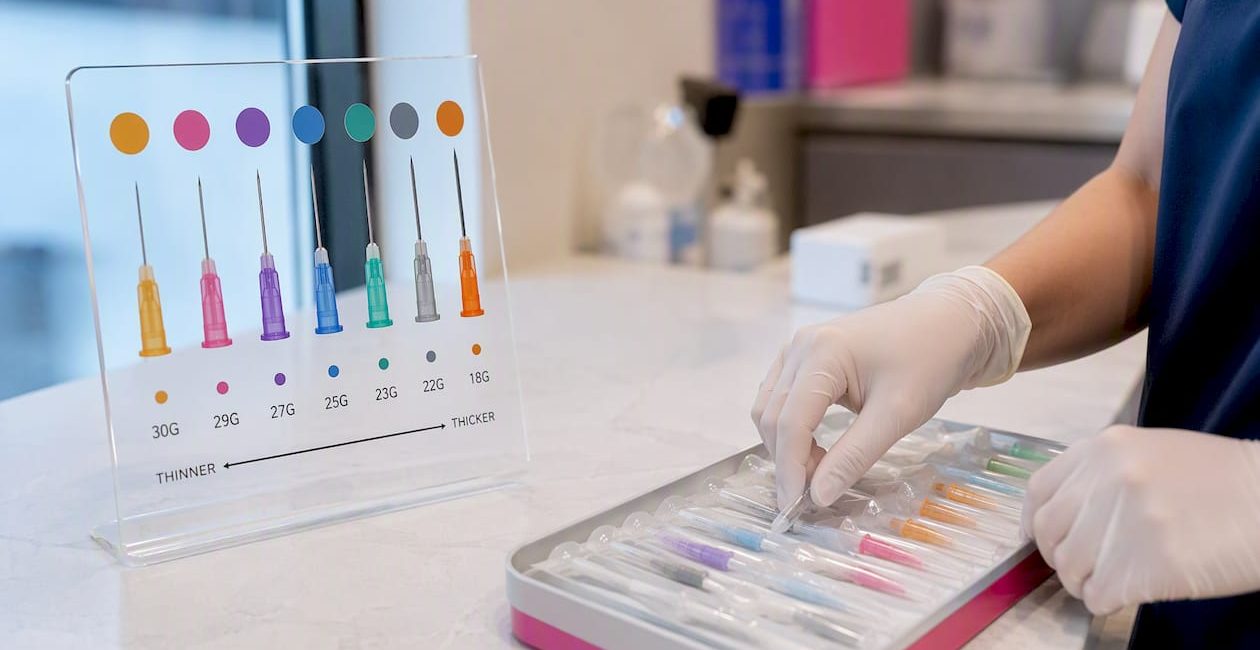
A needle gauge chart maps gauge numbers to nominal outer diameter (OD) in millimetres and inches, letting you match the right needle to route, volume, and product viscosity in seconds. The single most important rule for UK practice: default to a 4 mm or 5 mm pen needle at 90° for subcutaneous insulin delivery, and verify gauge and length markings on the packaging before every use.
Quick picks for licensed practitioners:
- Intradermal (ID): 26–27G, short length suitable for shallow placement
- Subcutaneous/vaccination: 25–30G, short to moderate length appropriate for tissue
- Intramuscular (IM): 22–25G, longer needles to reach muscle tissue depending on volume and viscosity
- Blood sampling/cannulation: 16–20G gauge range suitable for vascular access
Key takeaways
A needle gauge chart maps gauge numbers to nominal outer diameter, but inner diameter, wall thickness, and dead volume determine clinical suitability — always verify with the manufacturer’s datasheet.
| Point | Details |
|---|---|
| Gauge number vs diameter | Higher gauge numbers mean smaller outer diameters; a 32G needle is finer than a 20G needle. |
| UK pen needle default | NHS formulary guidance recommends 4 mm or 5 mm pen needles at 90° for subcutaneous insulin in most adults. |
| Thin-wall caution | A 22G and 22s share the same OD; the thin-wall version has a larger ID and better flow for viscous products. |
| Route-to-gauge quick picks | ID: 26–27G; SC: 25–32G; IM: 22–25G; blood sampling/cannulation: 16–21G. |
| Mirror Pharma consumables | Mirror Pharma supplies 32G micro-needles and syringes with datasheets for licensed practitioners. |
Table of Contents
- What does a needle gauge chart show?
- How does gauge number relate to needle diameter?
- How to choose the right gauge and length
- Recommended gauges and lengths by clinical route
- UK guidance for insulin pen needles and diabetes injections
- Thin-wall needles, ‘s’ designations, and ISO 6009 colour coding
- Safety, compatibility, and sharps disposal
- What should a printable pocket chart include?
- Why a chart alone can mislead — a note for licensed practitioners
- Consumables and datasheets for licensed practitioners
- Sources
- FAQ
What does a needle gauge chart show?
The table below maps common clinical gauges to nominal OD and typical inner diameter (ID), with a short clinical-use column. Inner diameter figures are nominal and depend on wall thickness; thin-wall variants exist for many gauges. Always cross-reference with the manufacturer’s technical datasheet for ID, wall thickness, and dead-volume data before selecting needles for micro-volume or viscous applications.
Nominal values sourced from the Birmingham gauge reference and the needle gauge comparison chart. Manufacturer values may vary; treat these as guidance only.
Callout: Dead volume matters more than most clinicians expect. Technical supplier charts list dead volume in µL per 25.4 mm of needle length. For very small-volume syringes or precision dosing, a needle with lower dead volume can meaningfully affect the delivered dose. Check the manufacturer’s datasheet for this figure before selecting needles for micro-dosing work.
How does gauge number relate to needle diameter?
Needle gauges follow the Birmingham Wire Gauge (BWG) system, a historical wire-sizing convention where a higher gauge number means a smaller outer diameter. A 32G needle is considerably finer than a 20G needle. The relationship is not linear: the OD steps between adjacent gauges narrow as gauge numbers increase, so the difference between 14G and 16G is far larger than between 30G and 32G.
OD vs ID: why wall thickness changes everything
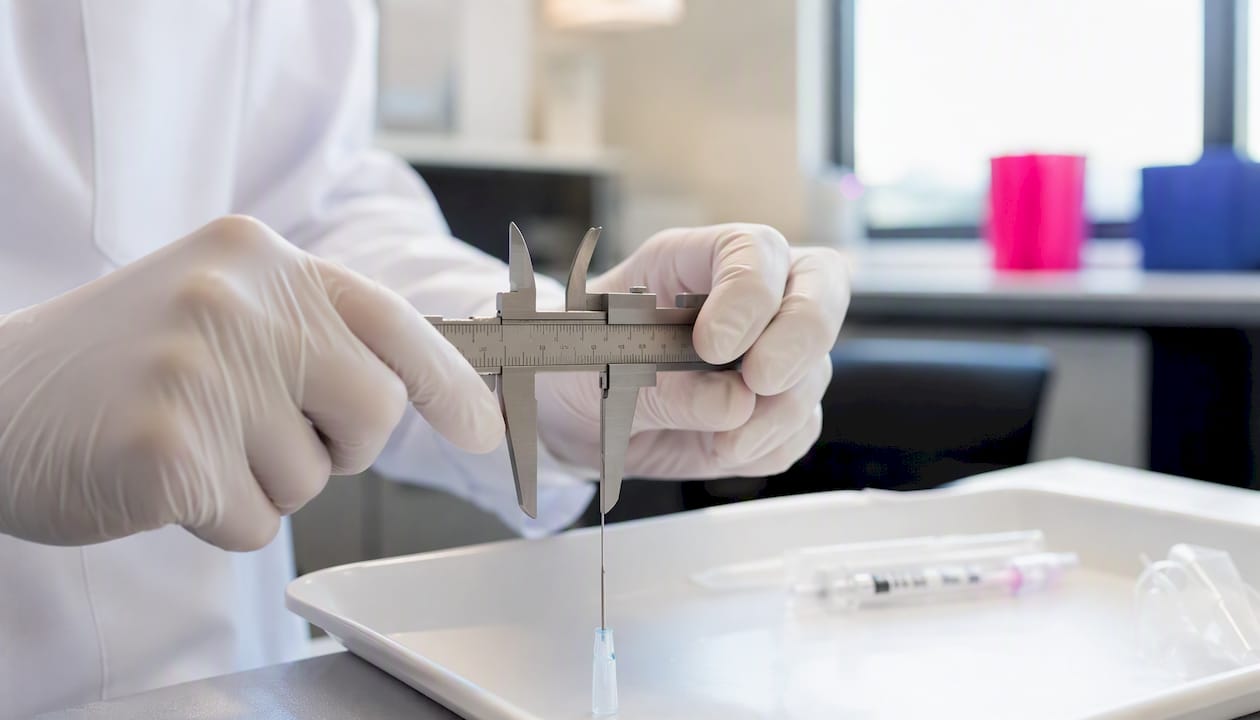
OD is fixed for a given gauge. ID is not. It depends entirely on wall thickness, and manufacturers offer at least two wall variants for many gauges:
- Regular wall: standard wall thickness; lower ID for the stated gauge
- Thin wall (marked ‘s’ or ‘TW’): same OD as the regular version but a thinner wall, giving a larger bore and better flow
A 22G regular-wall needle and a 22s (thin-wall) needle share the same 0.70 mm OD. The 22s has a meaningfully larger ID, which matters when drawing up viscous products or when flow rate is clinically relevant.
Pro Tip: Never assume two needles labelled with the same gauge are interchangeable. Check the ‘s’ or thin-wall designation on the packaging, and verify ID against the manufacturer’s datasheet before use, particularly for aspiration or viscous injectables.
How to choose the right gauge and length
A structured approach prevents the most common selection errors. Work through these steps in order:
- Identify the intended route. Intradermal, subcutaneous, intramuscular, and intravenous routes each have distinct gauge and length requirements. Route determines tissue depth, and tissue depth determines acceptable needle length.
- Consider volume and viscosity. Larger volumes and thicker products need a lower gauge (larger bore) to flow without excessive force. Forcing a viscous product through a fine-gauge needle risks dead-volume loss and inconsistent delivery.
- Check device compatibility. Confirm the needle fits the syringe or pen injector (luer lock vs luer slip, hub compatibility). Pen needles have specific hub designs; not all are interchangeable across devices.
- Account for patient factors. Body habitus, age, and injection site adipose thickness all affect how deep a needle of a given length will reach. A 6 mm needle that delivers subcutaneously in one patient may reach muscle in a slim adult or child.
- Apply clinical risk logic. Where subcutaneous delivery is intended, err towards shorter needles. Inadvertent intramuscular injection of a subcutaneous product alters absorption and can affect clinical outcomes.
For pen injectors specifically:
- Default to pen needles short enough (around 4 mm or 5 mm) at 90° for most adults
- Use shortest needles (around 4 mm) for children, young people, or very slim adults; a lifted skin fold may be needed
- Needles longer than about 6 mm should be reviewed carefully in children and adolescents
- When changing from a longer to a shorter needle, review technique and monitor glycaemic response
For syringes and small-volume work:
- Select low-dead-volume needles when precision dosing is required
- For viscous products, go one gauge lower (larger bore) than you might initially choose
- Confirm luer fit and dead-volume specification against the syringe volume
Recommended gauges and lengths by clinical route
The table below gives practical gauge and length ranges by route, with short rationale. These are guidance ranges; local protocols and product-specific SmPCs take precedence.
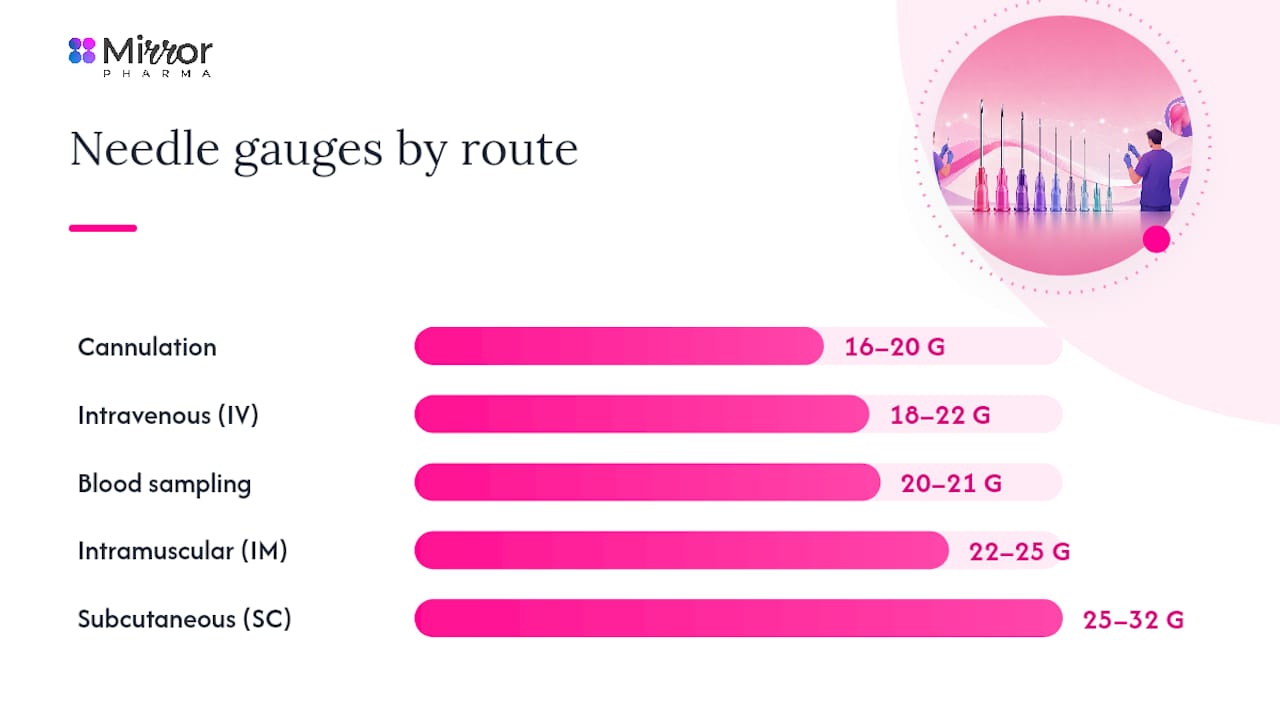
| Route | Gauge range | Typical needle length | Rationale |
|---|---|---|---|
| Intradermal (ID) | 26–27G | short length suitable for shallow placement | Fine gauge for shallow bevel placement; tuberculin/allergy testing |
| Subcutaneous (SC) | 25–32G | short to moderate length to reach subcutaneous tissue | Short needle to avoid muscle; insulin, LMWH, biologics |
| Intramuscular (IM) | 22–25G | longer needles to reach muscle tissue | Larger bore for volume/viscosity; deltoid vs gluteal site affects length |
| Vaccination (IM) | 23–25G | typical needle lengths used for adults and infants | Standard for most adult vaccines; 16 mm for infants |
| Intravenous (IV) | 18–22G | needle lengths suited for vascular access | Peripheral cannula; gauge depends on flow rate needed |
| Blood sampling | 20–21G | typical lengths used for phlebotomy | Phlebotomy; minimise haemolysis risk with appropriate bore |
| Cannulation | 16–20G | needle and cannula lengths suitable for infusion | Larger bore for rapid infusion or blood products |
Clinical notes:
- Some viscous products require a larger bore needle (lower gauge) for drawing up, regardless of administration gauge
- Vaccination routes and needle sizes vary; always consult product information for licensed details
- For insulin pen needles, UK NHS formulary guidance recommends 4 mm as the standard option for subcutaneous delivery across most patient groups
UK guidance for insulin pen needles and diabetes injections
NHS formulary sources are consistent on pen needle selection, and the recommendations are more specific than many clinicians realise.
Oxford Health Formulary guidance states: use 4 mm or 5 mm pen needles at 90° to the skin as the standard approach. Reserve 4 mm for children, young people, and very slim adults. A lifted skin fold may be required in these groups to avoid inadvertent intramuscular injection. Needles longer than 6 mm should be reviewed, and any change in needle length for insulin-treated patients should be accompanied by monitoring of blood glucose.
The Oxford Health Formulary injection technique guidance frames needle length and injection technique as inseparable: a chart value alone does not guarantee correct tissue targeting.
Key points for clinical practice:
- 4 mm pen needles are the default for subcutaneous insulin delivery across most adult patients
- Longer needles (8 mm and above) carry a meaningful risk of intramuscular injection, particularly in slim patients or when injecting without a skin fold
- Switching from a longer to a shorter needle requires technique review and blood glucose monitoring, because the change in tissue plane can alter insulin absorption
- The Covwark formulary guidance specifically advises reviewing any needle longer than 6 mm and monitoring when needle length changes
Thin-wall needles, ‘s’ designations, and ISO 6009 colour coding
Thin-wall vs regular-wall: what actually changes
Thin-wall needles keep the same OD as their regular counterpart but reduce wall thickness to increase the bore. The practical effect is improved flow for the same gauge, which matters when drawing up viscous products or when minimising injection force.
- Regular wall 22G: OD 0.70 mm, ID approximately 0.41 mm
- Thin-wall 22s: OD 0.70 mm, ID approximately 0.48 mm (nominal; verify with manufacturer)
- The difference is modest in absolute terms but clinically significant for viscous agents or aspiration procedures
ISO 6009 and colour coding
ISO 6009 defines a colour-coding system for hypodermic needle hubs, intended to allow rapid gauge identification. In practice, colour coding varies by manufacturer and is not universally standardised across all brands in clinical use. Relying on hub colour alone to confirm gauge is a known source of selection error in busy clinical settings.
- Always read the gauge and length printed on the packaging or needle label
- Do not assume the same hub colour means the same gauge across different manufacturers
- Thin-wall variants may share the same hub colour as regular-wall needles of the same gauge
Safety, compatibility, and sharps disposal
Before every injection, check:
- Sterility: needles are single-use only; never re-use or resheath after use
- Device compatibility: confirm luer fit (lock vs slip) and hub compatibility with the syringe or pen
- Route and angle: verify the correct route, angle, and length for the intended tissue plane
- Expiry and packaging integrity: do not use needles from damaged or previously opened packaging
Sharps disposal in UK clinical settings:
- Dispose of used needles immediately into a colour-coded sharps bin conforming to local NHS trust policy
- Do not re-cap needles after use; use a one-handed scoop technique only where re-capping is unavoidable
- Follow MHRA and local trust guidance on sharps bin fill levels and collection schedules
- Needles used for cytotoxic or infectious agents require segregated disposal per local protocol
Patient-centred considerations:
- Selecting the finest gauge appropriate for the route and product reduces tissue trauma and patient discomfort
- Topical anaesthetic cream (for licensed practitioners, where clinically indicated and authorised) can reduce injection-site pain, particularly for procedures using larger-bore needles. A product such as EMLA cream may be appropriate in certain clinical contexts
- Rotate injection sites to reduce lipohypertrophy, particularly for insulin-treated patients
What should a printable pocket chart include?
A well-designed pocket reference card for a clinical area should contain enough information to support a decision without requiring a clinician to leave the room. Keep it to one laminated card.
Essential fields:
- Gauge number and nominal OD in mm and inches
- Typical clinical use (one phrase per gauge: “IM vaccination”, “SC insulin”, “phlebotomy”)
- Example lengths in mm and inches
- Quick selection checklist: route → volume → viscosity → patient factors
- A local override line: “Check local protocol / SmPC before use”
- Date of issue and name of clinical reviewer
Practical tips for ward managers and training leads:
- Store the master PDF in a shared clinical drive with version control; update when local formulary guidance changes
- Laminated cards are appropriate for resuscitation trolleys and treatment rooms
- Include a QR code linking to the manufacturer’s datasheet for ID, wall thickness, and dead-volume data
- Cross-reference with the local formulary for insulin pen needle recommendations before finalising the card
Why a chart alone can mislead — a note for licensed practitioners
The chart is a starting point, not a clinical decision. Two needles with the same gauge number can have meaningfully different inner diameters depending on wall thickness, and the same hub colour can appear on needles from different manufacturers at different gauges. These are not edge cases; they are routine sources of selection error in busy clinical areas.
The most common misinterpretation is treating gauge as a proxy for flow rate. OD is fixed by gauge; ID is not. A practitioner who selects a 22G needle for a viscous product without checking whether it is regular or thin-wall may find the product draws up far more slowly than expected, or applies excessive force to the plunger. For aspiration procedures or viscous injectables, always confirm the ID from the manufacturer’s datasheet rather than inferring it from gauge alone.
Colour coding deserves particular caution. ISO 6009 exists, but manufacturer adherence is inconsistent enough that hub colour should be treated as a secondary check, never the primary one. Read the label.
When needle selection changes for a patient cohort, whether in a diabetes clinic switching to shorter pen needles or an aesthetic practice standardising on a new gauge, build in a brief audit cycle. Monitor outcomes, review technique, and document the change. A chart supports that process; it does not replace it.
Consumables and datasheets for licensed practitioners
For licensed practitioners sourcing needles and syringes with full technical documentation, Mirror Pharma supplies a range of micro-needles and insulin syringes with datasheets available on request. The FMS 32G insulin micro-needle and syringe and the FMS 32G 0.3 ml micro syringe are stocked for subcutaneous and micro-dosing applications. All consumables are intended for use by trained practitioners and prescribers with full compliance verification. Browse the full consumables range and request technical specifications directly via the Mirror Pharma product catalogue.
Sources
- Birmingham gauge — Wikipedia
- Correct injection technique in diabetes care — Oxford Health Formulary
- Needles for Diabetes Medicines — Covwark formulary
- Needle Gauge Chart | Knowledge Center
- Needle gauges size chart & uses — Lecturio
For manufacturer-specific ID, wall thickness, and dead-volume data, always consult the product datasheet supplied with the needle or available from the manufacturer directly.
This article is general information, not a substitute for advice from a qualified doctor. Consult a qualified healthcare professional about your own circumstances before acting on anything here.
FAQ
What is bigger: a 27G or a 30G needle?
A 27G needle is bigger. In the Birmingham Wire Gauge system, lower gauge numbers correspond to larger outer diameters, so 27G (0.40 mm OD) is wider than 30G (0.30 mm OD).
Is a 16G or 18G needle bigger?
A 16G needle is bigger. It has a nominal OD of 1.60 mm compared with 1.20 mm for an 18G needle, making it the preferred choice for rapid IV infusion or blood product administration.
Which is smaller: a 20G or 22G needle?
A 22G needle is smaller, with a nominal OD of 0.70 mm versus 0.90 mm for a 20G needle. The 22G is commonly used for intramuscular injections and IV access where a finer needle is acceptable.
How do you choose which needle gauge to use?
Select gauge based on route (ID, SC, IM, IV), product viscosity, volume, and patient factors. As a quick guide: 26–27G for intradermal, 25–32G for subcutaneous, 22–25G for intramuscular, and 16–21G for blood sampling or cannulation. Always verify with the product SmPC and local protocol.