

Tirzepatide (Mounjaro®) typically delivers greater weight loss and HbA1c reductions than semaglutide (Wegovy®/Ozempic®) in head-to-head trials, making it the preferred agent when maximal metabolic effect is the primary goal. Semaglutide retains an important advantage where established cardiovascular event reduction is the clinical priority, backed by more mature randomised outcome data from SELECT, SUSTAIN-6 and PIONEER-6. Neither agent is universally superior — the right choice depends on what matters most for each patient.
Three clinical takeaways before you read further:
- Weight-centric patients: Tirzepatide produces meaningfully greater weight loss across all responder thresholds in both RCT and real-world data.
- Established CVD risk: Semaglutide has the stronger randomised evidence for reducing major adverse cardiovascular events; tirzepatide’s CVOT data show non-inferiority to active comparators but no direct head-to-head CVOT against semaglutide yet.
- Safety caveat: Gastrointestinal adverse events dominate both profiles during titration; slower escalation is the single most effective mitigation strategy for both agents.
Immediate prescribing implications:
- Both agents are weekly subcutaneous injections; titration typically takes 16–20 weeks to reach maintenance dose.
- Reduce or stop concomitant insulin or sulfonylurea before initiating either agent to lower hypoglycaemia risk.
- In the UK, Mounjaro® holds MHRA approval for type 2 diabetes and, separately, for chronic weight management; Wegovy® is MHRA-approved for weight management and Ozempic® for type 2 diabetes. NHS commissioning remains restricted. Most patients currently access these medicines via private prescription or specialist weight management services.
- Document shared decision-making, including expected magnitude of benefit and stopping rules, before initiating therapy.
Key takeaways
Tirzepatide produces greater weight loss and HbA1c reductions than semaglutide in head-to-head trials, but semaglutide holds the more mature randomised cardiovascular outcome evidence — agent selection should be driven by each patient’s primary clinical priority.
| Point | Details |
|---|---|
| Weight loss advantage | Tirzepatide produced 20.2% vs 13.7% mean weight loss at 72 weeks in SURMOUNT-5 (P<0.001). |
| Glycaemic superiority | Tirzepatide showed greater HbA1c reductions than semaglutide across SURPASS head-to-head trials in type 2 diabetes. |
| Cardiovascular evidence | Semaglutide has more mature MACE-reduction data (SELECT, SUSTAIN-6, PIONEER-6); no direct head-to-head CVOT exists yet. |
| Dose and adherence | Model-based analyses show dose-dependent equivalence is plausible; optimising the tolerated dose matters as much as agent choice. |
| Mirrorpharma supply | Mirrorpharma provides verified prescriber-only supply of weight management medicines to UK clinicians via mirrorpharma.co.uk. |
Table of Contents
- How each drug works: GLP-1 monotherapy versus dual GIP/GLP-1 agonism
- Tirzepatide vs semaglutide: what the trial evidence actually shows
- Comparative safety: adverse events, serious risks and contraindications
- Dosing, titration and how to switch between agents
- How to choose between tirzepatide and semaglutide for different patients
- Regulatory status, NHS commissioning and private prescribing in the UK
- Preventing and managing side effects: what to tell your patients
- Interpreting the evidence: trial quality, dose effects and what we still do not know
- A prescriber’s perspective on choosing between these agents
- Mirrorpharma: supporting UK prescribers with verified supply and clinical resources
- Sources
How each drug works: GLP-1 monotherapy versus dual GIP/GLP-1 agonism
Semaglutide is a selective GLP-1 receptor agonist. It binds GLP-1 receptors in the pancreas, gut, and central nervous system, stimulating glucose-dependent insulin secretion, suppressing glucagon, slowing gastric emptying, and reducing appetite via hypothalamic pathways. The result is meaningful glycaemic control and moderate-to-substantial weight loss.
Tirzepatide adds a second mechanism: it is a dual agonist at both GIP (glucose-dependent insulinotropic polypeptide) and GLP-1 receptors. GIP receptors are expressed in adipose tissue and the central nervous system as well as the pancreas, and their co-activation appears to amplify the appetite-suppressing and energy-expenditure effects beyond what GLP-1 agonism alone achieves. Whether GIP agonism directly augments weight loss or reduces GLP-1-mediated nausea (or both) remains an active area of research, but the clinical signal is consistent: the dual mechanism produces greater metabolic effect.
Key mechanistic differences at a glance:
- Semaglutide acts solely at GLP-1 receptors; tirzepatide acts at both GIP and GLP-1 receptors simultaneously.
- Both slow gastric emptying, though the degree and clinical relevance may differ between agents.
- Tirzepatide’s GIP component plausibly augments insulin sensitivity in adipose tissue and may modulate nausea pathways, potentially explaining its comparable GI tolerability despite greater efficacy.
- Both agents suppress appetite centrally; tirzepatide’s dual receptor engagement appears to produce a larger energy deficit.
| Feature | Semaglutide | Tirzepatide |
|---|---|---|
| Receptor targets | GLP-1 only | GIP + GLP-1 |
| Mechanism class | GLP-1 receptor agonist | Dual GIP/GLP-1 agonist |
| Gastric emptying effect | Slowed | Slowed (degree may differ) |
| Appetite suppression | Yes (hypothalamic) | Yes (augmented via dual pathway) |
| Insulin secretion | Glucose-dependent | Glucose-dependent (both receptors) |
| Glucagon suppression | Yes | Yes |
Tirzepatide vs semaglutide: what the trial evidence actually shows
SURMOUNT-5: the pivotal head-to-head RCT
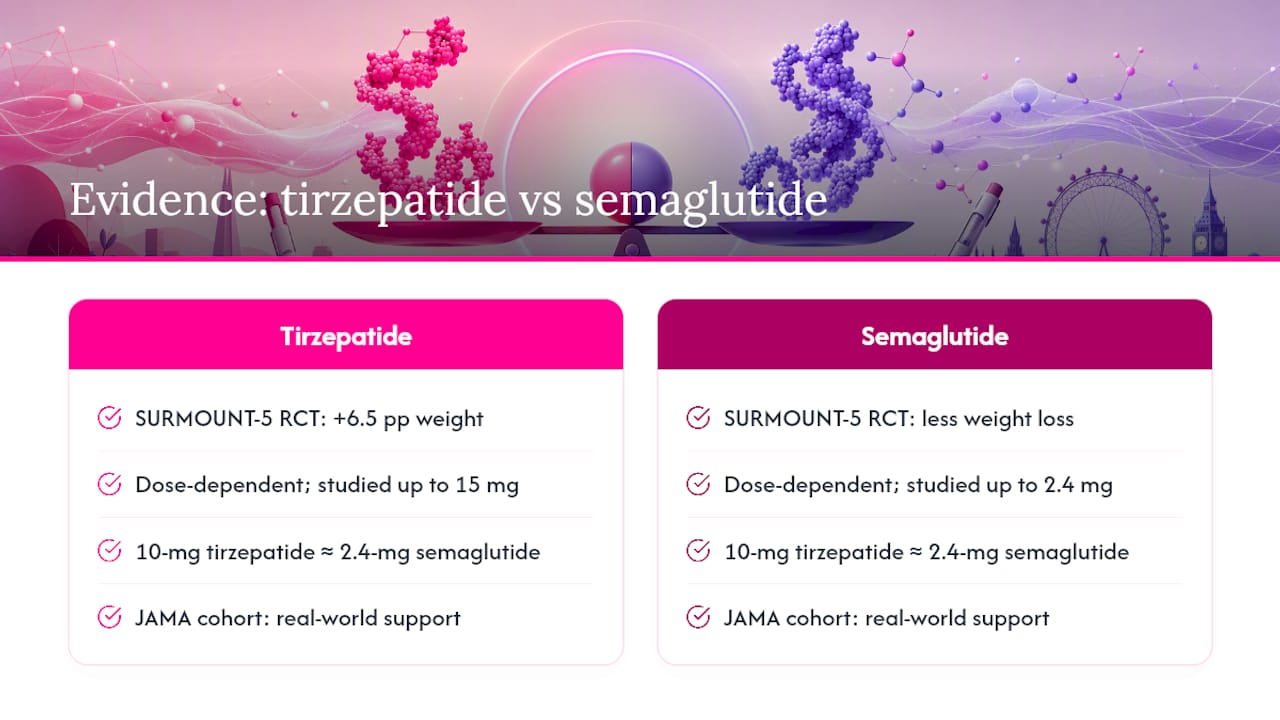
The most clinically definitive data come from SURMOUNT-5, a randomised controlled trial in adults with obesity but without type 2 diabetes. Tirzepatide produced greater mean weight loss than semaglutide at 72 weeks, with tirzepatide also achieving higher responder rates across every threshold from ≥10% to ≥25% body weight loss. That 6.5 percentage point absolute difference in mean weight loss is clinically meaningful — for a 100 kg patient, it translates to roughly 6.5 kg more weight lost on tirzepatide.
Statistic to anchor clinical expectations: In SURMOUNT-5, tirzepatide’s advantage over semaglutide for ≥15% weight loss was statistically significant and consistent across subgroups, with gastrointestinal adverse events being the most common side effects during dose escalation for both agents.
Real-world confirmation: the JAMA Internal Medicine cohort
Trial populations are always selected. A large propensity-matched cohort of 18,386 adults initiating either tirzepatide or injectable semaglutide in routine care found tirzepatide users were significantly more likely to achieve ≥5%, ≥10%, and ≥15% weight loss at 3, 6, and 12 months, with similar GI adverse event rates between the two groups. This real-world signal matters because it confirms the trial hierarchy holds outside controlled conditions.
Meta-analytic synthesis
A systematic review and meta-analysis pooling data across multiple trials concluded that tirzepatide provides greater absolute and percentage weight loss and a higher likelihood of achieving clinically meaningful weight-loss thresholds compared with semaglutide, though the authors note that longer-term data are still needed. The meta-analytic finding is consistent with SURMOUNT-5 and the real-world cohort.
Glycaemic outcomes: SURPASS and STEP series
For type 2 diabetes, the SURPASS programme tested tirzepatide against semaglutide and other active comparators. Tirzepatide showed superior HbA1c reductions versus semaglutide in head-to-head and comparator trials in people with type 2 diabetes. The STEP programme established semaglutide’s efficacy for weight management and glycaemic control, but STEP and SURPASS used different populations and doses, making direct cross-trial comparison imprecise.
Cardiovascular outcomes: where semaglutide leads
Semaglutide’s cardiovascular outcome trial (CVOT) portfolio — SELECT (obesity without diabetes), SUSTAIN-6 and PIONEER-6 (type 2 diabetes) — provides randomised evidence for major adverse cardiovascular event (MACE) reduction. Tirzepatide’s CVOT data show non-inferiority to active comparators and improvement in cardiometabolic risk factors, but no direct head-to-head CVOT against semaglutide exists yet. For a patient whose primary clinical concern is reducing CV events, semaglutide’s evidence base is currently more established.
Comparative safety: adverse events, serious risks and contraindications
Gastrointestinal adverse events
Both agents share a GI adverse event profile dominated by nausea, vomiting, diarrhoea, and constipation. These effects are most pronounced during dose escalation and typically attenuate once a stable dose is reached. Multiple trial reports confirm GI adverse events as the commonest side effects for both agents, with slower titration improving tolerability and adherence. SURMOUNT-5 reported comparable GI AE rates between tirzepatide and semaglutide at equivalent trial doses, which is notable given tirzepatide’s greater efficacy.
Serious and contested risks
- Pancreatitis: Both agents carry a class-level signal for acute pancreatitis. Neither should be initiated in patients with a personal or family history of pancreatitis; discontinue immediately if symptoms develop.
- Gallbladder disease: Rapid weight loss with either agent increases gallstone risk. Counsel patients accordingly, particularly those with prior biliary symptoms.
- Thyroid C-cell tumours: Regulatory bodies include safety warnings about a thyroid C-cell tumour signal observed in rodent studies. Both agents are contraindicated in patients with a personal or family history of medullary thyroid carcinoma (MTC) or multiple endocrine neoplasia type 2 (MEN2). The clinical relevance in humans remains uncertain, but the contraindication is firm.
- Hypoglycaemia: Neither agent causes hypoglycaemia as monotherapy. The risk rises substantially when combined with insulin or sulfonylureas — reduce or stop these agents before initiating a GLP-1 or dual agonist.
- Gastroparesis: Both agents slow gastric emptying. Avoid in patients with established gastroparesis; use with caution in those with symptoms suggestive of delayed gastric emptying.
Contraindications and special populations
- Pregnancy: Avoid both agents; document contraception counselling where relevant.
- Severe renal impairment: No dose adjustment is required for semaglutide in renal impairment; tirzepatide data in severe renal impairment are more limited — check the current Summary of Product Characteristics (SmPC) before prescribing.
- Older adults: GI side effects may be more pronounced; start at the lowest dose and titrate slowly.
- History of MTC or MEN2: Absolute contraindication for both agents.
Pro Tip: Before initiating either agent, screen for a personal or family history of MTC, MEN2, and pancreatitis. Document this screening in the clinical record — it is a regulatory requirement, not just good practice.
Dosing, titration and how to switch between agents
Standard titration schedules
Both agents are administered as once-weekly subcutaneous injections, typically into the abdomen, thigh, or upper arm. The titration schedules used in trials and routine practice are:
Semaglutide (Wegovy® for weight management):
- 0.25 mg weekly for 4 weeks
- 0.5 mg weekly for 4 weeks
- 1.0 mg weekly for 4 weeks
- 1.7 mg weekly for 4 weeks
- 2.4 mg weekly (maintenance)
Tirzepatide (Mounjaro®):
- 2.5 mg weekly for 4 weeks
- 5 mg weekly for 4 weeks
- 7.5 mg weekly for 4 weeks
- 10 mg weekly for 4 weeks
- 12.5 mg weekly for 4 weeks
- 15 mg weekly (maintenance, if tolerated)
The tirzepatide schedule is longer — reaching maximum dose typically takes around 20 weeks versus 16 weeks for semaglutide at the Wegovy® maintenance dose. Both schedules can be extended at any step if GI tolerability is a concern.
Practical switching workflows
Switching between agents is sometimes necessary due to tolerability, inadequate response, or access changes. A pragmatic approach:
- From semaglutide to tirzepatide: Stop semaglutide and initiate tirzepatide at 2.5 mg the following week. Do not attempt to match doses by potency — restart the full titration schedule.
- From tirzepatide to semaglutide: Similarly, restart semaglutide from 0.25 mg regardless of the tirzepatide dose previously reached.
- Insulin co-prescription: Reduce basal insulin by 20% on the day of the first GLP-1 or dual agonist injection; monitor fasting glucose closely for the first 4 weeks.
- Sulfonylurea co-prescription: Consider halving the dose or stopping the sulfonylurea before initiating either agent.
Pro Tip: Model-based analyses suggest that dose-dependent equivalence is plausible between agents — for example, semaglutide 2.4 mg versus tirzepatide 10 mg may approach clinical equivalence for weight loss in some patients. This means optimising the dose of whichever agent the patient tolerates may matter as much as the choice of agent itself.
How to choose between tirzepatide and semaglutide for different patients
A structured narrative review concludes that treatment should be individualised based on patient priorities, comorbidities, and the strength of available evidence — not on a blanket assertion that one agent is universally superior. Here is a practical decision framework.
Favour tirzepatide when:
- Maximal weight loss is the primary goal (BMI ≥35 with comorbidities, or BMI ≥40).
- HbA1c reduction is the dominant metabolic priority in type 2 diabetes.
- The patient has not achieved adequate response on semaglutide at maximum tolerated dose.
- No personal or family history of MTC, MEN2, or pancreatitis.
- The patient can tolerate a longer titration schedule.
Favour semaglutide when:
- Established cardiovascular disease is present and CV event reduction is the primary aim.
- The patient has type 2 diabetes with high CV risk (SELECT trial population analogue).
- Semaglutide is the only agent currently commissioned or accessible via NHS pathways for that patient.
- Prior experience with semaglutide has been well tolerated and partially effective.
Comorbidity considerations
- Renal impairment: Semaglutide has more extensive data across renal impairment stages; tirzepatide data in severe impairment are still accumulating.
- Older adults (>75 years): Both agents can be used, but GI side effects may limit tolerability; start low, titrate slowly, and monitor hydration.
- History of pancreatitis or gastroparesis: Avoid both agents; neither is appropriate in this setting.
- Pregnancy or planning pregnancy: Contraindicated; document contraception counselling.
Shared decision-making prompts
Before initiating either agent, discuss with the patient:
- Expected magnitude of weight loss (mean 14–20% over 72 weeks in trials, typically less in routine care).
- Time to meaningful response (most patients see ≥5% weight loss by 12–16 weeks at therapeutic dose).
- Stopping rules: if less than 5% weight loss is achieved after 16 weeks at the maximum tolerated dose, reassess the treatment plan.
- The need for continued lifestyle intervention alongside pharmacotherapy — NHS guidance is clear that pharmacotherapy should accompany, not replace, dietary and activity changes.
Real-world data show higher discontinuation rates and smaller absolute weight changes than RCTs, which makes adherence support and realistic expectation-setting as important as agent selection.
Regulatory status, NHS commissioning and private prescribing in the UK
MHRA licensing
- Semaglutide (Ozempic®): MHRA-approved for type 2 diabetes management.
- Semaglutide (Wegovy®): MHRA-approved for chronic weight management in adults with BMI ≥30, or ≥27 with at least one weight-related comorbidity, as an adjunct to a reduced-calorie diet and increased physical activity.
- Tirzepatide (Mounjaro®): MHRA-approved for type 2 diabetes and, separately, for chronic weight management. The weight management indication mirrors the Wegovy® criteria broadly.
NHS commissioning
NHS England’s commissioning framework for weight management injections restricts access to specific patient groups, typically those referred through specialist weight management services or meeting defined clinical criteria. As of 2026, NHS commissioning for these agents remains phased and geographically variable across England; Scotland, Wales, and Northern Ireland have separate commissioning arrangements through their respective health bodies.
Most patients currently access tirzepatide and semaglutide for weight management via private prescription. For type 2 diabetes, Ozempic® has broader NHS prescribing access through primary care, subject to local formulary decisions.
Private prescribing and clinic procurement
- Private prescribers must follow MHRA-approved indications and document clinical assessment, BMI, and comorbidities before prescribing.
- Supply chain reliability matters: shortages of both agents have occurred in the UK. Clinics should maintain relationships with verified pharmaceutical suppliers and plan stock accordingly.
- Prescribers are responsible for ensuring the product supplied is licensed for the intended indication in the UK.
Pro Tip: Check the current NICE technology appraisals and NHS England commissioning guidance before each prescribing decision — the landscape is evolving rapidly, and eligibility criteria have been updated multiple times since initial approval.
Preventing and managing side effects: what to tell your patients
Setting expectations from the start
Most GI side effects emerge during dose escalation and resolve or diminish once a stable dose is reached. Patients who understand this in advance are significantly less likely to discontinue prematurely. Frame the first 16–20 weeks as a titration phase, not a representative experience of the long-term treatment.
Stepwise management of GI adverse events
- Nausea: Eat smaller, lower-fat meals; avoid lying down immediately after eating; take the injection at bedtime if daytime nausea is problematic. If nausea persists beyond two weeks at a given dose, hold the escalation and consider a 4-week extension at the current dose before moving up.
- Vomiting: If vomiting occurs more than twice in a week, pause escalation. Short-term use of an antiemetic (e.g. metoclopramide or domperidone, per clinical judgement) can help bridge the titration period.
- Diarrhoea: Encourage adequate hydration; loperamide can be used short-term if diarrhoea is functionally disruptive.
- Constipation: Increase dietary fibre and fluid intake; consider a short course of osmotic laxative if constipation persists beyond two weeks.
Pro Tip: The single most effective strategy for improving GI tolerability is slower up-titration. Extending any dose step from 4 to 8 weeks is clinically reasonable and supported by clinical guidance on GI adverse event management. Never rush escalation to hit a trial protocol timeline in routine practice.
Red flags requiring urgent review
- Severe, persistent abdominal pain (possible pancreatitis): stop the agent immediately and refer.
- Signs of gallbladder disease (right upper quadrant pain, jaundice): investigate promptly.
- Significant dehydration from vomiting or diarrhoea: review hydration status and consider temporary dose reduction or pause.
- New or worsening visual symptoms in patients with diabetic retinopathy: semaglutide has a known signal for early worsening of retinopathy with rapid glycaemic improvement; monitor accordingly.
Interpreting the evidence: trial quality, dose effects and what we still do not know
The evidence hierarchy here is worth being precise about. SURMOUNT-5 is a randomised, double-blind, active-controlled trial — the strongest design for a head-to-head comparison. Its finding of a 6.5 percentage point weight loss advantage for tirzepatide is robust within its population (adults with obesity, no type 2 diabetes) and its dose comparison (tirzepatide up to 15 mg vs semaglutide up to 2.4 mg). The JAMA Internal Medicine propensity-matched cohort adds real-world weight to the same conclusion.
The key interpretive caveat is dose. Apparent superiority between agents is dose-dependent. Model-based analyses published in Diabetes Therapy show that certain dose pairings — for example, semaglutide 2.4 mg versus tirzepatide 10 mg — have a high probability of clinical equivalence for weight loss. In other words, a patient who cannot tolerate tirzepatide beyond 10 mg may achieve outcomes similar to a patient on semaglutide 2.4 mg. Choosing the highest tolerated dose and supporting adherence may narrow the between-agent gap considerably.
The cardiovascular evidence gap is the most clinically significant uncertainty. A structured narrative review concludes that tirzepatide yields superior metabolic effects in head-to-head trials while semaglutide has the more mature randomised cardiovascular outcome evidence. A direct head-to-head CVOT comparing tirzepatide and semaglutide for MACE outcomes does not yet exist. Until that data emerges, prescribers managing patients with established CVD should weigh semaglutide’s proven MACE reduction against tirzepatide’s greater metabolic efficacy — and document that reasoning clearly.
What would change the calculus? A positive tirzepatide CVOT showing superiority over semaglutide for MACE would likely shift the balance decisively. Conversely, longer-term safety data on both agents — particularly for gallbladder disease and any thyroid signal in humans — will refine risk-benefit discussions over the next several years.
A prescriber’s perspective on choosing between these agents
The debate around tirzepatide versus semaglutide sometimes gets framed as a simple question of which drug is better. It is not. The more useful question is: better for what, and for whom? Tirzepatide’s metabolic advantage is real and consistent across trial designs and real-world data. But semaglutide’s cardiovascular outcome evidence represents years of randomised follow-up that tirzepatide simply has not yet accumulated. For a 58-year-old with type 2 diabetes, obesity, and a prior myocardial infarction, the CV evidence matters as much as the HbA1c number. For a 42-year-old with obesity and no established CVD, tirzepatide’s greater weight loss potential is likely the more relevant consideration.
What concerns me more than the agent choice is the adherence gap between trials and routine care. Real-world data consistently show higher discontinuation rates and attenuated effect sizes compared with RCTs. The drug that the patient stays on at the highest tolerated dose will outperform the theoretically superior drug that gets stopped at week 12 because of unmanaged nausea. Slow titration, anticipatory counselling, and accessible follow-up are not optional extras — they are the difference between trial-level outcomes and the attenuated results seen in routine practice. Prescribers sourcing these medicines should work with suppliers who understand the professional context and can support consistent, verified supply. Mirrorpharma’s prescriber-only model, with professional verification built into the ordering process, is designed precisely for that kind of responsible procurement.
Mirrorpharma: supporting UK prescribers with verified supply and clinical resources
For prescribers running weight management clinics or integrating GLP-1 and dual agonist therapies into their practice, reliable supply is not a secondary concern — it is a clinical one. Shortages disrupt titration schedules and undermine the adherence that drives outcomes.

Mirrorpharma supplies prescription weight management medicines, vitamins, infusion therapies, and a full range of aesthetic and clinical products to verified healthcare professionals across the UK. Every order goes through professional verification before dispatch, keeping the supply chain compliant and the products in the hands of qualified prescribers. The weight management medicines resource on the Mirrorpharma site provides clinician-oriented background on the agents discussed here, and the full product catalogue is available at Mirrorpharma. Check current product availability and confirm UK licensing status before prescribing, then place your order directly through the verified prescriber portal.
Sources
The following primary sources and regulatory pages are worth consulting directly for dosing specifics, safety tables, and commissioning criteria:
- Tirzepatide as Compared with Semaglutide for the Treatment of Obesity | New England Journal of Medicine
Consult the original trial reports for full safety tables, subgroup analyses, and the precise dosing protocols used — summary articles, including this one, cannot substitute for the primary data when making individual prescribing decisions.
This article provides general clinical information for healthcare professionals and should not replace individual clinical judgement, current SmPC guidance, or advice from a qualified specialist. Confirm current MHRA licensing status and NICE guidance before prescribing.
This article is general information, not a substitute for advice from a qualified doctor. Consult a qualified healthcare professional about your own circumstances before acting on anything here.
Recommended
- Mirror Pharma – UK Aesthetic Supplier for Botox & Fillers
- Register as Prescriber – Mirror Pharma
- Biotine IM 0.5% Single Ampoule – Mirror Pharma
- Understanding Weight Management Medications: What You Need to Know – Mirror Pharma