
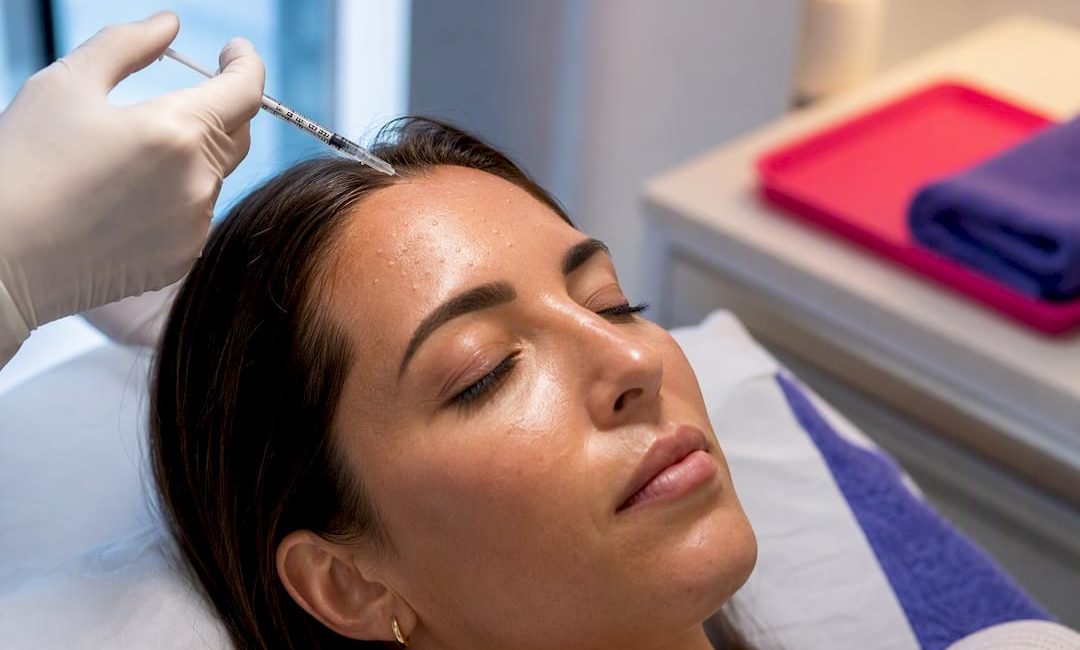
Microbotox is the intradermal injection of microdroplets of diluted botulinum toxin, placed to improve skin texture, shrink visible pores and control sebum while leaving deeper muscle function largely intact. For licensed practitioners, it sits apart from conventional anti-wrinkle treatment because the target is the dermis and its glands, not the muscle belly beneath. It suits patients chasing skin quality rather than static line correction, and it demands a different injection mindset from standard neuromodulation.
TL;DR:
- Microbotox targets superficial muscle fibers and glands, reducing pore size and sebum production, with effects lasting around three to four months.
- It requires precise shallow injections, aiming for tiny intradermal blebs spaced about one centimeter apart, with needle changes to maintain consistency.
- Suitable mostly for patients seeking skin quality improvements, such as pore shrinking and oil control, rather than deep wrinkle or static line treatment.
- Common dilutions include 1:5 or 1:10 ratios, with preparation involving sodium chloride reconstitution, labeling, and storage per manufacturer guidelines.
- Risks include transient bruising, asymmetry, or unintended muscle weakness, so careful patient selection and detailed documentation are essential.
Table of Contents
- What is the microbotox technique and how does it differ from standard injections?
- Which patients and areas suit microbotox for fine lines?
- What dilution and preparation does microbotox require?
- How do you perform the injection technique step by step?
- How long does microbotox last and what results should patients expect?
- What are the risks and contraindications of the microbotox procedure?
- What does patient selection and aftercare involve?
- How strong is the clinical evidence behind microbotox?
- Lessons from refining the microbotox technique in practice
- Sourcing supplies for the microbotox procedure
- Sources
- FAQ
What is the microbotox technique and how does it differ from standard injections?
Conventional botulinum toxin injections are intramuscular: the needle passes through skin and fat to reach a specific muscle, weakening contraction enough to soften a dynamic line. Microbotox works on a shallower plane entirely. The toxin is deposited as tiny intradermal microdroplets, sitting in or just beneath the dermis rather than inside muscle tissue.
That placement changes what the toxin actually touches. Instead of paralysing a defined muscle, it partially modulates superficial muscle fibres running through the dermis and acts directly on sweat and sebaceous glands nearby. Clinical evidence shows intradermal microbotox injections induce atrophy of sebaceous glands, which is the mechanism behind reduced pore size and lower sebum output.
Three physiological effects matter for practice:
- Superficial muscle modulation softens fine dynamic lines without the flattening effect seen with full-dose intramuscular treatment.
- Sebaceous gland atrophy reduces oil production, visibly shrinking pores over several weeks.
- Secondary dermal changes, including modest collagen stimulation and better hydration, contribute to the smoother, more reflective skin sheen patients notice.
The technique is often described in the literature as chemoresurfacing rather than neuromodulation. That framing matters clinically: a patient expecting Hollywood-style line erasure will be disappointed, whereas a patient told to expect tighter pores, less shine and softer texture over four to six weeks tends to walk away satisfied.
Which patients and areas suit microbotox for fine lines?
The strongest candidates are patients whose primary complaint is skin quality rather than deep static folds. Enlarged pores, persistent seborrhoea, oily T-zone shine and fine crepey lines respond well to the microdroplet approach, particularly on the forehead, cheeks, perioral area and neck.
Common indications and adjunct uses include:
- Enlarged pores and oily, shine-prone skin, especially across the mid-face and forehead.
- Fine lines and early textural changes where deep muscle weakening isn’t desired.
- Diffuse skin laxity or crepiness on the neck and lower face.
- Adjunctive use alongside treatment for mild acne, rosacea-associated flushing, or jawline recontouring protocols.
Not every patient is a good fit. Deep, etched rhytides from decades of muscle contraction still respond better to conventional intramuscular dosing, and patients wanting dramatic brow lift or significant frown-line elimination need standard technique, not microdroplets. Anyone with active skin infection over the treatment area, known hypersensitivity to the formulation, or unrealistic expectations about permanence should be redirected to a fuller consultation before booking a microbotox session.
What dilution and preparation does microbotox require?
There’s no single agreed dilution in the literature, and that’s worth saying plainly to anyone expecting a fixed recipe. Published protocols commonly cite dilutions in the region of a 1:5 equivalent (100 units reconstituted in 5 mL) or a 1:10 equivalent (10 units in 1 mL), with the choice depending on treatment area and desired spread, according to a review of microdroplet botulinum toxin technique.
Preparation, step by step:
- Reconstitute the vial using preservative-free sodium chloride 0.9%, working slowly down the vial wall to avoid excess foaming.
- Label the working syringe immediately with concentration, reconstitution time and area intended, before it leaves your hand.
- Draw into 1 mL Luer-lock syringes for precision, as Luer-slip tips are more prone to leakage under the light pressure microdroplet technique requires.
- Attach a fine-gauge needle only at the point of injection, not during storage, to protect the tip.
- Store reconstituted product according to manufacturer guidance and discard unused solution within the stated window.
Sodium chloride 0.9% ampoules remain the standard reconstitution fluid across most published microbotox protocols.
Pro Tip: Prepare only the volume you’ll use within the session. Diluted working solution for microdroplet technique is more exposed to temperature and light variance than a standard intramuscular draw, simply because it’s handled for longer during a treatment.
How do you perform the injection technique step by step?
Microbotox is unforgiving of sloppy depth control. Go too deep and you’re back to standard intramuscular effect; too shallow and you’ll raise a wheal without therapeutic benefit. The target is a visible, tiny intradermal bleb; that bleb is your confirmation the toxin has landed where it needs to.
Setting up:
- Cleanse the area and mark your grid, either freehand or using a transparent film held against the face to keep spacing consistent between sessions.
- Apply topical anaesthesia 20 to 30 minutes before injecting if treating a broad or sensitive area.
- Use a 30 to 32 G needle held at a shallow angle, close to horizontal against the skin surface.
- Advance until you feel light resistance rather than the deeper give of subcutaneous tissue.
- Deposit 0.01 to 0.05 mL per point, a volume and needle gauge consistent with published technique reviews.
- Space deposits at roughly 1 cm intervals across the grid, tightening spacing over more sensitive or thinner-skinned zones.
Area-specific adjustments matter more here than in standard toxin work:
- Forehead: stay superficial and keep spacing generous over the central brow to preserve frontalis elevator function; you’re softening texture, not weakening lift.
- Periocular and crow’s feet: use the smallest volumes on the list and widen spacing slightly to reduce the risk of diffusion towards orbicularis oculi and unwanted lid heaviness.
- Lower face and neck: grid patterns can run slightly looser here, with marginally lower total volume per zone given the thinner dermis over the platysma.
Sequence your injections from one anatomical zone to the next rather than jumping around, and document total volume, dilution and grid pattern per zone as you go, not afterwards from memory.
Pro Tip: Change your needle partway through a full-face session. A needle that’s passed through skin thirty or forty times dulls fast, and a dull needle pushes deeper than you intend, increasing both discomfort and the risk of drifting into muscle.
How long does microbotox last and what results should patients expect?
Split-face comparative work shows intradermal microbotox delivers superior efficacy and longevity compared with topical microbotox applied after microneedling, with visible improvement in pore size and oil control from a single session.
What the evidence shows: objective skin-scanning studies have recorded measurable improvements in microroughness and pore metrics following intradermal microdroplet injection, giving practitioners a quantifiable basis for before-and-after comparison beyond patient-reported satisfaction, per clinical trial outcomes using algorithmic evaluation.
Duration is commonly reported in the region of three to four months, though this varies with patient metabolism, treatment area, dilution used and total dose delivered. Plan review appointments around that window rather than waiting for the patient to notice fade.
- Pore appearance and shine typically soften within two to four weeks of treatment.
- Sebum control tends to be the most durable effect, often outlasting visible textural change.
- Maintenance sessions at three to four months preserve results better than waiting for full regression before reinjecting.
What are the risks and contraindications of the microbotox procedure?
Standard toxin contraindications apply in full: pregnancy and breastfeeding, known hypersensitivity to the formulation, neuromuscular disorders such as myasthenia gravis, and active infection at the treatment site all rule out microbotox on the day. Take a careful medication history too, since aminoglycoside antibiotics and certain muscle relaxants can potentiate toxin effect unpredictably.
- Screen for prior toxin exposure, timing of last treatment and any history of unexpected weakness or asymmetry.
- Review current medications for anything that might potentiate neuromuscular effect.
- Confirm no active skin infection, dermatitis or recent resurfacing procedure over the planned treatment area.
- Document informed consent covering realistic duration, need for repeat sessions and off-label positioning of the technique.
Transient bruising, mild erythema and pinpoint bleeding at injection points are expected and usually resolve within days. Because microbotox spreads toxin across a wide superficial area, unintended diffusion into adjacent musculature can cause temporary localised weakness, most often around the brow or lower lid if injected too close to those zones. Asymmetry and, rarely, ptosis are managed the same way as with conventional toxin: reassure, document, and review at two weeks, since most mild cases resolve as the toxin’s effect settles. Systemic spread is exceptionally rare at the microdose volumes used here, but any patient reporting swallowing difficulty, breathing changes or generalised weakness needs urgent medical review, not a wait-and-see approach.
Pro Tip: Photograph every patient in a neutral expression and a full smile before treatment. Asymmetry queries at the two-week review are far easier to resolve with a baseline image than with memory alone.
What does patient selection and aftercare involve?
Good candidate selection starts before the needle comes out. Take a full medical history, current medication list and prior toxin treatment record, and confirm expectations match what microbotox actually delivers: better texture and oil control, not a facelift.
Consent should explicitly cover:
- The limited, non-permanent duration of effect and the likely need for repeat sessions.
- Procedural risks, including bruising, temporary localised weakness and rare asymmetry.
- The technique’s positioning as an off-label, skin-quality-focused use of botulinum toxin rather than standard indicated treatment.
Aftercare is straightforward but worth writing down for the patient, not just saying aloud: avoid vigorous exercise, saunas and lying flat for four hours, avoid facial massage for 48 hours, and expect visible improvement to build over two to four weeks. Book the review at the one to two week mark to check symmetry and discuss touch-up policy before the patient leaves the first appointment.
How strong is the clinical evidence behind microbotox?
The evidence base is genuinely encouraging, not just enthusiastic. Split-face trials directly comparing intradermal injection against topical microbotox with microneedling found the injected technique performed better on both efficacy and how long results lasted, a meaningful distinction for anyone deciding which protocol to offer, according to the split-face comparative study.
Broader integrative reviews of clinical series report consistent short-term improvement in texture, pore size and sebum control across studies, which is reassuring at the review level.
The caveats are real, though:
- Dilution protocols vary widely between published studies, making direct comparison of outcomes difficult.
- Follow-up periods in most series are short, so long-term durability data beyond a handful of months remains thin.
- Recent integrative reviews specifically call for standardised, longer-term randomised trials before firm consensus protocols can be published.
Practically, that means running your own outcome tracking matters as much as following any single published dilution. Photograph consistently, note dilution and volume per zone, and audit your results over your first twenty or thirty cases before settling on a house protocol.
Lessons from refining the microbotox technique in practice
The learning curve on microbotox is steeper than it looks on paper. Beginners consistently inject too deep, chasing the familiar feel of intramuscular placement rather than trusting a shallow angle and a small bleb as their signal. Rotating the needle slightly between deposits and swapping to a fresh needle partway through a session both cut discomfort and keep placement consistent. Building it into a wider skin-quality pathway, alongside topical care or resurfacing, tends to produce more satisfied patients than treating it as a standalone procedure.
— Rizwan
Sourcing supplies for the microbotox procedure
Consistent results depend on consistent supplies, and that’s where a lot of clinics quietly lose reliability: a different diluent batch, a syringe swap, a delayed delivery before a fully booked treatment day. Suppliers provide licensed practitioners with the full kit a microbotox session needs, including botulinum toxin units in a range of pack sizes, sodium chloride for reconstitution, and the fine-gauge syringes and needles the technique depends on.
Every order runs through professional verification before dispatch, and extended cut-off times help ensure timely delivery for clinics. For smaller-volume microdroplet work, the 50-unit dual vial format gives more flexibility over dilution ratios than committing to larger packs, while 200-unit packs suit higher-throughput clinics running multiple full-face sessions weekly. Browse the full range of professional consumables and place your next order before your next treatment day fills up.
This article is general information, not a substitute for advice from a qualified doctor. Consult a qualified healthcare professional about your own circumstances before acting on anything here.
Sources
- Microbotox injection versus its topical application following microneedling in the treatment of wide facial pores: A split face comparative study
- Microdroplet Botulinum Toxin: A Review
- Skin rejuvenation with microbotox: a review
FAQ
How long does microbotox last?
Results are commonly reported to last several months, though duration varies with dilution strength, treatment area and individual patient factors. Review appointments at the three-month mark are a sensible default for planning maintenance sessions.
Can microbotox help shrink pores?
Yes. Intradermal microdroplet injection causes atrophy of the sebaceous glands, which reduces oil production and visibly shrinks pore size over several weeks following treatment.
What is microdosing Botox?
Microdosing, more precisely called the microbotox technique, refers to injecting small, diluted microdroplets of botulinum toxin intradermally rather than intramuscularly. It targets skin quality, superficial muscle tone and glandular activity rather than paralysing a specific muscle group.
What is the dilution for microbotox?
There’s no single standardised dilution across the field. Commonly cited ranges include a 1:5 equivalent (100 units in 5 mL) and 1:10 equivalents, with the exact choice depending on treatment area and desired spread of effect.
Is microbotox the same as traditional anti-wrinkle treatment?
No. Traditional intramuscular treatment weakens a targeted muscle to soften dynamic lines, while microbotox works intradermally on superficial fibres and glands to improve pore size, sebum control and overall skin texture without significant muscle weakening.