

A shortage is manageable when you see it early, know how many days of stock you hold, and have already agreed who decides on an alternative. For licensed practitioners running aesthetic, weight management or IV therapy services, that means three habits: watch the official supply signals, calculate cover from real usage, and document every substitution. Ordering from a verified supplier with extended order cut-off times, as we offer at Mirror Pharma, keeps the practical side of replenishment simple. This guide is for qualified aesthetic professionals and prescribers.
TL;DR
- Check official supply notifications and the Medicines Supply Tool regularly, and contact your wholesaler or supplier early for local, unannounced shortages.
- Work out cover: stock in hand divided by average daily or weekly use, then compare with the expected resupply date.
- Any alternative needs a documented risk assessment by a named senior clinician, and extra checks if it is unlicensed.
- Tell patients whether the shortage is national or local, and never leave them without treatment or an alternative.
- Keep supplier verification and cut-off times in your routine so reordering is fast when supply tightens.
Table of Contents
- Why shortages need a written process
- Step 1: Spot the shortage early
- Step 2: Estimate how long your stock will last
- Step 3: Record a shortage risk assessment
- Step 4: Prioritise limited stock
- Step 5: Assess and document any alternative
- Step 6: Communicate with patients and staff
- Step 7: Reorder smartly while supply is tight
- Where Mirror Pharma fits
- Perspective
- FAQ
- Sources
Why shortages need a written process
Most guidance on shortages is written for hospitals and NHS pharmacy teams. The principles still apply to an independent clinic: the earlier you know, the more options you have. The UK government’s August 2026 best-practice guidance says marketing authorisation holders (the companies that hold a medicine’s licence) must report potential supply issues or discontinuations as early as possible, and for NHS-supplied products six months in advance or as soon as practicable after identifying the issue. That early notice is designed to give services more time to plan.
A clinic that waits until a shelf is empty has lost that time. A written process turns a stressful week into a checklist.
Step 1: Spot the shortage early
The NHS Specialist Pharmacy Service’s medicines supply poster (November 2025, England) names the main routes:
- Medicines Supply Notifications (MSNs): these give the expected duration, clinical advice, actions and suggested alternatives, and are emailed to primary and secondary care as appropriate.
- National Patient Safety Alerts (NatPSAs).
- The Medicines Supply Tool, which you should check when a product becomes hard to get.
- Serious Shortage Protocols (SSPs): these let community pharmacists dispense a specified alternative. They are a community pharmacy route rather than something a clinic uses directly, but they show how national shortages are handled.
For a local, unannounced shortage, the same poster advises contacting wholesalers or checking their websites and liaising with local pharmacies. NHS Grampian’s guidance (September 2025, Scotland) adds that information should come from an appropriate, validated resource, and lists procurement teams, wholesalers and the pharmaceutical industry among shortage signals.
In practice, nominate one person to check these sources weekly and log what they find. Your supplier relationship is a signal too: a licensed supplier that verifies its customers and communicates stock position gives you notice that open marketplaces never will. Our guide to the documents a medicine supplier must show explains what to check before you rely on any source of supply.
Step 2: Estimate how long your stock will last
The Royal Pharmaceutical Society’s 2026 standards say that for a long-term or critical shortage, you should assess stock across the whole organisation and estimate how long it will last. For a multi-site clinic group, that means counting every treatment room, fridge and satellite location, not just the main clinic.
A simple cover calculation
- Count usable stock in hand, excluding anything expired or quarantined.
- Take average use from your own records over a representative period.
- Divide stock by average use to get days or weeks of cover.
- Compare it with the resupply date given in the official notification or by your supplier.
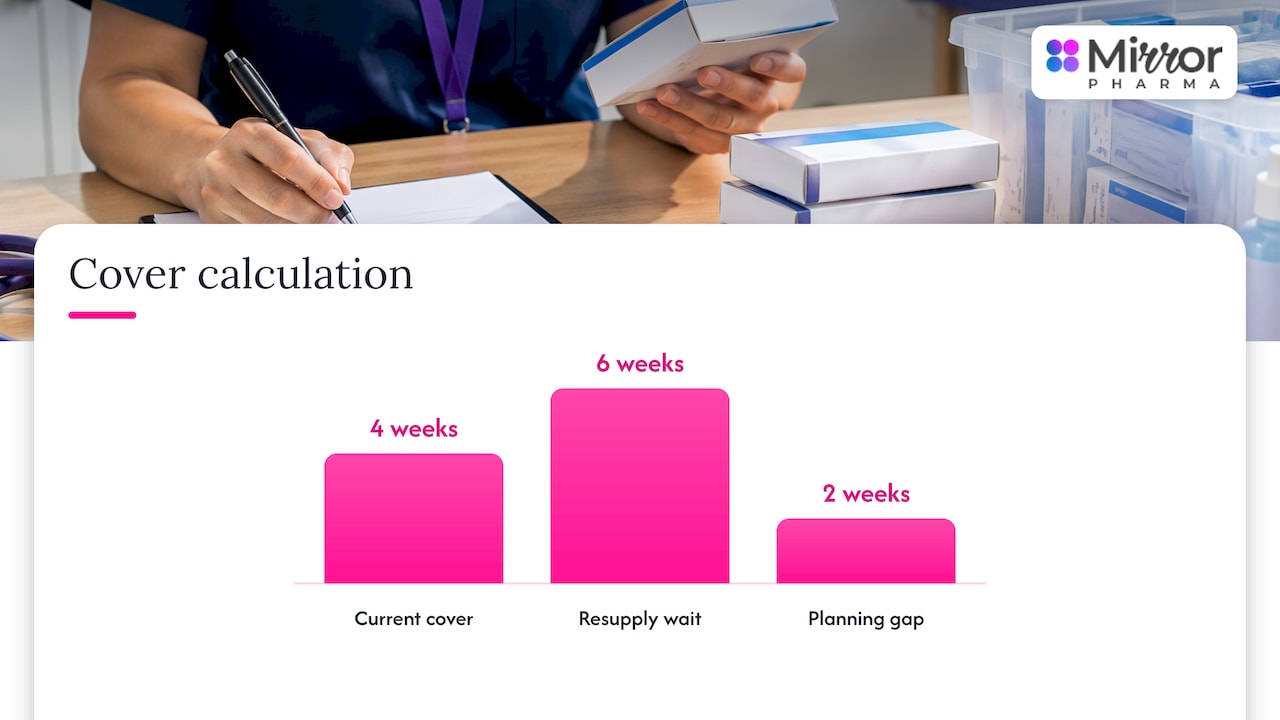
A worked example: a clinic holds 12 vials of a product and uses about 3 a week. That is four weeks of cover. If the stated resupply date is six weeks away, you have a two-week gap to plan for, either through restricting use, sourcing from another licensed route or agreeing an alternative.
Resupply dates can change, so recalculate whenever new information arrives. Expiry matters as well: stock that expires before you use it is not cover. Our medicine expiry management guide covers that side, and our clinic inventory management playbook shows how to keep the usage data this calculation depends on.
Step 3: Record a shortage risk assessment
The RPS standards call for a documented risk assessment covering estimated duration, usage, suitable alternatives and potential patient risk. NHS Grampian’s checklist is a useful template for the fields to record:
| Field | What to record |
|---|---|
| Product | Name, strength, form, manufacturer |
| Source of information | The official notice or supplier statement |
| Duration | Expected shortage length or resupply date |
| Stock | Quantity in hand and historic usage |
| Alternatives | What is available and in what quantity |
| Patients | Numbers affected, special groups, licensed or unlicensed use |
| Specialist input | Whether a prescriber or other specialist needs to advise |
A clinic does not need hospital-scale paperwork. One page per shortage, dated and signed, is enough to show you acted deliberately.
Step 4: Prioritise limited stock
Where supply is short, the RPS standards say any restriction should be agreed with the most relevant senior doctor, with start and review dates set and the decision communicated immediately to the relevant staff. In a clinic, that senior clinician is usually the lead prescriber or medical director.
Practical prioritisation questions:
- Which patients are mid-course, where interrupting treatment carries the most clinical consequence?
- Which treatments can be safely deferred?
- Is there a clinical reason to favour one patient group over another, recorded in writing?
For weight management and IV vitamin programmes, where patients may be part-way through a regimen, this is where the course schedule matters most. Our guides on understanding weight management medications and IV vitamin therapy protocols support those clinical decisions.
The RPS standards also note that regional collaboration can share limited stock based on clinical need. For independent clinics, the equivalent is a documented, lawful arrangement through your licensed supplier, never informal swapping.
Step 5: Assess and document any alternative
The RPS standards say a named senior pharmacist should fully document a risk assessment of the alternative. If the alternative is an unlicensed product, follow MHRA Medicines Advice Leaflet MAL 14, with quality assurance and medicines information advice as needed. In a clinic, that means your prescriber and your supplying pharmacy should both be part of the decision.
Checklist for an alternative:
- Is it the same active ingredient, strength and route, or a different product entirely?
- Is it licensed for the intended use?
- Who has signed off the risk assessment, and when?
- Has the prescriber issued a valid prescription for it?
- Has the patient been counselled and consented?
Unlicensed products carry specific prescriber duties. Read our summary of the two MHRA checks for unlicensed medicines in aesthetics before substituting. Prescribing must also follow current rules on consultation: see our remote prescribing checklist for aesthetic clinicians.
Step 6: Communicate with patients and staff
The SPS poster sets out what patients should hear: whether the issue is national or local, the anticipated resupply date with a note that it can change, and reassurance that they will not be left without treatment or an alternative. Counsel them on the alternative and on continuing treatment, say clearly when a medicine is unlicensed, and advise against rationing or stockpiling.
For staff, brief the whole team the same day a restriction starts: what is restricted, who approved it, when it will be reviewed and the script for patient conversations. Keep patient communication factual and balanced, and never promise outcomes.
Step 7: Reorder smartly while supply is tight
Ordering habits matter more in a shortage than at any other time.
- Know your cut-off times. Missing a cut-off can cost a day. Our guide to pharmacy cut-off times for licensed practitioners explains how to plan around them.
- Keep your verification current. Prescriber and clinic checks are required before prescription products ship. See prescriber verification in the UK and the prescription upload process, so paperwork never delays an urgent order.
- Do not over-order. Stockpiling can worsen a shortage for other services and risks expiry. Our guide on how much stock an aesthetic clinic should hold helps you set sensible minimum and maximum levels.
- Order consumables with your medicines. Needles, syringes and disposal supplies are easy to forget; see our sharps disposal checks.
Where Mirror Pharma fits
Mirror Pharma is an online pharmacy supplying prescription aesthetic medicines and consumables to licensed practitioners and clinics: toxins, dermal fillers, weight loss, IM/IV vitamins, polynucleotides, skin boosters and fat dissolving products. Access is subject to practitioner and prescriber verification, and orders are fulfilled by a dedicated team of healthcare professionals. Our extended order cut-off times are designed to help practitioners meet client appointments.
Perspective
Shortages rarely arrive as a surprise to clinics that keep good records. The difference we see in a well-run practice is a single page: usage per week, stock in hand, who signs off a change. Add a verified supplier relationship and a reorder routine that respects cut-off times, and a disruption becomes a scheduling task rather than a clinical emergency.
Our approach is to make the supply side simple for licensed practitioners: a smooth online ordering experience, strict verification so that only qualified prescribers and clinics buy, and a team of healthcare professionals behind fulfilment. That leaves you free to focus on patients and on documenting your decisions.
Rizwan
FAQ
What is the first thing a clinic should do when a product is in short supply?
Confirm the shortage from an official source such as an MSN or the Medicines Supply Tool, or from your wholesaler or supplier for a local issue. Then calculate your cover from stock in hand and average use, and compare it with the expected resupply date.
Can a clinic switch to an unlicensed alternative?
Only after a documented risk assessment by a named senior clinician, with the prescriber’s valid prescription and the patient informed that the product is unlicensed. MHRA MAL 14 sets out the relevant requirements for unlicensed medicines, so follow it before substituting.
Should we stockpile when a shortage is announced?
No. National guidance advises patients against stockpiling, and the same logic applies to clinics: it can deepen a shortage and leave you with expired stock. Set minimum and maximum levels and reorder within them.
What should patients be told?
Tell them whether the shortage is national or local, give the expected resupply date with a note that it can change, explain any alternative and say whether it is unlicensed. Make sure they are not left without treatment or an alternative.
Who decides how limited stock is used?
The RPS standards say restrictions should be agreed with the most relevant senior doctor, with start and review dates recorded. In a clinic, that is normally the lead prescriber or medical director.
Sources
- Managing medicines supply issues, NHS Specialist Pharmacy Service (November 2025)
- Guidance for the management of medicine shortages, NHS Grampian (September 2025)
- Best Practice Standards for managing Medicines Shortages, Royal Pharmaceutical Society (2026)
- Ensuring the efficient supply and distribution of medicine to patients, GOV.UK (August 2026)