
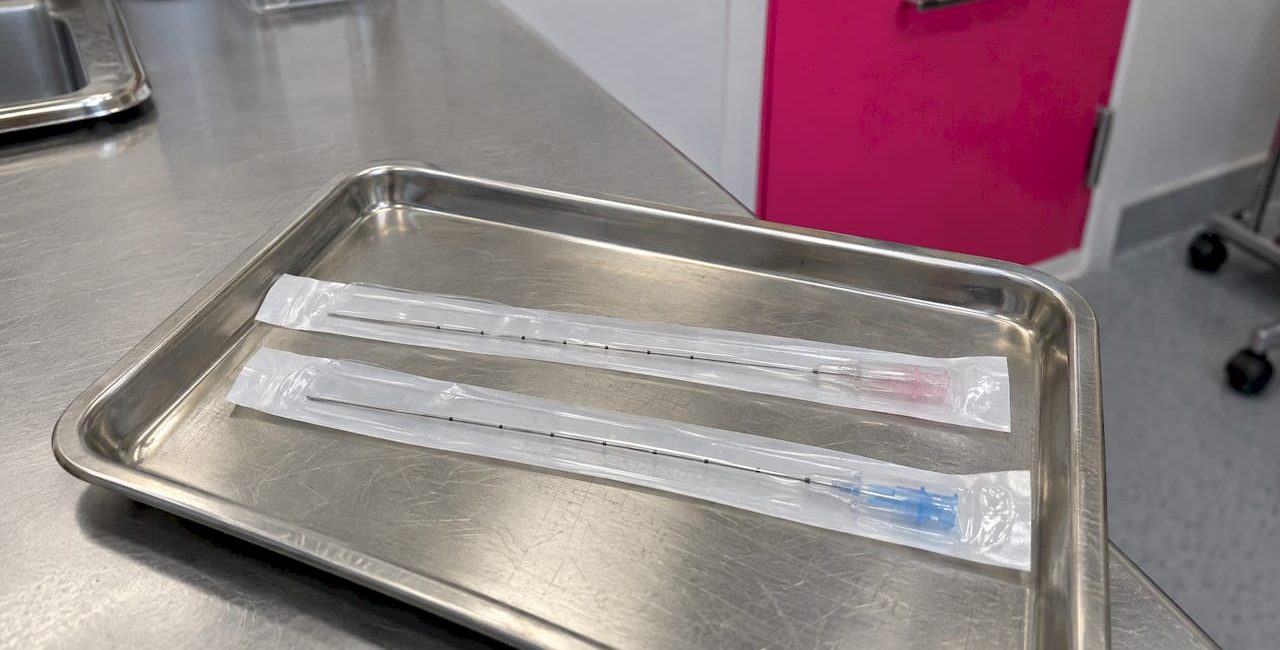
For licensed practitioners, the choice between a 25G and a 27G cannula is first a question of lumen and product rheology, and only then a question of safety. A 25G cannula has the wider bore and carries thicker hyaluronic acid filler with less effort. A 27G cannula is finer and suits low-viscosity products and delicate areas. Neither gauge is a safety guarantee, because the published force data show that both sizes can perforate an artery.
This guide is for qualified aesthetic professionals, prescribers and clinic teams who select consumables for dermal filler treatments. It sets out what the gauge numbers mean, what the evidence says about each size, and a practical way to decide.
TL;DR
- Lower gauge number means a wider cannula: 25G has a larger lumen than 27G, so it suits thicker, medium-viscosity hyaluronic acid fillers.
- 27G cannulas are generally described for low-to-medium-viscosity products in fine lines and the nose; 21G to 25G for most medium-viscosity facial work.
- Cadaver studies found that 27G cannulas penetrated the facial artery with less force than 25G, and both sizes could perforate it, so gauge alone is not a safety measure.
- The UK CMAC guideline describes a consensus to avoid cannulas smaller than 25G for filler injection, while keeping every other safety measure in place.
- Match gauge to product viscosity, area and technique, and buy consumables from a supplier that verifies practitioner status.
Table of Contents
- What the gauge number actually tells you
- 25G vs 27G at a glance
- Filler viscosity: the deciding factor
- What the safety evidence shows
- When a 25G is the natural choice
- When a 27G is the natural choice
- Checks before you commit to a gauge
- Who should be doing this work
- Our perspective
- Stocking your clinic with the right sizes
- FAQ
- Sources
What the gauge number actually tells you
Gauge describes the outer diameter of a needle or cannula, and the scale runs backwards: the higher the number, the thinner the device. A 2022 specifications review of microcannulas states that smaller gauge numbers correspond to larger diameters and inner calibres. In the same sizing system, 25G therefore has a larger lumen than 27G.
The lumen is the hollow channel the product travels through. It matters more at the syringe than at the tip, because it controls how easily a given filler can be extruded. Thicker products need a wider inner calibre, which is why the same review treats gauge selection as a matching exercise between lumen and viscosity.
Two practical points follow:
- Gauge is not length. A 25G x 38 mm and a 25G x 50 mm share a bore but behave differently in the tissue. The review says length should be chosen according to technique and treatment area.
- Gauge is not a brand-independent specification. The same review notes that cannulas vary in flexibility and length between manufacturers, so two devices of the same gauge can feel different in the hand.
25G vs 27G at a glance
| Factor | 25G cannula | 27G cannula |
|---|---|---|
| Lumen | Larger | Smaller |
| Typical product match | Medium-viscosity hyaluronic acid fillers in most facial indications (described for the 21G to 25G range) | Low-to-medium-viscosity fillers in fine lines and the nose (described for the 27G to 30G range) |
| Extrusion effort | Lower for thicker products | Higher with thicker products |
| Facial-artery penetration force in cadaver testing | Higher than 27G in the studies below | Lower than 25G in the studies below |
| Where the evidence leaves you | Can still perforate an artery | Can still perforate an artery |
The product-match row comes from the microcannula specifications review, whose authors describe 27G to 30G cannulas for low-to-medium-viscosity fillers in fine lines and the nose, and 21G to 25G for medium-viscosity hyaluronic acid in most facial indications. Treat it as a starting point for your own clinical judgement, not a rule.
Filler viscosity: the deciding factor
For most practitioners the first question is not “which is safer” but “will this product move through this cannula smoothly?” A thicker, more cohesive hyaluronic acid filler pushed through a 27G lumen demands more plunger pressure. Higher pressure makes a steady, controlled flow harder to maintain, and the review’s conclusion that thicker substances need a larger inner calibre reflects exactly that.
A workable sequence for qualified practitioners:
- Read the manufacturer’s instructions for use. The product’s own documentation states which needle or cannula sizes it is intended for. That outranks any general table.
- Identify the product’s viscosity class and the layer you are treating. Deeper, volumising work with a firmer product generally points towards the 25G end of the range or wider. Superficial, fine-line work with a softer product is where 27G is described.
- Choose the length for the route you plan to take. Entry point, area and technique decide whether a shorter or longer cannula is appropriate.
- Check the feel of the syringe and cannula together. Luer connection, plunger resistance and flexibility all differ between manufacturers.
For product-specific background, our guide to hyaluronic acid fillers and their safety covers the material side of this decision.
What the safety evidence shows
A common assumption is that a finer, blunt-tipped cannula is automatically the safer choice. The research is more careful than that, and it is worth reading closely if you work to a consent process that discusses vascular risk.
Penetration force in cadaver studies
A 2019 cadaver study by Pavicic and colleagues measured the force needed to penetrate the facial artery wall. The mean for the 25G cannulas tested was 1.04 ± 0.36 N, against 0.78 ± 0.35 N for the 27G cannulas. In other words, the finer devices needed less force to get through the artery wall.
A second 2019 study by Ugradar and Hoenig reported facial-artery perforation forces of 0.43 to 0.54 kg for 25G and 0.23 to 0.32 kg for 27G blunt microcannulas. Both sizes could perforate the artery under test conditions.
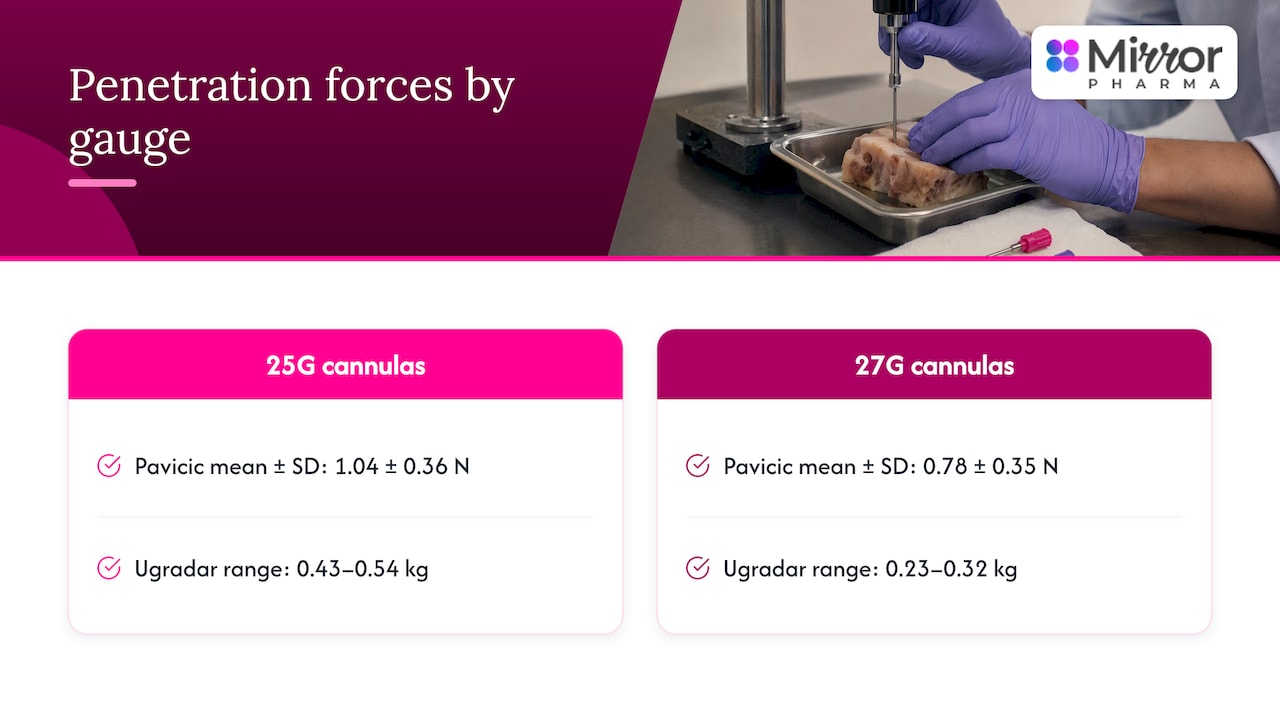
The pattern is consistent: the 27G needed less force than the 25G, and neither was immune.
Why gauge alone is not a safety guarantee
A 2022 article by Siperstein on the 27-gauge cannula points out that penetration force varies a great deal between brands and designs. It cites a range of 0.8 to 2.2 N among 25G cannulas, associated with taper, elastic modulus and coating. It argues that flexibility, tip design, tissue resistance and injection technique all influence practical safety, so gauge cannot be treated as a reliable guarantee.
That has a useful consequence for purchasing. A 25G cannula from one manufacturer may behave quite differently from a 25G from another. Once you have settled on a device that performs well in your hands, consistency of supply is itself a safety consideration.
What the UK guideline says
The CMAC guideline on managing hyaluronic acid vascular occlusion, published in 2021, notes that vascular complications can occur with cannulas as well as needles. It also states that a 27G cannula has been shown to penetrate an artery with force similar to a needle. The board’s consensus, as the guideline describes it, is to avoid cannulas smaller than 25G for filler injection, while stressing that all safety measures stay necessary whichever device you use.
So the evidence supports two statements at once: a 25G or larger cannula is the consensus floor in that guideline, and no gauge replaces anatomical knowledge, slow low-pressure injection and a complication protocol.
When a 25G is the natural choice
For licensed practitioners, a 25G cannula is usually the practical default in these situations:
- Medium-viscosity hyaluronic acid products in cheeks, temples, jawline and chin, where the review describes 21G to 25G as the usual range.
- Longer entry-point routes where a single access point serves a wider area and you want a device that tracks predictably.
- Work where the CMAC consensus matters to you, since it advises against going smaller than 25G for filler.
- Firmer products where extrusion effort through a finer bore would compromise control.
The larger lumen also tends to be more forgiving when a product has a thicker, more cohesive gel, which reduces the plunger pressure you need to apply.
When a 27G is the natural choice
A 27G cannula is described for finer work with low-to-medium-viscosity products:
- Fine lines where the product is soft and the layer is superficial.
- The nose, where the review places 27G to 30G cannulas for suitable products.
- Delicate areas where a smaller entry and finer calibre suit your technique and the product’s instructions.
If you choose a 27G, remember what the cadaver data show: lower penetration force than 25G in those tests, and similar force to a needle in the CMAC guideline’s summary. The choice is justified by product match and fine control, not by an assumption of added safety. Keep the same discipline you would apply with a needle: aspiration policy where you use it, small aliquots, slow injection and constant attention to the patient’s response.
Checks before you commit to a gauge
Before you standardise a gauge across your clinic, run through these:
- Product fit. Is the gauge listed in the filler’s instructions for use, and does it suit the product’s viscosity?
- Area and layer. Does the gauge and length suit the plane you are working in and the anatomy at risk?
- Device variability. Have you used this specific brand and model, with its particular flexibility and tip? Siperstein’s range of 0.8 to 2.2 N among 25G devices is a reminder that models differ.
- Technique. Slow injection, low pressure and small volumes matter more than the number on the hub.
- Emergency readiness. Is your vascular occlusion protocol, including the hyaluronidase pathway described in the CMAC guideline, in the room and rehearsed?
- Consent. Does your consent discussion avoid implying that a cannula removes vascular risk?
If you want the wider comparison of instruments, our article on cannula versus needle and filler safety goes further, and our piece on recognising dermal filler complications helps teams prepare for the events that no gauge rules out.
Who should be doing this work
Gauge selection sits inside a wider question of competence. The General Dental Council’s February 2025 consultation response on regulating non-surgical cosmetic procedures supports a clear regulatory framework. It says high-risk cosmetic procedures should be restricted to appropriately trained, qualified and indemnified regulated health professionals. It is a consultation response, not a cannula standard, and it does not name a preferred gauge. Its message for this topic is that patient safety rests on practitioner competence and scope, with the device as one part of the picture.
Our perspective
We supply prescription aesthetic medicines and consumables to verified healthcare professionals, so we see the 25G versus 27G question as a purchasing and protocol decision, not a slogan.
Our view is that the best gauge is the one your product’s instructions support, your training covers and your team uses consistently. The evidence tells you why: lumen decides how a filler flows, and the penetration studies tell you that no gauge removes vascular risk. A practitioner who understands both points will choose better than one who picks the finest cannula in the belief that it is safest.
That is why we care about how consumables reach you. Our team of healthcare professionals handles fulfilment, we verify practitioner and prescriber access before supplying, and our extended order cut-off times are designed to help you restock before the next clinic day. Needles, cannulas and the products they deliver should arrive together, from one place, so that your technique is not compromised by a missing size.
Rizwan
Stocking your clinic with the right sizes
Most clinics end up holding more than one gauge, because different products and areas call for different devices. A sensible approach is to define which gauge and length you use for each product and area, record it in your protocol, and keep enough of each in stock that you are never tempted to improvise mid-treatment.
We supply needles and consumables alongside our dermal filler range, for licensed practitioners and prescribers whose access we verify. Our extended order cut-off times are there to help you get orders in late and still plan for timely delivery. If your clinic is reviewing its injectables protocol, ordering consumables with your fillers keeps the whole set consistent.
FAQ
Is a 27G cannula safer than a 25G?
Not on the evidence available. Cadaver studies found that 27G cannulas penetrated the facial artery with less force than 25G, and both sizes could perforate it. The CMAC guideline also states that a 27G cannula has penetrated an artery with force similar to a needle. Technique, product choice and a complication protocol remain essential for licensed practitioners.
Which filler viscosities suit a 25G cannula?
The 2022 specifications review describes 21G to 25G cannulas for medium-viscosity hyaluronic acid in most facial indications. A larger lumen lets thicker products pass with less pressure. Always check the filler’s instructions for use first, since they name the sizes the product is intended for.
When would a qualified practitioner use a 27G cannula?
The same review describes 27G to 30G cannulas for low-to-medium-viscosity fillers in fine lines and the nose. Choose it where the product is soft, the layer is superficial and your training covers the technique. Product match and control are the reasons to choose it, not an assumption of lower risk.
Does cannula length matter as much as gauge?
Length matters for reach and handling, and the review says it should be chosen according to technique and treatment area. Two cannulas of the same gauge can also differ in flexibility between manufacturers. Decide gauge, length and brand together, and standardise once you have a combination that works for your protocol.
Who can buy cannulas and filler from Mirror Pharma?
We supply healthcare professionals, aesthetic practitioners and clinics, and we require verification of practitioner or prescriber status before supplying. Our products are intended for use by trained practitioners and prescribers only.
Sources
- Microcannulas in dermatology: specifications (Surgical & Cosmetic Dermatology, 2022)
- Arterial wall penetration forces in needles versus cannulas (Pavicic et al., 2019)
- Measurement of the force required by blunt-tipped microcannulas to perforate the facial artery (Ugradar and Hoenig, 2019)
- The use of a 27-gauge cannula in aesthetic medicine (Siperstein, 2022)
- CMAC guideline for the management of hyaluronic acid filler-induced vascular occlusion (2021)
- General Dental Council consultation response on non-surgical cosmetic procedures (February 2025)