

Before placing an order with any aesthetic wholesaler, verify regulatory authorisation, product traceability and cold chain handling, in that order. For licensed practitioners, this means requesting valid MHRA wholesale distribution authorisation details, the name of the Responsible Person, batch-level certificates of conformity and recent temperature logs for the specific consignment before any payment is made.
TL;DR:
- Check that the WDA(H) scope covers the activity and products, and confirm the UK resident Responsible Person has relevant experience and GDP training.
- Confirm the supplier is authorized for each brand and batch, and check certificates and packaging; unverified sourcing can jeopardize insurance cover if a claim arises.
- For devices, verify UKCA marking or CE marking within its applicable transition period, and ensure prescription medicines ship only after prescriber credentials are checked.
- Ask whether temperature controlled couriers are validated, and request signed transit records, shipment seal checks, and the written process for batch recalls.
- Check pharmacy, company, and VAT records; stop orders over suspicious prices, missing batch numbers, or cryptocurrency demands, then notify your insurer and report the supplier.
Table of Contents
- Checklist: questions to ask about legal status and regulatory compliance
- Questions to ask about product provenance and authenticity
- Questions about storage, cold chain and transport controls
- Questions to ask about purchasing terms, accounting and payments
- Questions to ask about delivery, fulfilment and clinical support
- Quick vetting checklist and red flags to stop the conversation
- Assessment of product range suitability for specific practitioner needs
- Quality assurance processes beyond regulation, including batch testing and expiration tracking
- Compliance with safety and handling training for specific product categories
- Customer service responsiveness and ongoing support mechanisms
- Terms and conditions regarding liability and product replacement policies
- Author perspective: why this checklist matters in practice
- How Mirror Pharma meets these checks: a compliance-first supplier option
- FAQ
- Sources
Checklist: questions to ask about legal status and regulatory compliance
A supplier’s legal right to wholesale medicines is the first thing to confirm, not the last. Anyone who sells or supplies human medicines to someone other than the patient needs a wholesale distribution authorisation, known as a WDA(H), and holders must operate under Good Distribution Practice and pass regular inspections. Ask for the authorisation number directly and cross-check it against the supplier’s own listing, in the way MHRA publishes details for authorised sites such as WDA(H) 1883, including the holder name, registered address and the exact scope of activities covered.
- What is your WDA(H) authorisation number, and does its scope cover the products I am ordering? A licence that only covers storage, for instance, does not automatically extend to broking or import.
- Who is your Responsible Person, and can you share evidence of their GDP training and ongoing oversight? Every licensed wholesaler must name an RP resident in the UK with relevant pharmaceutical experience.
- Which of your products are prescription-only medicines, and how do you verify that I am a registered prescriber before dispatch? A supplier willing to ship prescription-only stock without checking professional credentials is not operating within the rules.
- For devices such as dermal fillers, does each product carry a valid UKCA mark, or CE marking where still accepted? UKCA marking is the standard for products placed on the Great Britain market, and CE-marked devices remain accepted only up to set transition dates depending on the device category. A product with neither mark is not authorised for use here, whatever the price looks like.
Our checklist on MHRA-related documents covers what to collect at onboarding stage, before the first order is ever placed.
Questions to ask about product provenance and authenticity
Once legal status is confirmed, provenance is the next layer. A wholesaler with a valid licence can still distribute stock that has entered the supply chain through an unauthorised route, so provenance questions need to go product by product, not supplier by supplier.
- Ask whether the supplier is an authorised distributor for the specific brand and batch you are ordering, not just a general stockist.
- Request the manufacturer’s contact details so the chain of custody can be verified independently if needed.
- Ask for the batch number and a certificate of conformity for that batch before payment is confirmed.
- Check packaging and labelling against the manufacturer’s current specification: fonts, holograms, language and expiry formatting all matter.
Insurers and sector safety guidance treat supplier verification as a condition of cover, not a courtesy. Hamilton Fraser’s guidance on grey-market products notes that claims linked to unverified sourcing can be repudiated, which makes batch records and certified provenance part of basic financial protection as much as clinical safety. Harley Academy’s guidance on spotting fake products adds that missing batch numbers, poor packaging quality and suspicious domain names are reliable warning signs worth checking before every new order, not just the first one.
Questions about storage, cold chain and transport controls
Temperature-sensitive stock needs evidence, not assurances. Ask for validated storage procedures and the supplier’s own temperature mapping data for the facility holding your order.
- Request recent temperature logs covering the specific batch you are buying, not a generic company-wide summary.
- Ask which couriers are used for temperature-controlled delivery and whether those couriers have been validated against the supplier’s own quality management system.
- Ask what documentation arrives with the delivery: signed transit records, seal integrity checks or photographic evidence of the shipment on arrival.
Guidance on Good Distribution Practice sets out that licence holders should maintain temperature mapping and transport validation as part of routine inspection readiness, so a supplier operating properly should be able to produce this without delay.
Pro Tip: Ask to see a sample temperature log before your first order rather than after a problem arises. It tells you more about a supplier’s operating standard than anything in their sales material.
Questions to ask about purchasing terms, accounting and payments
Clean paperwork protects you as much as it protects the supplier, particularly if a product is ever queried by an insurer or a regulator. Confirm the financial basics before the clinical ones become relevant.
- Will you issue a full VAT invoice, and can I verify your VAT registration independently? GOV.UK’s invoicing guidance sets out what a compliant invoice must include, and a registration number can be checked separately against the official record.
- What are the trade account eligibility requirements, minimum order values and credit terms? A supplier should ask for proof of your professional status before opening an account, not simply process payment.
- What is your returns and replacement policy, and how are batch-linked recalls or credits handled? This matters most when a whole batch, rather than a single unit, needs to be withdrawn.
Questions to ask about delivery, fulfilment and clinical support
Continuity of care depends on predictable fulfilment as much as on product quality. A supplier worth keeping should be transparent about the practical limits of their service, not just the headline promises.
- Ask what the order cut-off time is for next-day delivery, and what happens when an order narrowly misses that window.
- Confirm whether a dedicated account manager or clinical support line is available if a question arises after hours.
- Ask for the documented recall and complaint procedure, including typical response times, before you need to use it.
Quick vetting checklist and red flags to stop the conversation
Some checks take minutes and rule out the worst suppliers immediately. Run these before any deeper conversation about price or product range.
- Search the GPhC register for pharmacy or pharmacist registration where the supplier claims it.
- Check Companies House for the registered company behind the website, including directors and filing history.
- Verify the VAT number through the official GOV.UK checker rather than trusting a number printed on an invoice.
- Treat an unusually low price, a domain name built around a specific product, missing batch numbers, absent English instructions or a crypto-only payment demand as reasons to stop the order immediately.
If any of these flags appear, halt further orders, notify your professional indemnity insurer and report the supplier to the MHRA or the Office for Product Safety and Standards. Our five-minute GPhC check guide walks through the register lookups in more detail.
Assessment of product range suitability for specific practitioner needs
A wholesaler’s product range needs to match what a clinic actually treats, not just carry a broad catalogue. A practice focused on facial rejuvenation has different stock needs from one running a weight management service alongside injectables, and a supplier who only stocks one category well is not necessarily the wrong choice, just the wrong fit for a multi-service clinic.
Ask whether the range covers dermal fillers, botulinum toxin, skin boosters, polynucleotides and fat-dissolving products with enough depth in each category to avoid splitting orders across multiple suppliers unnecessarily. Splitting orders increases the number of relationships to vet and the number of invoices to reconcile, which works against the audit trail you are trying to build. Ask whether the supplier can support seasonal demand spikes, such as the run-up to the Christmas period when treatment volumes often rise, without extending lead times unpredictably. A supplier who can talk specifically about how their range supports your treatment mix, rather than reciting a generic catalogue list, is usually the one who understands clinical procurement rather than simply processing transactions.
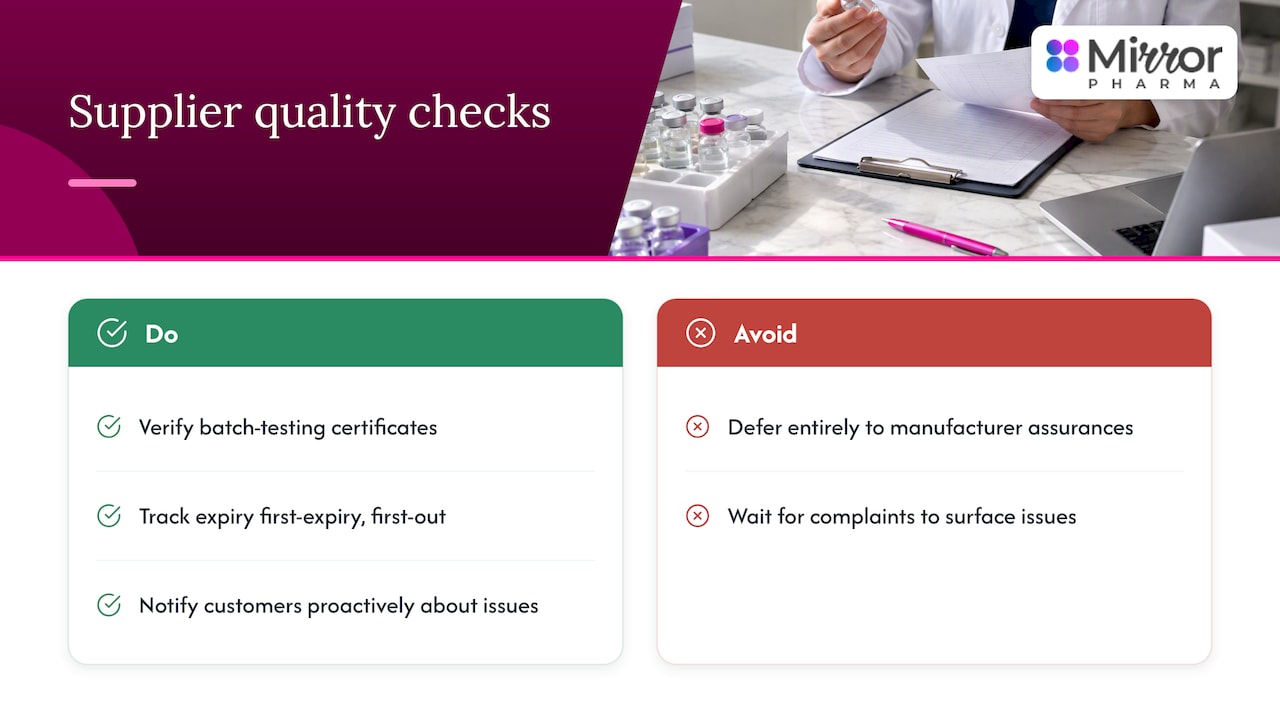
Quality assurance processes beyond regulation, including batch testing and expiration tracking
Regulatory licences set a floor, not a ceiling. Beyond WDA(H) compliance, ask what internal quality assurance a supplier runs on top of the legal minimum.
Ask whether incoming stock is checked against batch testing certificates from the manufacturer before it reaches their warehouse, and whether that checking is documented in a way you can request to see. Ask how expiration dates are tracked across the warehouse, since a supplier managing stock on a first-expiry, first-out basis reduces the risk of a clinic receiving short-dated product close to its use-by date. Ask whether quality issues identified internally, such as a damaged shipment or a batch flagged by a manufacturer, trigger proactive notification to customers who may have already received stock from that batch, rather than waiting for a complaint to surface the issue. A supplier with a genuine quality assurance process beyond the legal baseline should be able to answer these questions specifically, with reference to their own procedures, rather than deferring entirely to the manufacturer’s assurances.
Compliance with safety and handling training for specific product categories
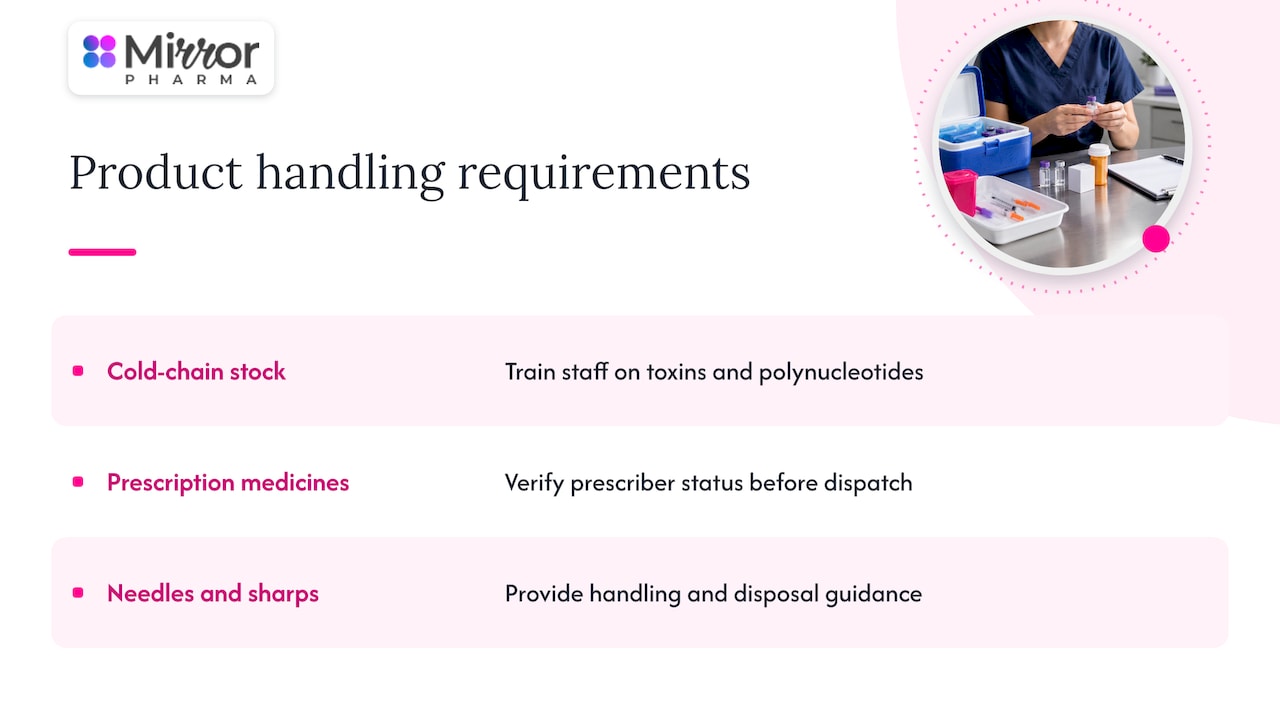
Different product categories carry different handling requirements, and a wholesaler’s own staff training is part of the chain that keeps stock safe before it ever reaches your clinic. Ask whether warehouse and dispatch staff receive specific training on temperature-sensitive categories such as toxins and polynucleotides, where a short break in cold chain can affect product integrity.
Ask whether staff handling prescription-only medicines are trained on the verification steps required before dispatch, including confirming prescriber status for products that legally require it. For consumables such as needles and sharps, ask whether handling and disposal guidance is provided alongside the order, since safe sharps management sits alongside product quality as part of a clinic’s own compliance obligations. A wholesaler who can describe category-specific training, rather than a single generic induction for all staff, is generally the one treating handling risk as seriously as the regulatory paperwork suggests they should.
Customer service responsiveness and ongoing support mechanisms
Support quality tends to reveal itself most clearly after something goes wrong, not during the sales conversation. Ask what the typical response time is for a query about a delayed order, a damaged delivery or a product question, and ask whether that response comes from a general inbox or a named contact who understands your account history.
Ongoing support matters beyond the transactional relationship. Ask whether clinical queries, such as questions about storage once a product has arrived at your clinic, are routed to someone with relevant pharmaceutical or clinical knowledge rather than a general customer service team unfamiliar with the products. Ask how the supplier handles a recurring issue, such as repeated late deliveries to a particular postcode, and whether that feeds into any operational change on their side. A wholesaler who treats support as a relationship to maintain, rather than a function to minimise, tends to be the one still answering your calls a year into the relationship.
Terms and conditions regarding liability and product replacement policies
Read the liability clauses before the first order, not after a problem arises. Ask specifically what happens if a product arrives damaged, out of temperature range, or past its expiry date through no fault of the clinic, and whether replacement or credit is automatic or requires a formal claim process.
Ask how liability is apportioned if a product causes an adverse clinical outcome that is later traced to a supply chain issue rather than clinical technique, since this is precisely where insurer involvement and supplier documentation intersect. Ask whether the terms and conditions specify a time limit for raising a claim about a faulty or mis-shipped product, since a narrow window can leave a clinic exposed if an issue is only noticed weeks later. A supplier’s written terms, rather than verbal reassurances from a sales contact, are what will matter if a dispute ever needs resolving formally.
Author perspective: why this checklist matters in practice
Supplier vetting works best as a continuous habit rather than a one-off task completed when a relationship begins. Build it into staff training, keep an audit trail of every check, and repeat stock audits regularly. Our guidance on injectable supplier verification is a useful reference point for embedding this into routine procurement.
— Rizwan
How Mirror Pharma meets these checks: a compliance-first supplier option
We built our verification process around the exact checks outlined above, because we expect clinicians to ask them. Every account opened with us goes through practitioner verification before dispatch, and our order cut-off times are designed to support timely fulfilment for clinics working to tight appointment schedules.
- Request documentation on our regulatory status and batch provenance before your first order.
- Open a trade account to access clinician-only purchasing and ongoing support from our team.
- Speak with our clinical support team about product selection across our dermal filler, toxin and IM/IV vitamin ranges.
If you are ready to review options for your clinic, explore our dermal filler category or get in touch to set up a trade account for licensed practitioners.
This article is general information, not a substitute for advice from a qualified doctor. Consult a qualified healthcare professional about your own circumstances before acting on anything here.
FAQ
What are some aesthetic related questions I should ask any wholesaler?
Ask for the WDA(H) authorisation number, the Responsible Person’s name, batch certificates and recent temperature logs before placing an order. These four checks cover legal status, provenance and cold chain handling in a single conversation.
What are the four types of aesthetics relevant to procurement decisions?
In a clinical procurement context, the relevant categories are injectables such as botulinum toxin and dermal filler, skin boosters and polynucleotides, weight management medications, and vitamin or infusion therapies. Each category carries its own storage, handling and prescribing requirements, so supplier questions should be tailored to the specific category being ordered.
What are some common topics in aesthetics procurement conversations?
Common topics include regulatory licensing, product provenance, cold chain integrity, invoicing and VAT compliance, and delivery reliability. Clinicians increasingly also ask about quality assurance processes that go beyond the legal minimum, such as batch testing and expiry tracking.
How do I quickly check if a supplier is legitimate?
Search the GPhC register for pharmacy registration, check Companies House for the registered business, and verify the VAT number through the official GOV.UK checker. These three lookups take minutes and rule out the most common red flags before any order is placed.
What should I do if I suspect a supplier is unlicensed?
Stop placing orders immediately and avoid using any stock already received until it has been checked. Notify your professional indemnity insurer and report the supplier to the MHRA or the Office for Product Safety and Standards, since continuing to use unverified stock can affect both patient safety and insurance cover.
Sources
- Gov
- UK WDA(H) 1883 – MHRA
- Grey market products: are you covered? – Hamilton Fraser
- How to spot fake Botox products — advice for aesthetic practitioners – Harley Academy