

For licensed practitioners, the right answer is not one number but a set of rules: hold enough low-value consumables to never delay a treatment, and hold the minimum justifiable amount of high-value or prescription stock, replenished often rather than bulk-bought. Two things decide the balance for each category: how fast that stock turns into revenue, and what your compliance obligations demand. Get those two right and the rest of your inventory system falls into place.
TL;DR:
- Clinics should set par levels based on usage, lead times, and safety stock, with larger buffers for cheap consumables and smaller ones for expensive, expiry-sensitive items.
- Regularly recalculating stock levels every few weeks, especially after adding new treatments or seasonal fluctuations, helps prevent overstocking or shortages.
- Maintaining strict documentation for controlled drugs, limited safety stocks, and frequent reordering are essential for regulatory compliance and audit readiness.
- Trustworthy suppliers with short, predictable lead times and extended cut-off windows enable smaller, more accurate reorder cycles and reduce stockholding costs.
- Routine stock checks should include verification of expiry dates, hidden stock audits, and assigning accountability to prevent slow drift into overstocking or expiry waste.
Table of Contents
- Building a stock framework: categories, objectives and risk tolerances
- How to calculate par levels and safety stock for each SKU
- Managing compliance-critical items: controlled drugs, toxins and prescription stock
- Expiry management and rotation strategies to reduce waste
- Inventory KPIs and financial checks clinics should monitor
- Adjusting stock for seasonality and changing service mix
- Systems, processes and team roles that make inventory work
- How a trusted supplier can help with procurement and delivery
- What I would check first in a clinic’s stock cupboard
- Supporting your clinic’s stock needs with a dedicated supplier
- Sources
- FAQ
Building a stock framework: categories, objectives and risk tolerances
Treating every product line the same way is the fastest route to either empty shelves or a stockroom full of money you cannot spend elsewhere. The starting point is to split your inventory into categories that reflect clinical risk, unit value and how quickly a product degrades or expires, because each of those factors changes how much buffer stock makes sense.
A practical split for most clinics looks like this:
- Routine consumables (needles, syringes, gloves, gauze, cleaning wipes): low unit cost, long shelf life, used constantly. The objective here is near-100% availability, because running out costs you an appointment, not just a product.
- Injectables and dermal fillers: moderate to high unit cost, defined expiry dates, batch-tracked. The objective is enough depth to cover a typical week or two of bookings without holding stock that ages out before use.
- Prescription-only medicines, including botulinum toxin and other controlled or restricted items: high unit cost, strict storage and record-keeping rules. The objective is the minimum quantity that meets documented clinical need, not a buffer for convenience.
- Ancillary products (aftercare creams, topical anaesthetics, retail lines): variable value, slower turnover. The objective is to avoid tying up capital in anything that is not moving.
The trade-off underneath all of this is bulk buying versus cash flow. Ordering larger volumes usually lowers your unit cost, but it increases the amount of money sitting on a shelf and raises the chance that a high-value prescription item expires before it is used. For consumables, that trade-off barely matters because the products are cheap and stable. For toxins, fillers and other prescription lines, it matters a great deal, and clinics that chase unit discounts on those categories often end up writing off more stock than they saved in the first place.
Once categories are defined, decide what “in stock” actually means for each one. For consumables, it might mean never dropping below a two-week supply. For prescription items, it might mean holding only what is needed to fulfil confirmed bookings plus a short, documented safety margin. That distinction, applied consistently, is what separates a clinic that manages inventory deliberately from one that reorders on instinct.
How to calculate par levels and safety stock for each SKU
Once categories are set, the next step is arithmetic rather than guesswork. Four inputs feed every par level calculation: average daily or weekly usage, supplier lead time, the service level you want to guarantee (how often you are comfortable being caught short), and how reliable that supplier’s delivery actually is in practice.
The standard formula for a reorder point is:
- Calculate average usage per day for the SKU over a representative recent period.
- Multiply average daily usage by the supplier’s typical lead time in days to get your lead-time demand.
- Add a safety stock buffer to cover variability in usage or delays in delivery.
- Set the reorder point as lead-time demand plus safety stock, and set the par level (the amount you order up to) above that to cover the review period until the next delivery.
Worked example, a routine consumable: say a clinic uses 40 needles a week, its supplier’s lead time is three days, and it wants a safety margin equivalent to two extra days of use. Weekly usage of 40 means roughly 5.7 per day. Lead-time demand is 5.7 multiplied by 3, which comes to around 17 units. Safety stock of two days’ use adds roughly 11 more, giving a reorder point of about 28 units. Given how cheap and stable needles are, most clinics round this up generously, ordering in boxes of 100 rather than splitting hairs over single units.
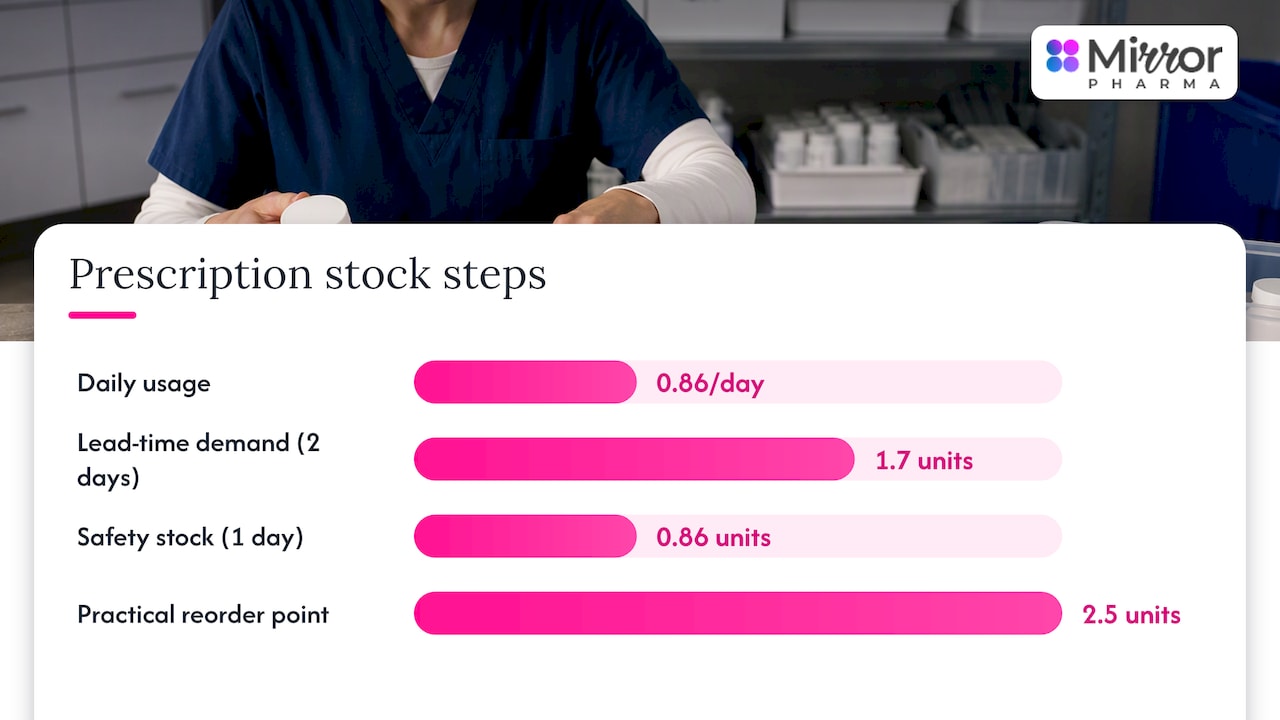
Worked example, a high-value prescription item: say a clinic administers a typical weekly usage of treatments with a short supplier lead time, and a minimal safety cover given the cost and expiry sensitivity of the product. Weekly usage of six is roughly 0.86 per day. Lead-time demand is 0.86 multiplied by 2, around 1.7 units, and one day of safety stock adds roughly 0.86 more, giving a reorder point close to 2.5, which in practice means holding two to three vials on hand rather than a box of ten. This is the opposite instinct to the needle example: round down and reorder more frequently, because the cost of holding an extra vial that expires unused is far higher than the inconvenience of a slightly tighter reorder cycle.
The rounding rule that falls out of these two examples is worth stating plainly: round up for cheap, stable consumables where stockouts are the main risk, and round down for expensive, expiry-sensitive prescription items where overstocking is the main risk. Applying the same rounding habit to both categories is one of the more common ways clinics quietly lose money.
Review cadence matters as much as the initial calculation. Usage patterns shift with seasonal demand, new treatment launches or staff changes, so par levels calculated in January can be wrong by June. A periodic review every few weeks for consumables and more frequent reviews for prescription items is a reasonable starting cadence for most single-site clinics, tightening to weekly if a supplier’s lead time is inconsistent.
Pro Tip: Recalculate par levels every time you add a new treatment to your menu, since a new service almost always changes usage patterns for existing consumables and injectables.
Managing compliance-critical items: controlled drugs, toxins and prescription stock
Prescription-only medicines and controlled drugs are where inventory decisions stop being purely financial and become regulatory. Care Quality Commission guidance advises keeping running balances of controlled drugs and holding only minimal but adequate quantities to meet normal patient demand, with prescribers expected to limit prescriptions of certain schedule drugs to amounts that meet clinical need, commonly limited to supply for about one month, and to record any justified exceptions.
That guidance has direct implications for how much stock a clinic should hold. It is not a suggestion to stockpile “just in case”: it is a steer towards holding the smallest quantity that keeps treatments running smoothly, backed by paperwork that shows why any larger holding exists. Practically, that means:
- Keep a running balance for every controlled drug, updated at the point of use, not reconstructed at month end.
- Assign a named responsible person for stock counts and reconciliation, so accountability does not drift between staff members.
- Document any holding above routine limits with a clear clinical justification, rather than leaving a gap for an auditor to question.
- Monitor expiry dates on a fixed schedule, since compliance-critical stock is often also the most expensive to write off.
- Restrict physical and system access to controlled and prescription items, recording who accessed stock and when.
The CQC’s emphasis on documented stock counts and expiry monitoring also affects par level maths directly. Because you are deliberately holding a minimal quantity, your safety stock buffer for these items should be small and reviewed often, rather than large and left untouched. A wider buffer might reduce the risk of running short, but it increases the audit burden and the financial exposure if stock expires or goes unaccounted for.
Inventory turnover is a useful lens here, even though this is fundamentally a compliance question. A clinic that holds the minimum justified quantity of a controlled drug and reorders frequently will show a high turnover rate for that line, which is exactly the pattern regulators and finance teams both want to see: stock moving quickly, not accumulating.
Storage conditions add another layer. Prescription items with strict temperature or light requirements need dedicated, monitored storage, and any deviation from that storage needs to be recorded and, where appropriate, the affected stock withdrawn from use rather than kept “just in case.” Building that discipline into daily routine, rather than treating it as an occasional audit exercise, is what keeps both patient safety and stock levels under control at the same time.
Expiry management and rotation strategies to reduce waste
Even well-calculated par levels fail if stock is not rotated properly, and expiry write-offs are one of the more avoidable costs in an aesthetic clinic. NHS Specialist Pharmacy Service guidance sets out a practical process: assess all clinical-area stock, establish how long it will realistically last, identify anything approaching its expiry date, and decide whether to move it into active use or wind it down before it becomes unusable.
The core rotation protocol translates well to a clinic setting:
- Identify near-expiry stock on a fixed schedule, not only when someone happens to notice a date on a box.
- Rotate near-expiry items into high-usage treatment rooms first, so they are used before slower-moving stock elsewhere.
- Replenish emergency kits and procedure trays with longer-dated stock, keeping the freshest supply where it is used least often.
- Track “hidden” stock, including items in staff bags, reception drawers or rarely opened cupboards, since these locations are where near-expiry stock most often gets missed.
That last point matters more than it sounds. NHS SPS guidance is explicit that hidden stock in locations like emergency kits needs to be included in routine audits, precisely because it sits outside the normal flow of daily use and is easy to forget until it is already out of date.
There is also a structural decision to make: centralise stock in one storage point with a single owner, or decentralise it across treatment rooms for convenience. Centralisation gives better visibility and makes audits faster, since one person can see the full picture at a glance. Decentralisation speeds up treatment room turnaround but multiplies the number of places expiry dates need checking, and it is the model most likely to hide a forgotten box of near-expiry filler behind a stack of towels. For most single-site clinics, a centralised main store with small, frequently restocked satellite points in each treatment room strikes a workable balance.

When stock does expire, the disposal process needs to be as documented as the ordering process. Record what expired, the quantity, the batch number, and the disposal method, and keep that record with the same rigour as your purchase records, since it forms part of the evidence that your stock control system is working rather than just reacting.
Pro Tip: Put a laminated expiry-check card on every emergency kit and procedure tray, with the earliest expiry date in the kit written in marker pen, so a single glance tells staff whether that kit needs attention.
Inventory KPIs and financial checks clinics should monitor
Stock decisions are financial decisions, and a handful of metrics tell you whether your current approach is working before it shows up as a cash flow problem. Inventory turnover is a widely used financial metric across retail and healthcare settings, and tracking it regularly helps a clinic avoid tying up working capital in slow-moving, high-value items.
Inventory turnover measures how many times you sell through and replace your stock over a given period. It is calculated by dividing the cost of goods used in that period by the average value of stock held. A high turnover rate for a category generally means stock is moving quickly and capital is not sitting idle, while a low turnover rate is a signal to investigate, whether that means the product is overstocked, falling out of favour, or simply ordered in batches that are too large.
Days of stock converts that turnover figure into something more intuitive: roughly how many days your current stock would last at typical usage rates. It is useful for spotting both extremes quickly, whether a product is dangerously close to running out or sitting on the shelf for months.
Holding cost captures what it actually costs to keep stock on hand, beyond the purchase price. This includes tied-up capital, storage space, insurance, and the risk of expiry or damage. For high-value prescription items, holding cost is often the single biggest argument for smaller, more frequent orders rather than bulk purchasing.
Practical trigger levels to watch:
- Rising days of stock on a high-value line signals it is time to trim the next order rather than repeat the usual quantity.
- Falling turnover on a specific category is worth investigating before it becomes a write-off.
- A pattern of emergency reorders on the same SKU points to a par level set too low, not just bad luck.
- A growing gap between total stock value and monthly usage value is an early warning that capital is accumulating in the stockroom rather than moving through it.
These KPIs should feed directly back into reorder frequency and batch size. A category with high turnover and stable demand can usually run on larger, less frequent orders without much risk. A category with low turnover, high value or tight expiry windows should move the other way: smaller orders, placed more often, even if that means a marginally higher unit cost. That trade-off, chasing turnover over unit discounts, is the financial backbone of a sound stock policy for anything expensive or expiry-sensitive.
Adjusting stock for seasonality and changing service mix
Demand for aesthetic treatments is not flat across the year, and treating every month like every other is one of the quicker ways to either run short during a busy period or sit on excess stock once it passes. Seasonal patterns in aesthetics are genuine and largely predictable: pre-summer bookings for body contouring and skin treatments, busy periods such as the run-up to holidays increase demand for facial treatments, and periods around graduations, weddings or holidays that shift demand towards specific services.
The right response is a temporary staging plan, not a permanent increase in baseline stock. Building a seasonal buffer that you deliberately wind down afterwards keeps working capital from getting stuck in stock you no longer need once the season passes.
A practical staging approach looks like this:
- Forecast 6 to 8 weeks ahead of a known seasonal peak, using last year’s booking data or, for a new service, early enquiry volume as a proxy.
- Increase par levels temporarily for the specific products tied to that demand, rather than raising stock across the board.
- Confirm supplier lead times before the peak begins, since delivery delays are far more damaging in a high-demand window than in a quiet one.
- Communicate expected volume increases to your supplier in advance, particularly for prescription items that may need longer processing or verification.
- Wind stock back down to standard par levels once the peak passes, rather than leaving elevated levels in place by default.
The same logic applies when you add a new treatment to your service mix rather than a seasonal spike. A new service usually needs a short period of higher safety stock while you learn its real usage pattern, followed by a return to standard par-level calculations once a few weeks of genuine data are available. Treating a new launch with the same par level as an established, well-understood service is a common way to either under-supply the first few weeks of bookings or over-order based on optimistic projections that do not materialise.
Systems, processes and team roles that make inventory work
The method matters less than the discipline behind it, but the method does set a ceiling on how much discipline is realistic. Manual stock cards work for a very small clinic with a handful of SKUs, but they rely entirely on someone remembering to update them at the point of use, which is where most manual systems quietly break down. Spreadsheets are a step up, giving you calculation and trend tracking, but they still depend on manual entry and are easy to let slip during busy weeks. Dedicated inventory software, whether standalone or built into a clinic management platform, adds automated reorder alerts, expiry tracking and audit trails without relying on someone’s memory.
The upgrade trigger is usually volume and risk, not size for its own sake: once a clinic is managing multiple prescription lines with strict expiry and compliance requirements, the audit trail that software provides becomes worth more than the cost of setting it up.
Whatever the system, a consistent routine keeps it accurate:
- Daily: update usage against stock records at the point of use, and flag any discrepancy immediately rather than at month end.
- Weekly: check reorder points against current stock levels and place orders for anything approaching its trigger.
- Monthly: reconcile physical counts against system records, review KPI trends, and check upcoming expiry dates across all locations, including hidden stock.
- Quarterly: review par levels and safety stock assumptions against actual usage data from the previous quarter.
An audit-ready clinic keeps that routine documented, with a named owner for stock reconciliation and a clear record of who has access to controlled and prescription items. Traceability, meaning the ability to show exactly which batch of a product was used on which date, is the thread that connects daily stock management to compliance readiness: if you can produce that trail instantly, an audit becomes a formality rather than a scramble. A practical playbook for inventory visibility covers batch traceability and replenishment routines in more depth for clinics building this out for the first time.
Pro Tip: Set expiry alerts at 90, 60 and 30 days before a batch expires rather than a single warning, giving you three separate chances to rotate or use the stock before it becomes a write-off.
How a trusted supplier can help with procurement and delivery
A supplier’s reliability is itself a form of stock control. Short, consistent lead times and clear order cut-off windows let a clinic hold less safety stock with confidence, because the gap between placing an order and receiving it is small and predictable. Batch traceability from the supplier side also feeds directly into the audit trail a clinic needs for compliance-critical items, since a clear record of which batch arrived when makes reconciliation far faster.
A trusted supplier can provide qualified practitioners with dermal fillers, anti-wrinkle treatments, IM/IV vitamins, weight-loss products, polynucleotides, skin boosters, fat-dissolving injectables, needles and consumables, with extended order cut-off times designed to support reliable next-stage delivery and practitioner verification built into the ordering process.
Some practical ways this fits into the calculations covered above:
- Extended cut-off windows give clinics more flexibility to place a same-day reorder once a KPI trigger, such as rising days of stock, flags that a category is running low.
- Practitioner verification at account level means reordering routine items does not require re-submitting credentials each time, which keeps the weekly reorder routine fast.
- A dedicated ordering process across multiple product categories lets a clinic consolidate consumables, injectables and prescription items through fewer supplier relationships, simplifying the traceability records needed for audits.
For a clinic applying the par-level and safety-stock method described earlier, a supplier with dependable lead times is what makes a tighter, lower-risk reorder point realistic in the first place, rather than something to be padded with extra buffer stock “just in case.”
What I would check first in a clinic’s stock cupboard
The clinics that get into trouble with stock rarely have a dramatic failure. It is usually a slow drift: par levels set once, at launch, and never revisited as the treatment menu grew or the booking pattern shifted. A year later, the stockroom holds a strange mix of overstocked, half-forgotten prescription lines and consumables that run out every other week, and nobody quite remembers why either happened.
If I were auditing a clinic’s inventory in its first 30 to 90 days, the priority order would be: first, pull every hidden stock location, meaning emergency kits, staff bags and rarely opened cupboards, and check expiry dates against what the main system shows. Second, separate compliance-critical items from everything else and confirm a running balance and a named responsible person exist for each. Third, recalculate par levels for the three or four highest-volume SKUs using real usage data from the last quarter rather than whatever number was set when the clinic opened.
None of that requires new software or a bigger budget. It requires someone treating stock control as a weekly discipline rather than a task that gets done when a shelf looks empty. The clinics that do this well are not the ones with the most sophisticated systems. They are the ones where somebody owns the problem.
— Rizwan
Supporting your clinic’s stock needs with a dedicated supplier
Running a tighter, better-calculated stock policy is only half the equation. The other half is having a supplier that does not force you to hold extra buffer stock just to feel safe. A trusted supplier provides dermal fillers, anti-wrinkle treatments, IM/IV vitamins, weight-loss products, polynucleotides, skin boosters and fat-dissolving products, alongside needles and consumables, to qualified practitioners, with extended order cut-off times and practitioner verification built into the ordering process.
For a clinic working to the par-level method set out above, that combination matters in three concrete ways:
- Shorter, more predictable lead times support the smaller, more frequent reorder pattern recommended for high-value prescription items.
- Extended cut-off windows mean a stock alert flagged in the afternoon can still often be turned into a same-day order.
- A single verified account across product categories simplifies the reordering routine for consumables, injectables and prescription lines alike.
Qualified practitioners can review current dermal filler, toxin and consumable ranges directly through the Mirror Pharma shop to see how a more responsive supply chain fits into their own stock policy.
Sources
- GP mythbuster 28: Management of controlled drugs – Care Quality Commission
- Managing expired stock and decommissioned products – NHS SPS
FAQ
How much does it cost to open an aesthetic clinic?
Start-up costs vary widely depending on location, premises, equipment and the range of treatments offered, and no single figure applies across the industry. A realistic budget is best built from itemised quotes for premises, equipment, training, insurance and initial stock, rather than a generic industry average.
Is the aesthetics industry saturated?
Demand for aesthetic treatments has grown steadily and competition varies significantly by region and treatment type, so “saturated” is not a fair description everywhere. A clinic’s viability depends more on service quality, location and specialisation than on a fixed level of market saturation.
How much profit do you make from Botox?
Profit margins on botulinum toxin treatments depend on the clinic’s pricing, supplier costs, wastage rates and how efficiently vials are used across bookings, so there is no single reliable figure to quote. Clinics that manage vial usage, expiry and par levels tightly, as outlined above, generally protect their margin better than those that overstock or under-book relative to their vial size.
Do I need a licence for aesthetics?
Requirements depend on the specific treatment and vary by region and professional body, and prescription-only treatments such as botulinum toxin must be prescribed and administered by an appropriately qualified and registered prescriber. Practitioners should confirm current requirements with the relevant professional and regulatory bodies for their own qualifications and location before offering any treatment.
How often should a clinic review its stock levels?
Periodic reviews every few weeks for routine consumables, with more frequent checks for compliance-critical and prescription items given their cost and regulatory requirements, are advisable. Reviews should also be triggered by any change in service mix, seasonal demand or a run of emergency reorders on the same product.