

Before you place a single order, confirm four things: a valid wholesale dealer’s licence (WDA(H)) or GPhC registration, a named Responsible Person with genuine hands-on experience, documented Good Distribution Practice covering cold chain and transport, and full batch traceability back to the manufacturer. If any one of those is missing or unverifiable, don’t buy. This is for licensed practitioners only, and the checks below explain exactly how to run each one.
TL;DR:
- Suppliers must hold a valid wholesale dealer’s licence (WDA(H)) or GPhC registration and have a responsible person with practical license-related experience.
- Cold chain validation requires suppliers to provide tested storage and transport documentation, with temperature readings checked upon delivery and logged for traceability.
- Price discrepancies, packaging inconsistencies, and direct manufacturer verification are key signs of counterfeit or diverted stock.
- Every order should include invoice details, batch documentation, and lot-to-patient tracing, with immediate quarantine if any discrepancies or breaches occur.
- Transparency in sharing licences, batch info, and recall procedures is the main indicator of a trustworthy supplier, and accounts are limited to licensed practitioners with credential verification.
Table of Contents
- What to look for in an aesthetics injectable supplier: licences and the Responsible Person
- What proof should you demand for cold chain and transport?
- How do you spot counterfeit or diverted injectable stock?
- What documentation should every order include?
- A step-by-step supplier vetting and receiving checklist
- Why transparency separates a genuine supplier from a risky one
- How to order from Mirror Pharma as a verified practitioner
- Sources
- FAQ
What to look for in an aesthetics injectable supplier: licences and the Responsible Person
A wholesale dealer’s licence, known as WDA(H), is the legal foundation of any injectable supply relationship. Under the Human Medicines Regulations 2012, it’s an offence to distribute medicinal products by wholesale dealing without one, and distribution has to happen from premises named on that licence. If a supplier can’t produce a licence number you can check, walk away.
Where the supplier operates as a pharmacy, GPhC registration matters too, but check that retail supply and wholesale dealing are kept operationally separate. A pharmacy selling to the public and wholesaling to clinics under the same stock and paperwork is a compliance problem waiting to surface.
The Responsible Person named on the licence isn’t a formality. Government guidance for WDA(H) holders expects them to have at least a year’s practical experience in licence-related activities, and to be genuinely accountable for GDP compliance, not just named on a document somewhere.
Practical steps before your first order:
- Ask for the WDA(H) or GPhC number directly and cross-check it yourself rather than trusting a screenshot.
- Request the name and experience summary of the Responsible Person.
- Ask for the quality manual or SOP index, even a contents page tells you whether one exists.
- Confirm premises listed on the licence match where stock is actually held and dispatched.
- Check the MHRA’s guidance on applying for wholesaler licences if you’re unfamiliar with what a genuine licence document should contain.
A supplier confident in their compliance will hand this over without friction. Hesitation is itself a data point.
What proof should you demand for cold chain and transport?
Temperature mapping means the supplier has physically tested their storage units and vehicles across seasons and load conditions to prove they hold the required range consistently, not just once, on a good day. Transport validation is the equivalent exercise for the journey between warehouse and your clinic door. Both should exist as documents, not verbal reassurance.
Ask for:
- A recent temperature mapping report for the storage facility.
- The cold-chain SOP that governs picking, packing and dispatch.
- Evidence the courier or in-house fleet uses validated refrigerated transport, not just an insulated bag and hope.
On arrival, open the box before you sign anything urgent onto the shelf. Check the temperature indicator or data logger reading, log it against the delivery note, and reject stock immediately if the indicator shows a breach. Applicants for WDA(H) status are expected to have contingency plans precisely for this scenario, so a credible supplier will have a named contact for temperature deviation queries, not a generic customer service inbox.
Pro Tip: Keep a simple receiving log next to your fridge, one line per delivery with date, courier, temperature reading and signature. It takes ten seconds and becomes invaluable if you ever need to trace a deviation back to a specific shipment.
How do you spot counterfeit or diverted injectable stock?
Price is usually the first tell. A batch priced significantly below market prices is a common warning sign reported in industry coverage of counterfeit aesthetic products, because legitimate manufacturers and authorised distributors rarely apply deep discounts on regulated stock.
- Compare the price against at least two other authorised sources before assuming a bargain is genuine.
- Inspect packaging closely: check spelling on the box and leaflet, verify any hologram or QR code scans correctly, and confirm the lot number and expiry date match exactly between outer packaging, inner vial, and accompanying paperwork.
- Call the manufacturer or the authorised distributor listed on their website and quote the lot number directly, most will confirm authenticity within minutes.
- If anything doesn’t check out, quarantine the stock immediately, photograph it, keep every document, and report it to both the manufacturer and the MHRA rather than simply returning it quietly.
Diverted stock, product that’s genuine but has left the authorised supply chain through grey channels, is harder to spot than outright counterfeits because the packaging often looks correct. Provenance verification through the manufacturer is the only reliable check.
What documentation should every order include?
Every delivery needs to arrive with an invoice showing the supplier’s licence details, the batch or lot number, expiry date, and paperwork confirming cold-chain handling during transit. Missing any of these on a regulated injectable is a reason to query the order before it reaches your treatment room.
Beyond the paperwork on the box, ask your supplier upfront about their quality agreement, recall procedure and returns process. A supplier that can’t describe how they’d handle a manufacturer recall hasn’t thought it through, which tells you plenty about their audit readiness generally.
- Request a written quality agreement or at least a summary of recall and returns terms.
- Keep every invoice and batch certificate on file, not just the ones for high-value orders.
- Log incoming lot numbers against patient notes at the point of treatment, not retrospectively.
Industry guidance on verifying authentic supply chains consistently points to this lot-to-patient link as the single habit that makes recalls manageable rather than chaotic. If a batch is later recalled, you need to know within minutes which patients received it.
A step-by-step supplier vetting and receiving checklist
Use this sequence for every new supplier relationship and every incoming order:
- Before ordering: confirm the WDA(H) or GPhC licence number and check it independently.
- Ask for Responsible Person details and evidence of their practical experience.
- Confirm authorised distributor status directly with the manufacturer if the product is unfamiliar.
- Request SOPs covering storage, dispatch and cold chain.
- On delivery: inspect packaging integrity before signing.
- Check lot number and expiry match across outer box, inner vial and delivery note.
- Confirm cold packs are still cold and log the temperature reading.
- Quarantine immediately if anything looks inconsistent, don’t treat a patient with stock you haven’t cleared.
- After delivery: file all documentation and update lot-level inventory the same day.
- Record lot numbers against patient treatment notes for full traceability.
Why transparency separates a genuine supplier from a risky one
Transparency is the clearest behavioural signal you’ll get. Commentary on wholesale supplier vetting makes the point well: suppliers worth trusting share licence documents, batch paperwork and recall procedures before you have to ask twice.
The supplier positions itself as a provider of aesthetic products for healthcare professionals, offering extended order cut-off times to help practitioners manage client schedules. A supplier that proactively answers verification requests, rather than treating them as an inconvenience, is telling you something about how they’d handle a genuine problem. Only licensed practitioners may purchase prescription injectables, and any credible supplier will ask for that verification before your first order goes through.
— Rizwan
How to order from Mirror Pharma as a verified practitioner
The supplier provides prescription injectables and clinic consumables directly to licensed practitioners, with extended order cut-off times designed to accommodate urgent restocking around client appointments. Accounts generally require credential verification at setup, and professionals may request batch documentation or compliance evidence for products before or after purchase.
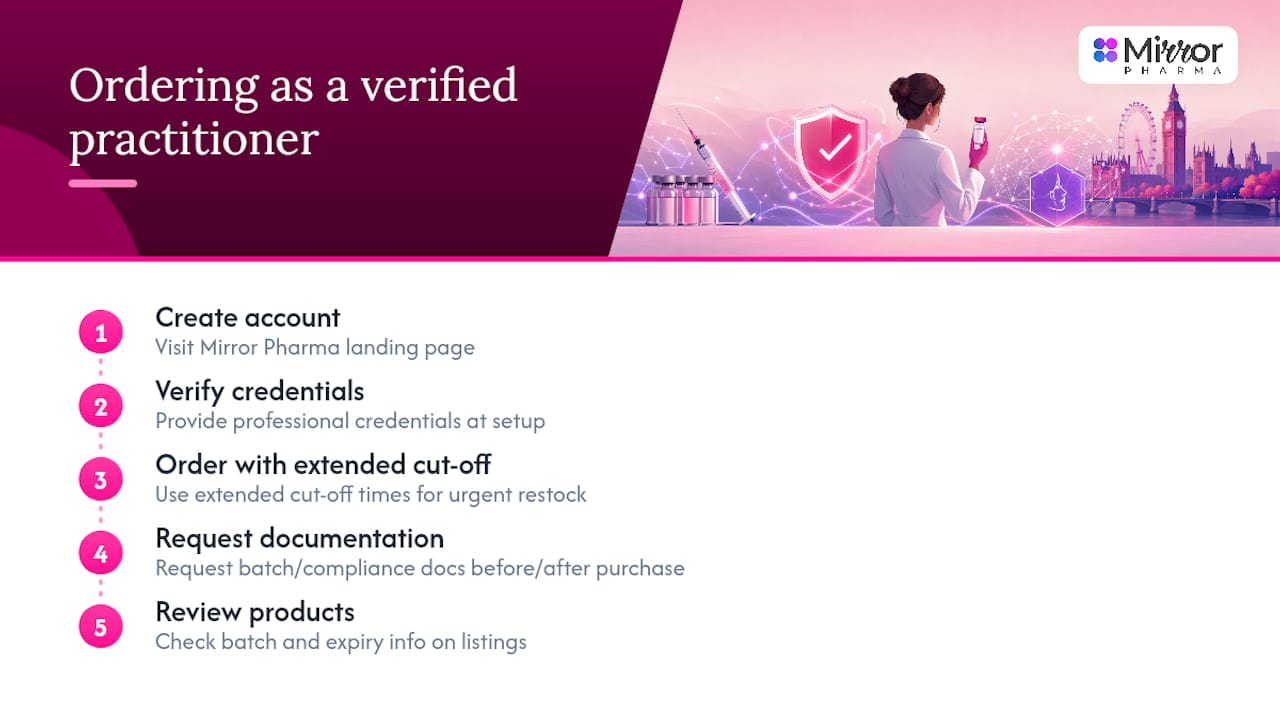
If you’ve read this far, you already know what to ask for. Visit the Mirror Pharma landing page to set up a verified account, or browse the product catalogue to see how batch and expiry information is presented on individual listings before you commit to an order.
Sources
- Notes for applicants and holders of a Wholesale Dealer’s Licence (WDA(H)) or Broker Registration
- The Human Medicines Regulations 2012 — regulation 18
- The Growing Problem Of Counterfeit Aesthetic Products
FAQ
What licence should an injectable supplier hold?
A wholesale dealer’s licence, WDA(H), is required for lawful wholesale distribution of medicinal products, and pharmacies must also hold GPhC registration if they supply at retail level.
What should I do if a delivery arrives with a temperature breach?
Reject the affected stock, log the reading against the delivery note, quarantine the items, and contact the supplier’s named point of contact for deviations immediately.
How can I tell if injectable stock is counterfeit?
Check for unusually low pricing, mismatched lot numbers or expiry dates between packaging layers, and verify the batch directly with the manufacturer or authorised distributor.
Do I need to keep records linking lot numbers to patients?
Yes. Logging lot numbers against patient treatment notes lets you trace stock quickly if a recall or safety concern arises later.
Can any clinic buy directly from Mirror Pharma?
The supplier provides products exclusively to licensed practitioners and clinics and generally verifies professional credentials during account setup before enabling purchases.