

For qualified aesthetic professionals, the two most widely used botulinum toxin type A preparations produce clinically comparable results when dosed correctly. The real differences that should drive product selection are onset speed, tissue diffusion, and unit-dosing conventions rather than raw efficacy. One preparation tends to diffuse more widely and act a little faster, while the other offers a longer-established dataset and tighter localisation for precision work. This guidance is intended for licensed practitioners and training academies, not for patient self-diagnosis.
TL;DR:
- Units are specific to each product’s assay and cannot be directly exchanged; converting doses requires area-specific titration and careful documentation.
- The more diffusive product tends to spread wider and act slightly faster, making it suitable for large, flat areas like the forehead, but riskier near sensitive regions such as the eyes.
- Clinicians should adjust dosing based on observed patient response rather than relying solely on standardized conversion ratios, especially when switching formulations.
- Retreatment should occur at least ten to twelve weeks apart to minimize the risk of antibody development and ensure consistent treatment response.
- Patient expectations should be managed with honest timelines, as effects typically start within 3 to 5 days and last around three to four months, with individual variation.
Table of Contents
- Botox vs Dysport: how botulinum toxin A actually works
- Botox vs Dysport: onset, diffusion and dosing differences
- Which facial areas suit each formulation
- Onset, duration and retreatment timing in practice
- Safety, side effects and contraindications to check before treatment
- Getting the dosage and conversion right
- Choosing a practitioner: a consultation checklist
- Mirror Pharma’s role in supporting practitioner practice
- A clinician’s take on product selection
- How Mirror Pharma supports registered practitioners
- Sources
- FAQ
Botox vs Dysport: how botulinum toxin A actually works
Both preparations belong to the same pharmacological class: botulinum toxin type A. They work by blocking acetylcholine release at the neuromuscular junction, producing temporary weakening of the targeted muscle. That mechanism is identical across licensed type-A products, which is why outcomes converge so closely when dosing is handled properly by an experienced injector.
Where the products diverge is in formulation and assay. Each manufacturer measures potency using its own proprietary biological assay, so a “unit” of one product is not the same biological quantity as a unit of another. This single fact drives most of the confusion clinicians encounter when switching between preparations or training new injectors.
- Units are assay-specific and non-interchangeable between manufacturers.
- Molecular size and the accessory proteins wrapped around the neurotoxin core differ, influencing diffusion and, according to some data, immunogenicity.
- All licensed botulinum toxin A products are prescription-only medicines and carry class-wide boxed warnings regarding the risk of toxin effects spreading beyond the injection site.
- Reconstitution volume, injection technique, and depth of placement all affect the clinical outcome independently of the product chosen.
The official prescribing information for one widely used preparation states explicitly that units are not interchangeable between products, a point that should sit at the centre of any practitioners’ dosing protocol. This is not a labelling formality. Miscalculating a dose conversion when switching a patient between preparations is one of the most common preventable errors in aesthetic practice.
Botox vs Dysport: onset, diffusion and dosing differences
The onset and spread profile of a botulinum toxin product often matters more in practice than any headline efficacy figure, because it dictates which anatomical areas suit which product and how quickly a patient can expect visible change.
Onset windows. Clinical reviews report that most botulinum toxin A products begin working within a few days, with one formulation tending to show visible effect slightly faster than others, sometimes by a day or two. That gap sounds trivial until a patient is booking treatment ahead of a wedding or a televised event, where even 48 hours of extra lead time changes the appointment schedule.
Diffusion behaviour. This is the area where the two most-discussed preparations genuinely part ways. One formulation is generally understood to diffuse more widely through tissue after injection, spreading further from the injection point than its counterpart. Wider diffusion can be an advantage over larger, flatter muscle groups such as the forehead, where even coverage matters more than pinpoint precision. It becomes a liability in areas demanding tight control, such as close to the orbital rim, where unwanted spread risks eyelid or brow ptosis.
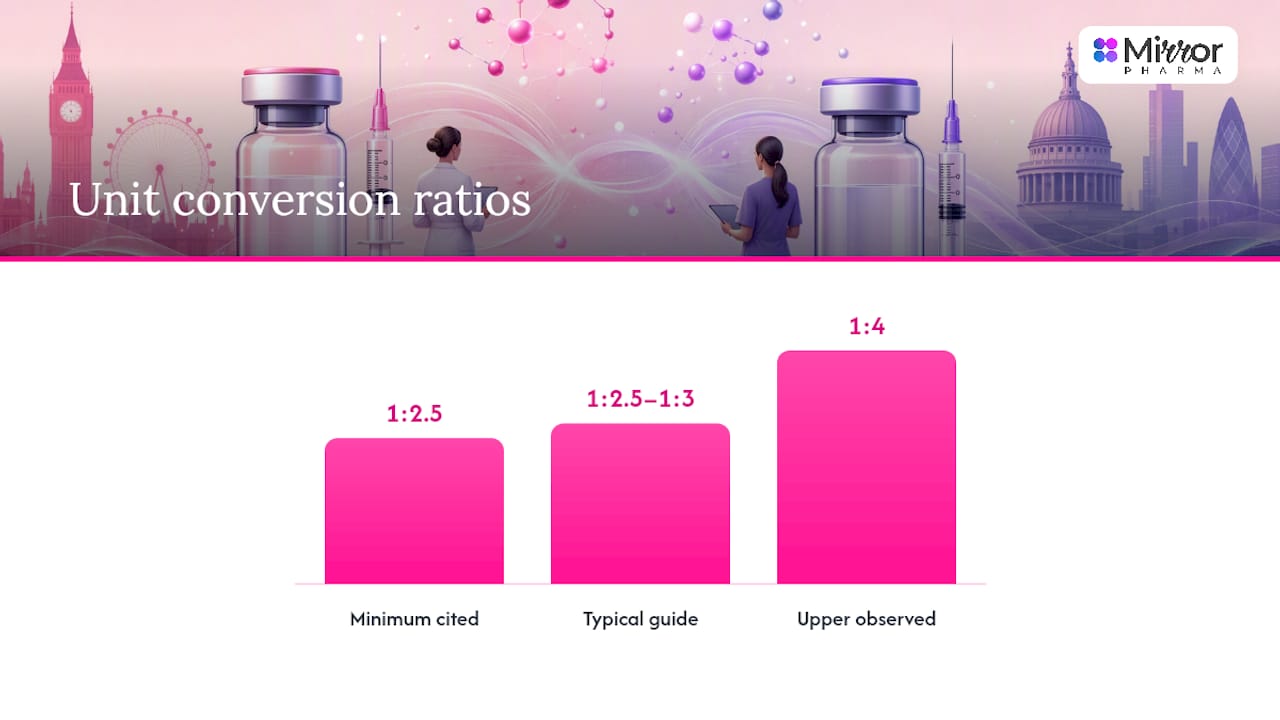
A double-blind randomised study comparing the two preparations in a hyperhidrosis model found broadly similar efficacy overall, but recorded greater local effect and more localised weakness with the more diffusive product when dosed at a 1:4 ratio. That trade-off, more spread and effect against more localised weakness, is the practical calculus injectors weigh area by area.
Unit conversion. Practical clinician guides commonly cite a conversion range of approximately 1:2.5 to 1:3 (units of the first-line product to units of the more diffusive one), though this figure is a starting point, not a formula.
- Conversion ratios vary between published studies and clinical experience, ranging from roughly 1:2.5 up to 1:4 depending on the muscle group and study design.
- Ratios should never be applied mechanically across an entire treatment plan; titrate by area and by observed patient response.
- Document the exact unit count, dilution, and product used at every visit so future conversions are based on that patient’s actual history, not a generic table.
Which facial areas suit each formulation
Area selection is where diffusion behaviour becomes a genuine clinical decision rather than a theoretical debate.
- Forehead and glabellar complex: larger, flatter muscle groups often tolerate, and can benefit from, a product with wider spread, since fewer injection points can achieve even coverage.
- Crow’s feet and periocular area: precision matters here because of proximity to the orbicularis oculi and the risk of eyelid or brow droop; many injectors favour more contained diffusion in this zone.
- Masseter (jawline slimming): a deeper, bulkier muscle that generally accepts broader diffusion well, making this a common off-label use where wider spread is not a drawback.
- Neck bands and platysma: thin overlying skin and proximity to swallowing muscles call for conservative dosing and precise placement regardless of product choice.
- Chin dimpling (mentalis): a small, discrete muscle where tight control reduces the risk of affecting the lower lip.
Several of these applications, particularly masseter reduction and neck banding, are used off-label in many practices. Off-label use is common in aesthetic medicine, but it raises the bar on informed consent: patients must understand that the treatment falls outside the product’s licensed indication, and that should be documented in the consultation record.
Many experienced injectors also combine formulations within a single patient, choosing a wider-diffusion product for the forehead and a more localised one for the periocular area in the same session. This is a matter of technique and comfort with each product’s spread characteristics rather than a fixed rule.
Onset, duration and retreatment timing in practice
Setting patient expectations correctly starts with an honest account of timelines. Most patients notice initial softening within 3 to 5 days, with peak effect typically reached between two and four weeks post-treatment. This window matters for counselling: a patient who expects Friday results from a Wednesday appointment before a Saturday event needs a different injection date, not a different product.
Duration is broadly similar across most licensed type-A products, with effects typically lasting around three to four months, though individual variation is considerable. Muscle mass, metabolic rate, injection depth, and treatment frequency all influence how long the effect holds. Patients who exercise heavily in the treated area, for instance, often report faster fade than sedentary patients treated at an identical dose.
Retreatment intervals deserve more attention than they typically receive in consultation. Treating too frequently, before the muscle has fully recovered function, is thought to raise the theoretical risk of antibody formation against the toxin, which can blunt response over time. Most practitioners default to a minimum interval of ten to twelve weeks between sessions, adjusting based on how quickly an individual patient’s effect wears off.
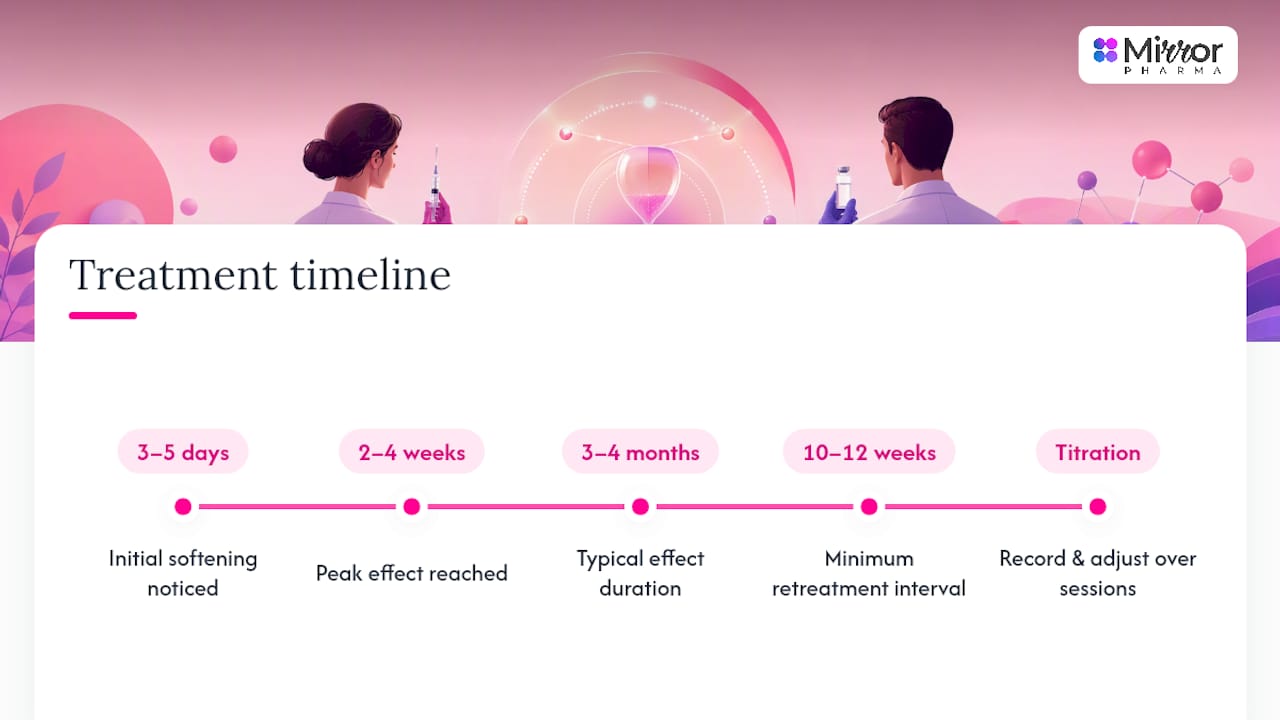
The practical approach many experienced injectors use is titration by observed response rather than a fixed formula: record the exact units used, the dilution, the injection points, and the patient’s reported duration of effect, then adjust the following session based on that specific record rather than a generic textbook interval. Over two or three sessions, this builds a personalised dosing map that outperforms any standard conversion table.
Safety, side effects and contraindications to check before treatment
Local reactions are common and mostly self-limiting. Bruising, mild swelling, and temporary redness at injection sites typically resolve within days, and can be minimised by avoiding blood-thinning supplements and alcohol in the 48 hours before treatment. Temporary unwanted muscle weakness, such as brow heaviness or eyelid droop, is the most frequently cited functional side effect and usually resolves as the treatment wears off.
Systemic risks are rare but serious, and every practitioner must be able to recognise and act on them immediately.
- Screen thoroughly before treatment. Confirm no known hypersensitivity to botulinum toxin or any formulation component, no neuromuscular disorder (such as myasthenia gravis or Lambert-Eaton syndrome), and no current infection at the proposed injection site.
- Document pregnancy and breastfeeding status. These are contraindications for elective aesthetic treatment across all licensed type-A products.
- Record concurrent medications. Aminoglycoside antibiotics and other agents that interfere with neuromuscular transmission can potentiate toxin effect and increase the risk of excessive weakness.
- Watch for red-flag symptoms post-treatment. Difficulty swallowing, breathing problems, or muscle weakness spreading well beyond the treated area require urgent medical assessment; the official medication guide explicitly warns that these systemic spread effects, though rare, have been reported.
- Confirm informed consent is documented, including discussion of off-label use where relevant, expected duration, and the fact that outcomes vary between individuals and are never guaranteed.
The Mayo Clinic’s overview of botulinum toxin injections is a useful patient-facing reference for explaining these risks in plain language during consultation.
Getting the dosage and conversion right
Dosage practicalities are where inexperienced injectors most often come unstuck, usually not through poor technique but through careless arithmetic when switching products. The commonly cited conversion range of roughly 1:2.5 to 1:3 is a reasonable starting reference, but it was derived from specific study populations and muscle groups, not a universal biological constant. Applying it blindly to a new treatment area or a patient with unusual muscle bulk invites either under-treatment or, more concerning, excess dosing.
Reconstitution technique matters just as much as the ratio itself. Both preparations require reconstitution with preservative-free saline, and once reconstituted, they must be stored under refrigeration and used within the manufacturer’s stated expiry window, typically within hours to a few days depending on the product. Using toxin beyond that window risks reduced potency and inconsistent results, which then gets misattributed to the product itself rather than to handling error.
Documentation should record the exact units drawn, the dilution used, the specific injection points and depths, and the patient’s subjective and observed response at follow-up. This record becomes the practitioner’s own conversion table over time, one built on actual patient data rather than a printed guideline. For clinics managing multiple formulations, keeping vial stock organised, whether BOTOX in 50-unit or larger 200-unit formats, alongside 500-unit dual-vial abobotulinumtoxinA, reduces the risk of reaching for the wrong vial mid-session.
Choosing a practitioner: a consultation checklist
For clinic managers auditing injectors, or for patients being referred within a network, a handful of qualification markers separate a properly trained practitioner from a risk.
- A recognised medical, dental, or nursing qualification plus documented, accredited training specifically in botulinum toxin injection technique.
- Evidence of ongoing continuing professional development in aesthetic medicine, not a single weekend course several years ago.
- Clear, itemised consultation notes covering medical history, current medications, prior toxin treatments (including product and dose), and known allergies.
- A written consent process that names the specific product, discusses off-label use where relevant, and sets realistic expectations about duration and variability.
- Visible hygiene standards: single-use needles, proper vial storage, and a clean treatment environment.
Watch for red flags during any consultation: an injector who cannot say which product or how many units they used last time, pressure to book multiple areas immediately, or reluctance to discuss contraindications in detail.
Pro Tip: Ask any prospective injector to walk you through their exact reconstitution protocol, dilution volume, and storage practice for the product they use. A confident, specific answer says more about their competence than any certificate on the wall.
Mirror Pharma’s role in supporting practitioner practice
The company supplies prescription anti-wrinkle vials and related consumables exclusively to verified healthcare professionals and aesthetic practitioners, with clinician support built into the ordering process. Stock ranges from smaller 50-unit dual vials to larger 200-unit formats, alongside consumables and skin-health resources such as the prescription treatment guidance for acne and anti-ageing.
Author bio and relevant case studies to be added by editorial.
This article is educational content intended for qualified aesthetic professionals, licensed practitioners, and training academies. It does not constitute medical advice for members of the public and should not be used to self-select or self-administer prescription treatments.
A clinician’s take on product selection
Product choice generates far more debate in training rooms than it deserves. The evidence across comparative studies keeps landing in the same place: injector skill and technique account for more variation in patient outcome than the specific formulation on the tray. Both preparations, dosed properly by someone who understands their diffusion profile, deliver comparable patient satisfaction.
Where practitioners get into trouble is impatience with documentation. Start conservatively with any new product, especially when converting a returning patient from one formulation to another, and write down exactly what you used. That record will serve you better than any conversion chart. Consult the screening checklist above before every first session with an unfamiliar patient.
— Rizwan
How Mirror Pharma supports registered practitioners
Mirror Pharma operates as a B2B supplier: every product listed, from botulinum toxin vials to dermal fillers and consumables, is available only to verified healthcare professionals and registered aesthetic practices, never to the general public. Verification checks are built into account registration, which keeps the supply chain restricted to trained injectors working within their scope of practice.
Practical features matter as much as product range. Mirror Pharma offers vial formats suited to different clinic volumes, from 50-unit options for smaller practices to 200-unit vials and 500-unit dual formulations for higher-throughput clinics, alongside strategically extended order cut-off times designed to keep delivery windows aligned with real clinic schedules. Clinician support is available for practitioners with questions about product handling or ordering logistics.
If you are a verified practitioner, visit Mirror Pharma to register an account and review the full professional product catalogue, including toxin vials, dermal fillers, and treatment consumables.
Sources
For further reading, these sources are among the most reliable references for prescribing and patient counselling:
- Dose‑equivalence trials and comparative studies (PubMed entry)
- DYSPORT prescribing information (DailyMed)
- Clinical review on botulinum toxin use (NCBI PMC)
- Mayo Clinic — botulinum toxin overview
- AestheticMedGuide — practical clinician comparison
- American Society of Plastic Surgeons — cost factors
This article is general information, not a substitute for advice from a qualified doctor. Consult a qualified healthcare professional about your own circumstances before acting on anything here.
FAQ
Which looks better, the more diffusive or the more localised formulation?
Neither produces a visibly superior result when dosed correctly by a skilled injector; comparative studies show broadly similar efficacy, with the main differences lying in onset speed and how the effect spreads through tissue rather than in final aesthetic outcome.
Why is one botulinum toxin product typically cheaper per unit than another?
Units are assay-specific and not interchangeable, so a lower price per unit does not mean a lower cost per treatment area; the American Society of Plastic Surgeons advises comparing total session cost rather than per-unit pricing for this reason.
Why are younger patients increasingly hesitant about preventative toxin treatment?
Growing public discussion around treatment reversibility, natural-looking results, and the desire to avoid frozen expressions has made some younger patients more cautious, which is exactly why thorough consultation and realistic expectation-setting matter more than ever for practitioners.
Does the more diffusive preparation last longer than its counterpart?
Duration is broadly comparable across most licensed type-A products, typically averaging around three to four months, with individual variation driven more by muscle mass, metabolism, and treatment frequency than by the specific product chosen.