

Anyone in the UK can report a suspected side effect or device fault to the MHRA today, and you do not need a medical background to do it. The Medicines and Healthcare products Regulatory Agency runs the Yellow Card scheme, the UK’s system for tracking safety problems with medicines, vaccines, devices, and other health products.
The fastest routes are:
- The online form at yellowcard.mhra.gov.uk
- The free Yellow Card app (Apple App Store or Google Play)
- Freephone 0800 731 6789
- FREEPOST or email for those without internet access
Whichever route you choose, one detail matters more than any other: the batch or lot number on the product packaging, or the device identifier if a piece of equipment is involved. It sounds like a small thing. It is often the difference between MHRA tracing a fault to a specific production run and a report sitting unresolved.
Key Takeaways
Reporting a suspected side effect to MHRA works best when the reporter submits promptly, includes the product’s batch number, and treats suspicion alone as sufficient grounds to file.
| Point | Details |
|---|---|
| Anyone can report | Patients and professionals both file through yellowcard.mhra.gov.uk, the app, or by phone, post, or email. |
| Suspicion is enough | MHRA does not require proof of causality before you submit a Yellow Card report. |
| Batch numbers matter most | Include the product’s batch or lot number, or a device’s UDI, wherever possible. |
| New medicines need extra vigilance | Report every suspected reaction to a newly licensed medicine, however minor. |
| MHRA won’t give clinical advice | Contact a GP, pharmacist, or NHS 111 for urgent health concerns, not the Yellow Card team. |
Table of Contents
- What the Yellow Card scheme covers and who should report
- When should you submit a Yellow Card report?
- How do I report a Yellow Card, step by step?
- What information should you include in your report?
- What happens after you submit a Yellow Card report?
- Yellow Card reporting for licensed practitioners: a governance checklist
- What the data actually tells us about Yellow Card reporting
- Sources
- FAQ
What the Yellow Card scheme covers and who should report
The Yellow Card scheme is the UK’s voluntary system for tracking suspected harm from health products, and MHRA is the body that runs it and decides what action follows. Its scope is wider than most people assume.
It covers:
- Prescription and over-the-counter medicines
- Vaccines
- Medical devices, including software, apps, and AI-driven tools now treated as device incidents
- Blood products
- E-cigarettes and refill containers
- Suspected falsified or counterfeit products
Both patients and healthcare professionals are expected to report, and the threshold for doing so is deliberately low. You do not need to prove that a medicine or device caused the problem. A reasonable suspicion is enough to submit a Yellow Card report, and MHRA states this explicitly in its own reporting guidance.
Some cases carry extra weight. Reports involving children, adults over 65, biological medicines (including biosimilars), and reactions with a delayed onset are all flagged as priorities, because these groups and patterns are harder to monitor through routine data alone.
When should you submit a Yellow Card report?
Timing depends on how serious the suspected reaction or fault is, and on whether the product is new or well established.
- Report immediately for serious suspected adverse drug reactions. This includes anything linked to hospitalisation, permanent disability, a birth defect, a life-threatening reaction, or death.
- Report every suspected reaction for newly licensed medicines, even mild ones, because the safety profile is still being built. New medicines carry a black triangle symbol for this reason.
- Report serious suspected reactions for established medicines, even ones already listed in the patient information leaflet. Known side effects still need tracking if they occur seriously or more often than expected.
- Report device incidents involving death, serious injury, or a malfunction that could have caused harm, including software errors or false readings from a connected device.
None of this replaces urgent medical care. If you are worried about a reaction happening right now, contact a GP, a pharmacist, or NHS 111 before or alongside filing a report. MHRA cannot give you clinical advice.
How do I report a Yellow Card, step by step?
Each reporting channel takes a slightly different path, but none of them should take more than a few minutes once you have the basics to hand.
- Start online at yellowcard.mhra.gov.uk. The site’s report guide first asks whether you are reporting as a member of the public or a healthcare professional, then tailors the questions that follow.
- Work through the guided fields. You will be asked for the product name, the suspected reaction or fault, dates, and any identifying numbers you have. Save what you can and finish later if you need to check something.
- Use the Yellow Card app for speed. Download it free from the Apple App Store or Google Play. It mirrors the online form but is quicker for reporting on the move, particularly useful in a clinic setting between patients.
- Call, post, or email if you prefer not to go online. The freephone line is 0800 731 6789, and printable reporting forms can be posted FREEPOST YELLOW CARD or scanned and emailed.
- Use clinical IT systems where available. Some practices report directly through integrated systems such as SystmOne, Vision, or specialist platforms like MiDatabank and Ulysses, which can pull patient data automatically and reduce duplicate entry.
Pro Tip: Keep the product packaging or device until your report is submitted. Batch numbers rub off boxes and get thrown away faster than people expect, and MHRA cannot trace a faulty lot without one.
What information should you include in your report?
A report with rich detail is far more useful to MHRA than a bare-bones one, and it usually takes only a few extra minutes to gather.
At minimum, include:
- Patient age and sex
- A clear description of the reaction or device fault, including when it started
- The outcome, whether resolved, ongoing, or requiring treatment
- The product’s batch or lot number, and its brand and generic name
- For devices, the UDI, catalogue number, and lot number where printed on the packaging
Beyond that, note any other medicines the patient was taking at the time, relevant medical history, and whether another clinician was involved in managing the reaction. Photographs of a skin reaction, a device fault, or damaged packaging can support your account meaningfully. Guidance from Yellow Card Centre Scotland notes that descriptive reports with identifiers attached speed up investigation considerably compared with vague ones.
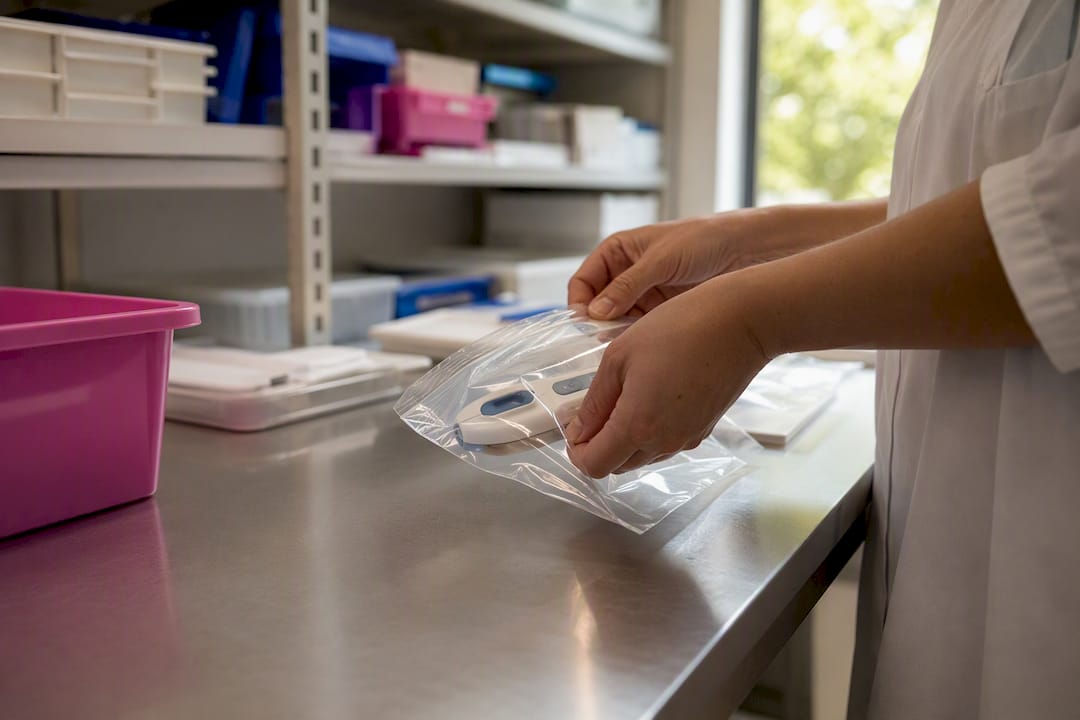
If a device is involved, keep it and its packaging where you safely can. Document who has handled it since the incident, particularly if legal or coronial involvement seems possible.
What happens after you submit a Yellow Card report?
Your report joins a much larger dataset, and MHRA looks for patterns across thousands of similar submissions rather than judging any single one in isolation.
- Signal detection. Analysts scan for clusters of similar reports linked to a product, a batch, or a device model that suggest a genuine safety issue rather than coincidence.
- Regulatory action where warranted. This can range from updated product information and safety alerts to field safety notices, restricted use, or in serious cases a product recall.
- Case studies published on the Yellow Card site show real examples where reporting patterns led directly to label changes or withdrawal, evidence that individual reports genuinely feed into national decisions, as MHRA’s own site sets out.
- Limited individual follow-up. MHRA may contact you for more detail on a serious report, but it will not usually provide personal clinical advice on your case, and investigations into a signal can take months rather than days.
Yellow Card reporting for licensed practitioners: a governance checklist
For qualified aesthetic professionals, a Yellow Card report is not a substitute for internal incident logging, and it is not a substitute for the other way round either. Clinic governance systems capture what happened locally; the Yellow Card scheme feeds a national surveillance picture that only works if practitioners actually submit to it.
A practical sequence for practitioners:
- Gather product identifiers (batch number, device UDI) before anything is disposed of
- Preserve the device or product packaging if a fault is suspected and safe to retain
- Log the incident in your own clinic records first, including staff involved and timeline
- Submit the Yellow Card report separately, even if you have already told the manufacturer
- Contact the supplier or manufacturer directly if a product fault looks batch-specific, since they may run their own investigation alongside MHRA’s
Licensed practitioners sourcing prescription-only medicines, devices, and consumables should work with verified UK suppliers who can support this kind of traceability. Mirror Pharma’s prescriber registration process is built around that compliance relationship, giving practitioners a documented supply chain to fall back on when a batch needs checking.
Pro Tip: Even something as routine as a batch of pre-injection swabs is worth noting by lot number in your clinic records. If a skin reaction turns out to be linked to a consumable rather than the injected product itself, that record is what narrows down the cause.
Sourcing consistently from a single, compliant supplier makes this kind of traceability far easier when something does go wrong. Mirror Pharma supplies UK aesthetic practitioners with verified anti-wrinkle treatment and dermal filler products alongside the consumables and infusion therapies used alongside them, each with clear batch documentation from the point of purchase. That paper trail is exactly what you need on hand the moment a Yellow Card report becomes necessary. Registered prescribers can review the full product range at mirrorpharma.co.uk.
What the data actually tells us about Yellow Card reporting
The gap in Yellow Card reporting is not awareness, it is confidence. Most practitioners know the scheme exists. What stops them filing a report is uncertainty about whether their case is “serious enough” or whether they have enough proof.
That hesitation is misplaced. MHRA’s own guidance removes the burden of proof entirely: a suspected link is grounds enough to report. Waiting for certainty before submitting is the single biggest reason good signals go missing from national data. If a clinician has already decided a reaction was “probably nothing,” they have usually made that call with less information than MHRA’s analysts have once thousands of similar reports sit alongside it.
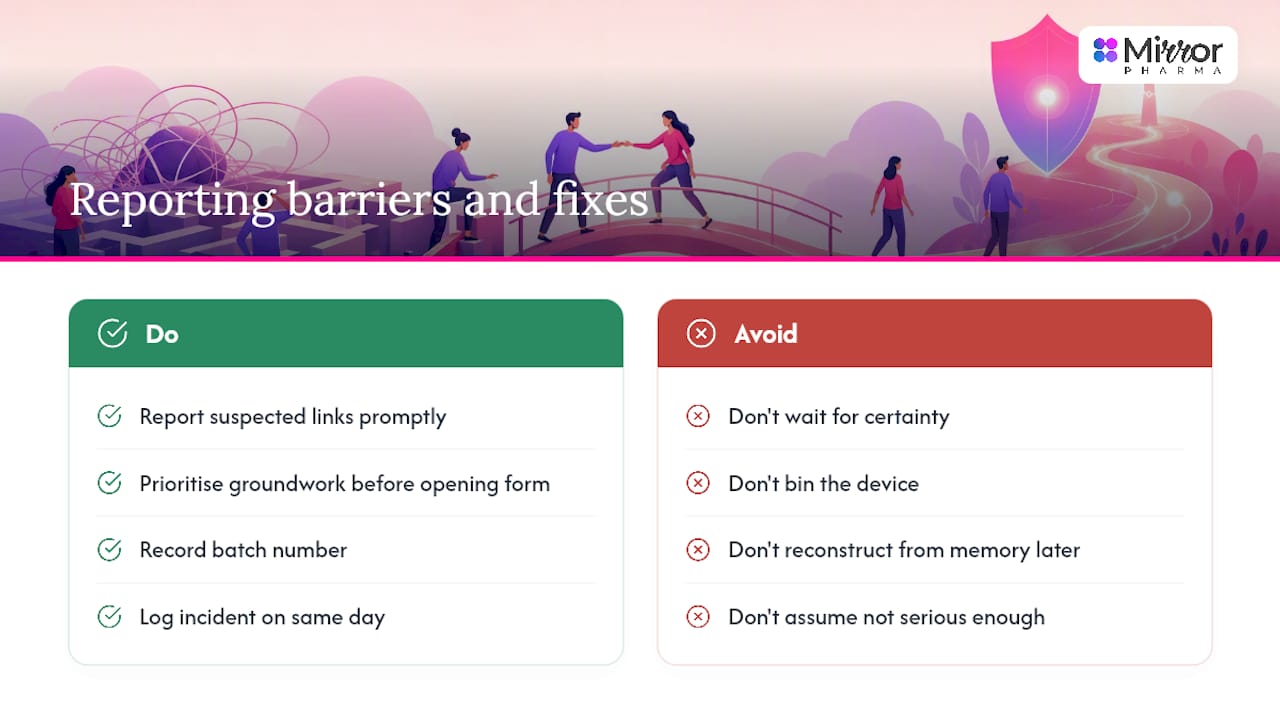
The conventional advice on this topic tends to focus heavily on the reporting form itself, how to fill it in, which box to tick. That is the easy part. What actually moves the needle is what happens before the form is opened: whether the batch number was written down, whether the device was kept rather than binned, whether the incident was logged in clinic records the same day rather than reconstructed from memory a week later. Prioritise that groundwork first. The form takes five minutes regardless.
Sources
- The Yellow Card scheme: guidance for healthcare professionals, patients and the public
- What to report to the Yellow Card scheme | Making medicines and medical devices safer
- Report guide | Making medicines and medical devices safer
FAQ
How do I report a Yellow Card?
Report online at yellowcard.mhra.gov.uk, through the free Yellow Card app, by calling 0800 731 6789, or by post or email using a printable form.
What is the MHRA Yellow Card scheme?
It is the UK’s voluntary pharmacovigilance system, run by the MHRA, for reporting suspected side effects and faults linked to medicines, vaccines, medical devices, blood products, and e-cigarettes.
When should I submit a Yellow Card report?
Report immediately for any serious suspected adverse reaction, such as hospitalisation or a life-threatening event, and report all suspected reactions to newly licensed medicines regardless of severity.
What needs to be reported to the MHRA?
Any suspected adverse drug reaction, vaccine side effect, medical device fault (including software and app-based devices), blood product issue, or suspected falsified product should be reported, based on suspicion rather than confirmed proof.
Do I need proof that a medicine caused my reaction?
No. MHRA asks reporters to submit suspected reactions, and explicitly states that no proof of causality is needed before filing a report.