
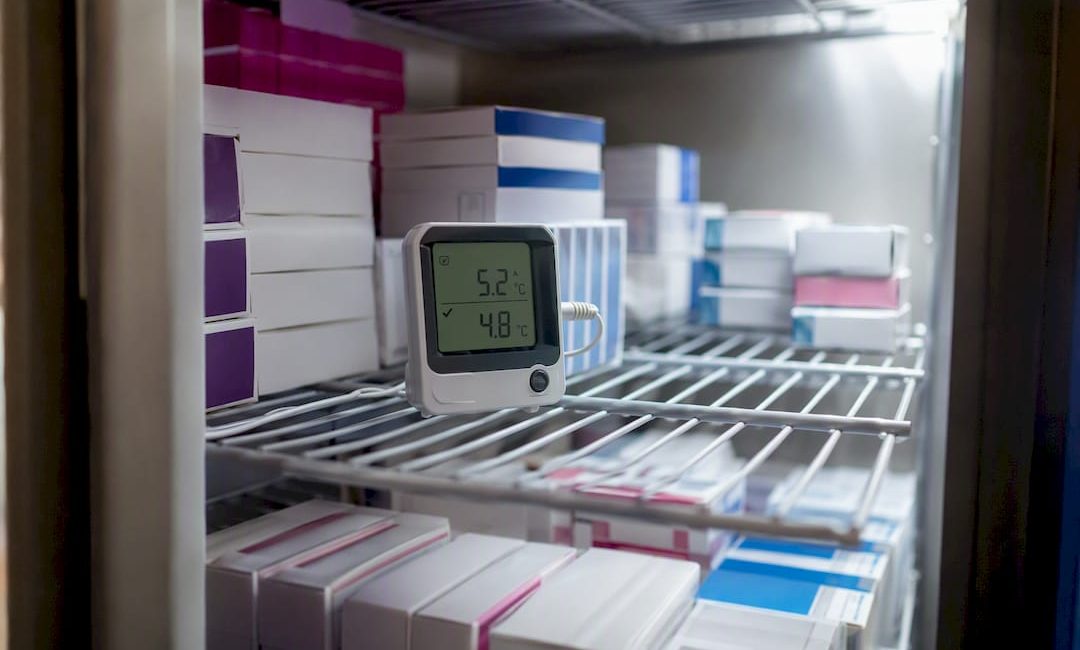
The correct storage range for medicines and vaccines requiring cold-chain conditions is +2°C to +8°C, with +5°C as the practical midpoint most services aim for. Check current, minimum and maximum readings daily, and more frequently if your unit has no min/max memory. Any reading outside this band means immediate quarantine, labelling, recording and escalation under your SOP. This guidance is for licensed practitioners and qualified care-home teams responsible for medicines storage.
Copy this into a handover sheet or SOP:
- Set point: +5°C, acceptable range +2°C to +8°C
- Record current, min and max temperatures once daily (or twice if no memory function)
- Any excursion: quarantine stock, label “DO NOT USE”, record time and duration, escalate per SOP
Key Takeaways
Cold-chain compliance for medicines and vaccines rests on holding +2°C to +8°C, recording readings daily, and acting immediately on any excursion.
| Point | Details |
|---|---|
| Target range | Store at +2°C to +8°C, aiming for a +5°C midpoint set point. |
| Daily recording | Log current, minimum and maximum temperatures once daily, or twice if no min/max memory. |
| Excursion response | Quarantine, label “DO NOT USE”, record duration, and escalate per SOP for longer excursions. |
| Equipment choice | Use forced-air pharmaceutical fridges with buffered probes, never domestic units. |
| Calibration cycle | Book annual calibration and probe verification, with certificates kept for audits. |
Table of Contents
- Why the +2°C to +8°C medical fridge temperature range matters
- What equipment keeps medical fridges within range?
- How often should staff check and record fridge temperatures?
- What to do if the fridge goes outside +2°C to +8°C
- How often should fridges and probes be calibrated?
- How should medicines be arranged inside the fridge?
- Where to source compliant fridges and monitoring systems
- Sources
- FAQ
Why the +2°C to +8°C medical fridge temperature range matters
Most refrigerated medicines and virtually all liquid vaccines depend on this narrow band to stay effective. Drift too warm and potency degrades faster than the expiry date suggests. Drift towards freezing and some products are ruined outright, with no way to reverse the damage.
Insulin is a familiar example: freezing destroys its structure, and once frozen it cannot be salvaged by rewarming. Many aluminium-adjuvanted vaccines behave the same way. The CDC’s guidance on immunobiologics confirms that liquid vaccines with an aluminium adjuvant permanently lose potency once frozen, even briefly.
That’s why services increasingly frame the target as +5°C rather than “somewhere between 2 and 8”. A midpoint set point gives you headroom in both directions, absorbing a door opening or a defrost cycle without tipping into unsafe territory, as outlined in the East of England Cold Chain Policy.
- Warmer than 8°C: accelerated degradation, often invisible until the medicine underperforms clinically
- At or below 0°C: irreversible damage for many injectables and vaccines
- +5°C set point: the safest operational buffer against both risks
What equipment keeps medical fridges within range?
Purpose-built pharmaceutical refrigerators, validated cold rooms for larger stockholders, and validated portable cool boxes for transport are the three categories worth considering. Each is designed around forced-air circulation, which is the feature that actually keeps temperature uniform.
Monitoring kit matters as much as the fridge itself. Look for a digital data logger (DDL) with a buffered or glycol-filled probe, continuous monitoring with remote alarms, a min/max display, and a battery-independent backup thermometer. The CDC Pink Book chapter on vaccine storage explains that buffered probes track the thermal mass of stored product rather than transient air temperature, which prevents false alarms every time the door opens.
Domestic fridges fail on both counts. They’re built to cycle temperature across a range, they lack forced-air systems, and single-compressor units commonly develop pronounced gradients between shelves, according to Specialist Pharmacy Service guidance. A domestic unit might read 5°C at the sensor while stock on the door shelf sits at 1°C.
A quick procurement checklist:
- Forced-air cooling, not passive convection
- Calibration certificate supplied at installation
- Remote or audible alarm for out-of-range temperatures
- Downloadable audit log with time-stamped records
How often should staff check and record fridge temperatures?
Daily monitoring is the baseline requirement, and the routine is simple enough to build into an opening shift task. Read the current, minimum and maximum temperatures at the start of each working day, then reset the min/max function so it captures a fresh 24-hour window.
If your fridge lacks a min/max display, care home refrigerated medicines guidance recommends checking twice daily, at the start and end of the working day, and recording both readings manually.
- Open the log at the start of shift and record date, time, current reading, minimum and maximum
- Reset the min/max function immediately after recording
- Note probe ID if more than one fridge is in use, plus operator initials
- If a reading falls outside +2°C to +8°C, record the action taken and sign it off
- File or upload the record where it can be retrieved for an audit
Sample log fields worth building into any template:
- Date and time of reading
- Current, minimum and maximum temperature
- Probe or fridge ID
- Operator initials and signature
- Action taken (if an excursion occurred)
Nominate a lead and a deputy for this task so cover during annual leave or sickness doesn’t create a gap. Most services retain temperature records for at least the length of a full audit cycle, often longer where vaccines are involved.
What to do if the fridge goes outside +2°C to +8°C
An excursion doesn’t automatically mean stock is ruined, but it does mean you stop using it until you know. The sequence matters more than speed.
- Check the reading against a second thermometer or probe to rule out a faulty sensor
- Note the time the excursion started and how long it lasted
- Physically inspect stock for signs of freezing (ice crystals, cracked ampoules) or overheating
- Move any at-risk stock to a validated fridge if one is available
- Quarantine the affected batch, keep the original packaging, and log lot numbers and expiry dates
Label quarantined stock clearly: “DO NOT USE. Temperature excursion [date/time]. Awaiting review.” Isolate it physically from usable stock so nobody reaches for it under pressure.
Guidance commonly treats short excursions under about twenty minutes as low risk; longer deviations usually warrant a formal cold-chain review, per care home guidance. Always check the manufacturer’s stability data or your local pharmacy lead before returning anything to use.
- Contact your local vaccine lead or supervising pharmacist first
- Escalate to the manufacturer if stability data isn’t held locally
- Document who was contacted, when, and what advice was given
How often should fridges and probes be calibrated?
Annual calibration of the fridge controller and annual verification of monitoring probes is the standard interval most services work to. High-risk settings, such as units storing large vaccine stockholdings, often justify more frequent checks.
- Book annual calibration with a competent contractor and request a certificate, not just a verbal confirmation
- Carry out temperature mapping when a new unit is commissioned, to find hot and cold spots before you rely on it
- Position the buffered probe in the location that best represents actual product temperature, based on that mapping, as described in CDC’s Pink Book chapter
- Allow stabilisation time after commissioning, defrosting, or a power interruption before trusting readings again
Keep calibration certificates and service records in a single, accessible file. CQC and audit visits routinely ask for this evidence, and a fridge that’s “probably fine” without paperwork is a finding waiting to happen.
How should medicines be arranged inside the fridge?
Keep stock in its original packaging so batch numbers, expiry dates and product-specific storage instructions stay visible at a glance. Group by product type rather than by arrival date, which makes stock rotation and expiry checks faster.
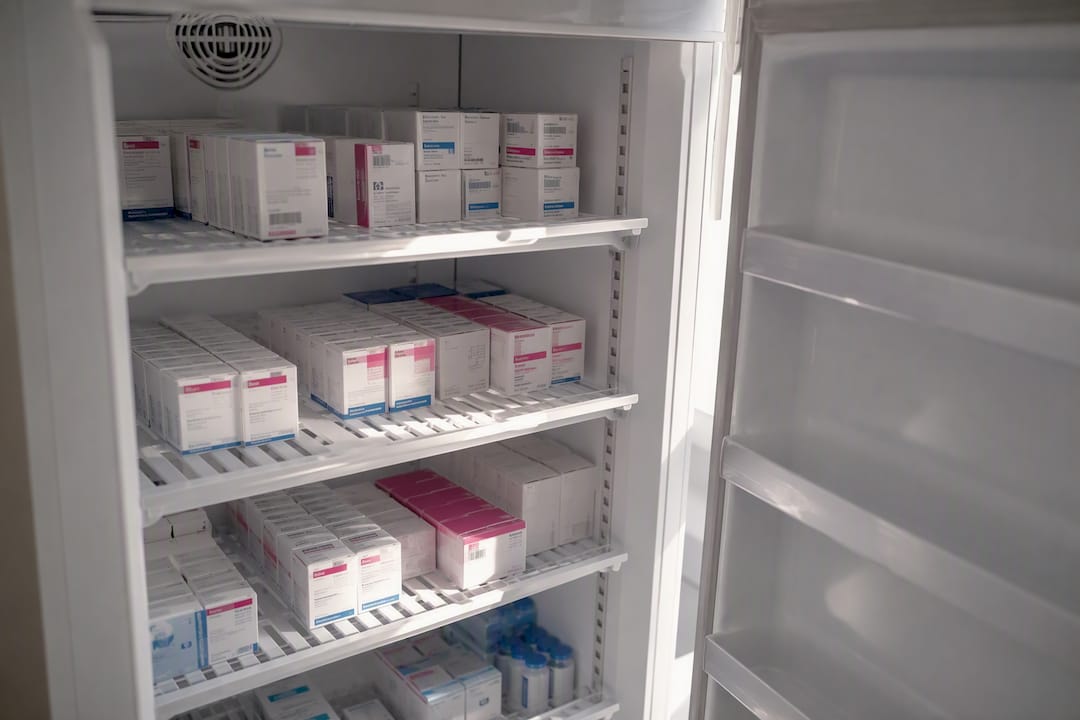
Avoid door shelves entirely for anything temperature-sensitive. Door storage sees the widest temperature swings in any fridge, domestic or pharmaceutical, simply from opening frequency. Keep stock centrally on shelves with gaps between packs so cold air can circulate properly.
Pro Tip: Nominate one person per shift as the only one who opens the medicines fridge. Fewer openings means fewer temperature spikes, and it makes it obvious who to ask if something’s out of place.
For transport, use a validated cool box with its own monitored probe, and keep time outside validated storage to the shortest window possible. Individual products can carry their own storage rules that override general advice, so always check the product information leaflet or SmPC before assuming standard guidance applies.
Where to source compliant fridges and monitoring systems
Three supplier categories matter here: medical refrigeration manufacturers, monitoring-system vendors, and independent calibration services. Few suppliers cover all three well, so many services mix and match.
Before ordering, ask whether the unit offers forced-air cooling, a remote alarm, downloadable data logging, and a calibration certificate at handover. A supplier who can’t answer these without checking isn’t the right one for regulated storage.
Questions worth putting to any supplier:
- What warranty and spare parts support is included?
- Can you provide validation or temperature-mapping data for this model?
- What are typical lead times for replacement units or parts?
- What evidence do you supply that would satisfy a CQC or audit visit?
Never substitute a domestic fridge, even temporarily, and always ask for mapping data rather than taking uniformity on trust. Products such as Amoxicillin capsules or Clarithromycin tablets don’t need refrigeration at all, which is worth checking before you assume every item on a delivery note belongs in the fridge.
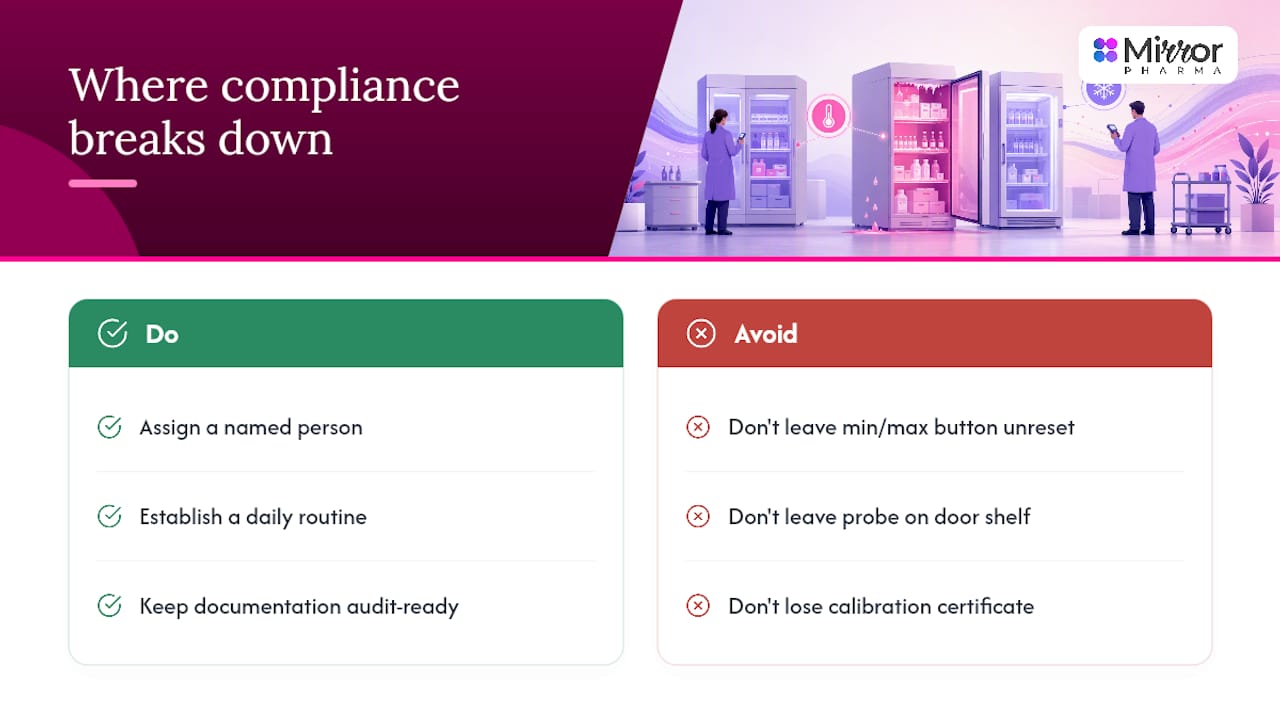
A practitioner’s view on where fridge compliance actually breaks down
The failures I see repeated most often aren’t dramatic. It’s a min/max button never reset, a probe left on a door shelf, a calibration certificate nobody can find when the auditor asks. None of that requires expensive kit to fix, just a named person and a habit that survives staff turnover. Get the daily routine right and the rest of cold-chain compliance mostly takes care of itself.
Mirror Pharma supplies prescription and non-prescription products, including vitamins, injectables and consumables, to registered practitioners who need reliable, verified stock. If your practice is sourcing temperature-sensitive medicines or building out a fully compliant clinic setup, register as a prescriber or browse the Mirror Pharma shop for products supplied with the documentation your audits will ask for.
Sources
For SOP templates and policy detail, consult the East of England Cold Chain Policy, SPS NHS guidance on refrigerator storage, and CDC’s vaccine storage and handling resources for downloadable logs and excursion checklists.
This article is general information, not a substitute for advice from a qualified doctor. Consult a qualified healthcare professional about your own circumstances before acting on anything here.
- East Cold Chain Policy V9.1 (2026)
- Care homes — refrigerated medicines guidance (Bucks Healthcare)
- Storage and Handling of Immunobiologics | Vaccines & Immunizations | CDC
- Using a refrigerator or freezer to store medicines (SPS NHS)
FAQ
Should I set my fridge to 3°C or 4°C?
Neither extreme is ideal on its own; most guidance recommends setting the fridge to around +5°C, which sits centrally within the +2°C to +8°C range and gives buffer against both freezing and overheating.
What happens if you store medicines above 25°C?
Storage above the manufacturer’s stated limit accelerates chemical degradation, meaning the product may lose potency well before its printed expiry date, even if it looks unchanged.
What is the difference between a medical fridge and a normal fridge?
A medical fridge uses forced-air cooling to keep temperature uniform throughout, plus alarms and data logging, whereas a domestic fridge cycles temperature and often develops gradients between shelves, according to SPS NHS guidance.
What is the ideal temperature range for a medication fridge?
The ideal range is +2°C to +8°C, with +5°C commonly used as the practical set point for stability and safety margin.