
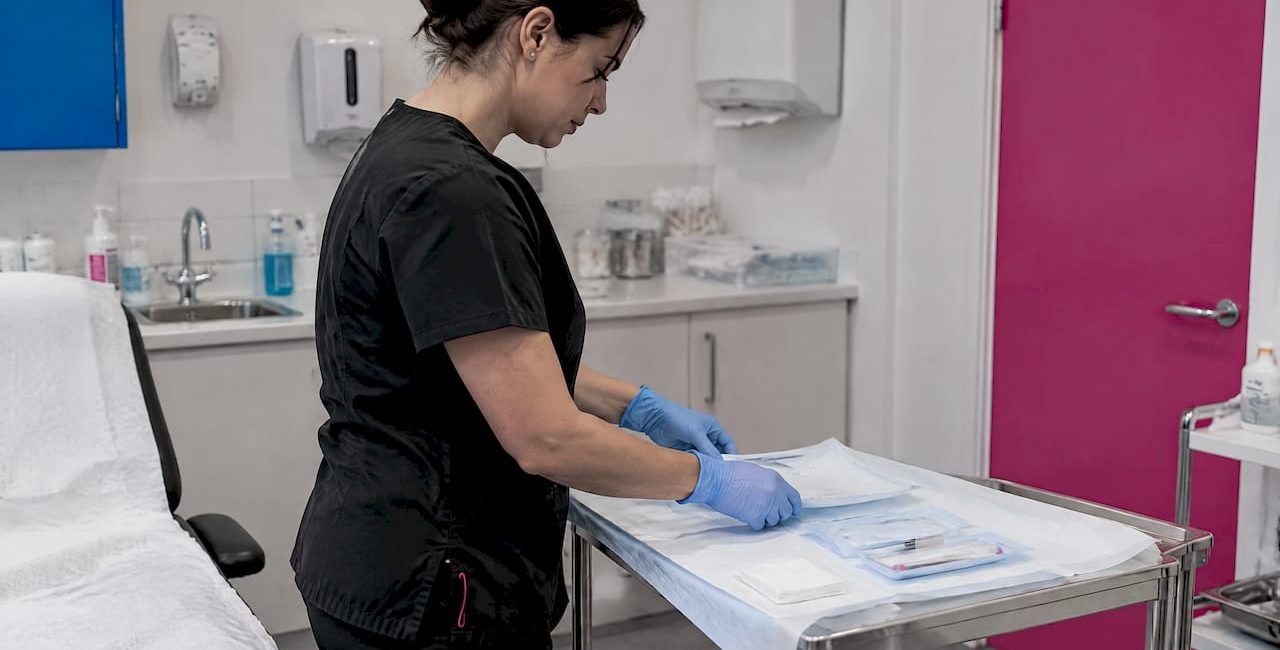
Aseptic technique for injectables means preparing and giving every injection so that no organism reaches the medicine, the equipment or the patient’s tissue. For licensed practitioners in the UK, the working standard is aseptic non-touch technique (ANTT): protect the sterile parts of your equipment, protect the injection site, work from a clean field and dispose of sharps at the point of use. This guide is written for qualified aesthetic professionals, prescribers and clinic teams. It sets out the routine step by step, where it tends to fail in a busy treatment room, and the UK guidance each step rests on.
TL;DR
- Injections bypass the body’s natural defences, so NHS Specialist Pharmacy Service guidance treats the handling of injectable medicines as high risk and says all injectables should be given using ANTT.
- ANTT rests on two ideas: protect the key parts (needle tip and hub, syringe tip, vial tops) and the key site (where the skin is breached).
- Prepare per the product’s Summary of Product Characteristics (SmPC) and give the medicine immediately after preparation. Anything outside that needs a pharmacy aseptic unit.
- Put the sharps container within reach before you start and discard the needle at the point of use.
- For licensed practitioners: use sterile, single-use consumables from a verified supplier, and keep your protocol in line with your organisation’s current local policy.
Table of Contents
- Why aseptic technique matters for injectable treatments
- ANTT in plain terms: key parts, key sites and the aseptic field
- The seven steps for a safe injection
- What to do if sterility is compromised
- Where risk rises: IV vitamins and higher-risk preparation
- Reduce the number of manipulations
- A quick audit checklist for your clinic
- Sterile supply is part of the technique
- FAQ
- Sources
Why aseptic technique matters for injectable treatments
A needle or cannula breaks the skin, the body’s first barrier. Anything on the needle, on the syringe tip or in the vial goes straight into tissue or the bloodstream. NHS SPS describes the manipulation of injectable medicines as high risk because injections bypass natural microbial defences, and notes that contamination can cause severe harm, particularly in immunocompromised patients.
That applies in an aesthetic clinic as much as on a ward. Whether you are drawing up a botulinum toxin for an anti-wrinkle treatment, loading a hyaluronic acid filler syringe, mixing an IM/IV vitamin preparation or giving a weight management injection, the contamination routes are the same: hands, surfaces, the vial septum, the syringe tip and the skin.
Two terms are worth fixing before the routine:
- Asepsis means free from pathogenic (disease-causing) organisms.
- Aseptic technique is the set of practices that keeps a procedure in that state. ANTT is a specific, widely used framework within it.
ANTT in plain terms: key parts, key sites and the aseptic field
NHS Scotland’s ANTT guidance describes asepsis as achieved through protecting key parts and key sites. The framework is simple enough to teach a whole team in one session.
Key parts are the parts of equipment that touch the patient or touch other sterile equipment. Typical examples are the needle tip and hub, the syringe tip, the neck of an ampoule and the top of a medicine vial.
Key site is the point where the skin is breached: the injection site, or the insertion point of a cannula.
Aseptic field is a designated working space that contains and protects the equipment. It can be a clean tray or a sterile drape, depending on the procedure. Smaller protected spaces, such as the inside of a syringe wrapper or a sterile cap, can shield a key part until you need it.
The rule that follows: do not touch key parts or key sites directly. If you must, the same guidance says sterile gloves should be used. The NHS Greater Glasgow and Clyde policy states the same principle for IV medicines: use non-touch technique and avoid touching sterile key parts, such as syringe tips and decontaminated access ports.
The seven steps for a safe injection
The phrase “seven steps for giving a safe injection” is a teaching shorthand, and trusts and training bodies word it differently. The sequence below follows the UK sources cited in this article and is the order we recommend for licensed practitioners. Adapt it to your organisation’s own policy.
Step 1: Check the patient and the prescription
Before touching any equipment, confirm you are entitled to give this medicine to this person. The Cambridgeshire and Peterborough NHS Foundation Trust guideline directs staff to check valid authorisation, health status, recent and prior administration, allergy status and capacity to consent before an injection.
In aesthetic practice this is where the prescriber relationship matters: prescription-only products need a valid prescription from a prescriber for the named patient. Record allergies, medication history and the consent discussion in the notes before you open any pack.
Where it goes wrong: a consultation done days earlier and not re-checked on the day. Confirm allergies and any change in health again at the chair.
Step 2: Prepare the room and the surface
Clean the tray or work surface, and keep it clear of anything not needed for the treatment. Position a sharps container within arm’s reach. NHS England’s infection prevention and control manual says waste should be discarded immediately and as close as possible to the point of use into the correct segregated container, so the container must be in place before you begin, not fetched afterwards.
Where it goes wrong: a crowded tray with phones, pens and packaging sharing the same space as the syringe.
Step 3: Hand hygiene and the aseptic field
The same Trust guideline directs staff to perform hand hygiene and establish an ANTT field before preparing and administering an injection. Wash or decontaminate your hands, put on gloves suited to the procedure, and lay out your equipment on the clean field.
Gloves do not replace hand hygiene. They are a barrier for you and, in standard ANTT, a way to avoid touching skin without contaminating equipment. The NHS England manual’s chapter on standard infection control precautions applies across healthcare settings in England and tells professionals to follow their organisation’s current local policies as well.
Where it goes wrong: putting gloves on, then touching a phone, a door handle or a hair clip, and carrying on.
Step 4: Check and open the equipment without touching key parts
Check every item: product name, strength, expiry date, packaging integrity and batch number. Open sterile packs so that the needle hub, the syringe tip and the cannula stay inside their wrappers until needed. Use a new, single-use sterile needle and syringe for every patient and every draw-up.
A practical habit: peel packaging back like a sleeve and let the item drop onto the field, or hold it only by the barrel and plunger, never the tip. Keep needle caps on until the moment of use.
Where it goes wrong: a hub brushed against a glove finger or a tray edge. If you touch a key part, replace the item. Do not decide it “probably” stayed clean.
Step 5: Prepare the medicine to its licence
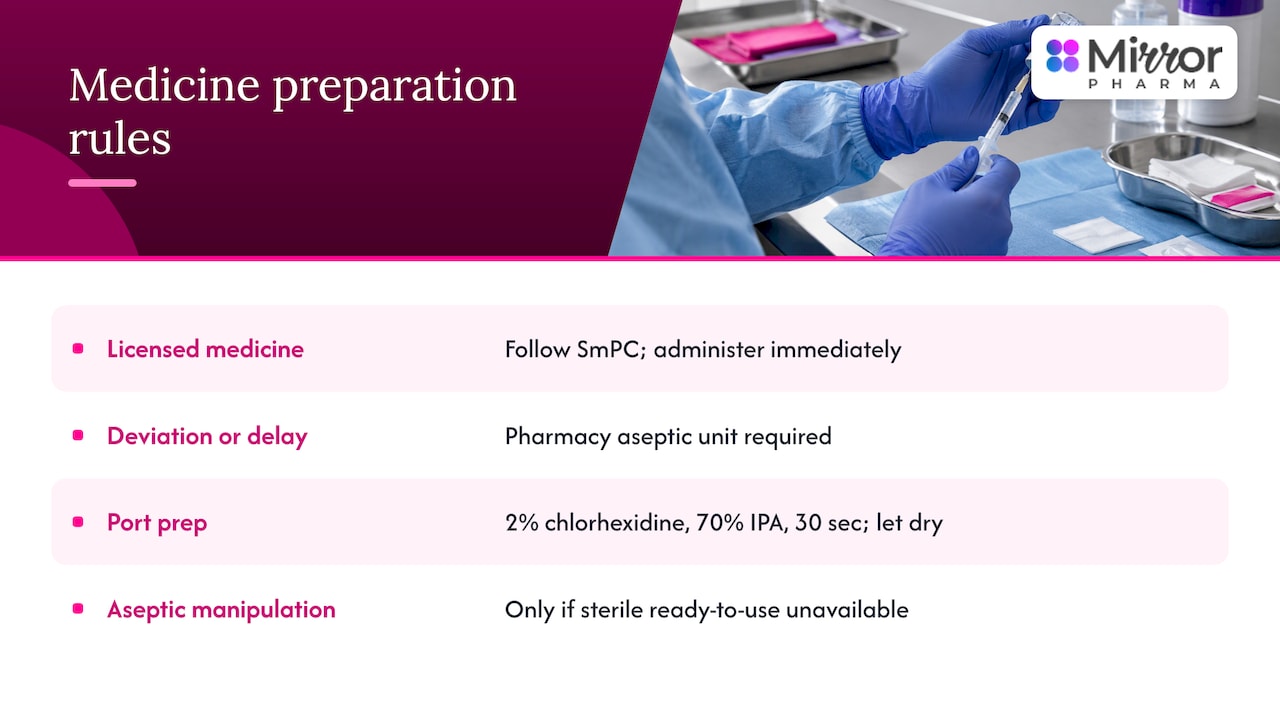
This is the step where the rules are most specific. NHS SPS guidance says licensed medicines should be prepared according to their SmPC and administered immediately after manipulation. The SmPC (Summary of Product Characteristics) is the document that sets out how a licensed medicine is to be reconstituted, diluted and used.
The same guidance says that if a manipulation appropriately deviates from the SmPC, or administration will not be immediate, the work must be performed in a pharmacy aseptic unit. That means no preparing syringes in advance “to save time” between patients, and no pooling or storing drawn-up product outside what the SmPC allows.
For access ports and vial tops, the NHS Greater Glasgow and Clyde policy specifies cleaning a needle-free access device or port with 2% chlorhexidine in 70% isopropyl alcohol for 30 seconds, then letting it dry before access. That policy is Scottish and written for IV medicines, so check your own organisation’s policy for the equivalent in your setting.
NHS SPS also states that aseptic manipulation should only be used when licensed, sterile ready-to-administer presentations are not available. The less you manipulate, the fewer chances contamination has. This is the practical case for ready-to-use presentations where your treatment allows them.
Where it goes wrong: a vial left open between patients, or a diluent drawn up for a whole list.
Step 6: Prepare the skin and give the injection
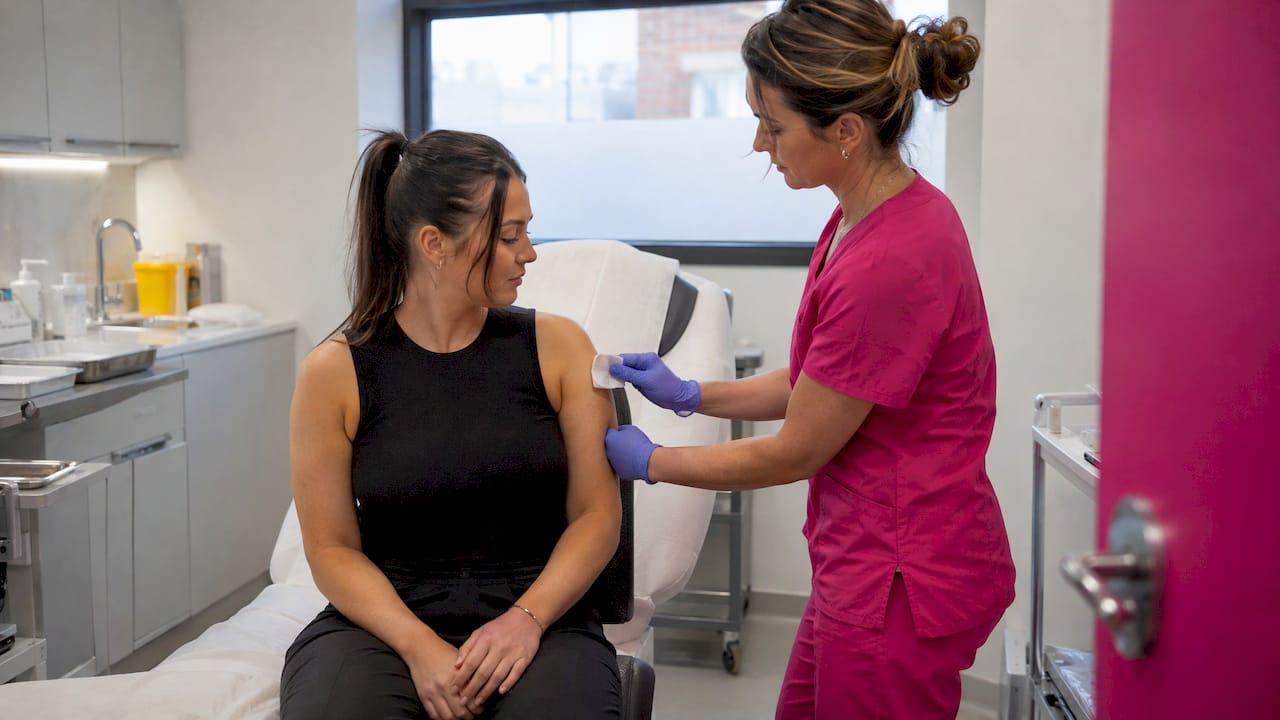
Clean the key site with the skin antiseptic your local policy specifies and let it dry fully; wiping and injecting straight away reduces the antiseptic’s effect and can drag liquid into the puncture. Then inject without re-touching the cleaned area. If you need to palpate landmarks again, re-clean or use a sterile glove.
Choose the device for the treatment. If you are weighing needle against cannula for a filler technique, our piece on cannula and needle safety data sets out the evidence for clinicians. For the route itself, IV versus IM injection explains how the route changes onset and what that means for your protocol.
Where it goes wrong: repeat injection points done by touching the treated skin with a gloved finger after the first prep.
Step 7: Dispose, document and decontaminate
Do not resheath the needle. Place the entire syringe and needle into the sharps container at the point of use. The NHS England manual notes that employers and contractors have duties under the Health and Safety (Sharp Instruments in Healthcare) Regulations 2013 covering safe sharps use and disposal, training, and the response to occupational sharps injuries.
Record the product, batch number, site and any event in the notes. Clean the work surface, remove gloves, and perform hand hygiene again. Our guide to sharps disposal checks for UK clinics covers the audit side in more detail.
Where it goes wrong: a sharps bin filled beyond its fill line, or a needle carried across the room to a bin.
What to do if sterility is compromised
The rule is short: if you are unsure, discard and start again. If a needle, syringe tip or vial top touches a non-sterile surface, replace the item. If a prepared syringe has been set down and its status is uncertain, do not give it. Where a medicine has been drawn up and not used immediately, the SPS position is that preparation outside the SmPC belongs in a pharmacy aseptic unit, not at the treatment chair.
If a sharps injury occurs, follow your organisation’s sharps injury procedure at once and seek occupational health advice. This is a time-critical matter for you, not an admin task for later.
If a patient develops redness, swelling, heat, pain or fever after treatment, they should be reviewed by a clinician promptly, and your protocol should state who that clinician is and how the patient reaches them out of hours.
Where risk rises: IV vitamins and higher-risk preparation
SPS guidance published 10 February 2026 states that preparation risk depends on product and process factors and that assessing it helps decide the safest preparation location and controls. It also states that some activities, including systemic anticancer chemotherapy and parenteral nutrition, cannot be mitigated in clinical areas and need a pharmacy aseptic unit.
Those examples are outside aesthetic practice, but the principle is not. The more steps between the vial and the patient (reconstituting, mixing, adding to a bag, running a line), the more key parts you have to protect. IM/IV vitamin work is the clearest case in aesthetic and wellness clinics. If you offer it, work through our IV infusion setup checklist and the protocol for mixing IV vitamins, and review the safety conditions for IV vitamin therapy before every new product is added to your menu.
Syringe choice is another quiet source of error in a draw-up. Our comparison of the insulin and tuberculin syringe explains the tenfold dosing risk of picking the wrong one for small volumes.
Reduce the number of manipulations
Every manipulation is an opportunity for contamination, so a sound protocol removes steps where it can. Three habits do most of the work:
- One patient, one set. Draw up for one patient, give immediately, and discard what is left.
- Fewer transfers. Where the clinical need allows, choose presentations that need less preparation. Our note on liquid botulinum toxin versus powder looks at the preparation time that reconstitution adds.
- A planned set-up. Pre-pack single-patient trays of sterile consumables (not drawn-up medicines) so the aseptic field is built in one movement.
Stock control belongs here too. Expired or damaged packaging is a contamination risk before you have even washed your hands, and rotating stock by expiry date is part of an aseptic routine. See our guide to injectable stock management.
A quick audit checklist for your clinic
| Area | What to check | Evidence in practice |
|---|---|---|
| Training | Every injector has been trained in ANTT and the training is recorded | Training log, refresher dates |
| Hand hygiene | Hand hygiene at the right moments, with facilities in the treatment room | Observation audit |
| Aseptic field | Clean field built before opening the first pack | Observation, photo of set-up |
| Preparation | Medicines prepared to the SmPC and given immediately | Protocol, spot check of trays |
| Consumables | Sterile, single-use, in date, packaging intact | Stock records, batch logs |
| Sharps | Container at point of use, below the fill line, correctly assembled | Bin check, waste records |
| Incidents | Sharps injury and infection pathway known to all staff | Written procedure |
The NHS manual’s chapter on standard precautions tells professionals to follow their organisation’s current local policies. Make your clinic’s own protocol the document your team signs and reviews, and base each line of it on the sources above.
Sterile supply is part of the technique
A clean technique cannot rescue a compromised product. That is why consumables and medicines should come from a supplier that verifies who it sells to. Mirror Pharma is an online pharmacy supplying prescription aesthetic medicines, toxins, dermal fillers, skin boosters, polynucleotides, fat dissolvers, IM/IV vitamins, weight loss medications, syringes, needles and consumables to healthcare professionals and aesthetic clinics. Access requires strict verification of practitioner or prescriber status, and orders are fulfilled by a dedicated team of healthcare professionals. Extended order cut-off times are designed to help practitioners get stock when a treatment list needs it.
For licensed practitioners, the relevant ranges are toxins, dermal fillers, IM/IV vitamins and needles and consumables.
Perspective: why we build the supply around the routine
When we talk to the practitioners we supply, the discussion about asepsis rarely stays on technique alone. It moves to logistics: whether sterile single-use items are on the shelf when the list starts, whether the stock in the fridge is in date, and whether a missing item tempts someone to improvise.
Our view is that a good aseptic routine begins before the patient arrives. That is why we verify that every buyer is a practitioner or prescriber, why our orders are fulfilled by a team of healthcare professionals, and why we have extended our order cut-off times: so that licensed practitioners can restock for the next day’s treatments without compromising the way they work.
The routine in this guide is not complicated. It asks for discipline at seven points. We would rather make the supply side of that discipline simple, so your attention stays on the patient and the key site.
Rizwan
FAQ
What is the difference between aseptic technique and ANTT?
Aseptic technique is the general practice of preventing contamination during a procedure. ANTT is a specific framework within it, built on protecting key parts and key sites. NHS SPS guidance says all injectable medicines should be administered using ANTT to reduce the likelihood of contamination.
Do I need sterile gloves for every injection?
Not necessarily. The principle of ANTT is that you avoid touching key parts and key sites, and sterile gloves are used when they must be touched. The glove choice for each procedure should be set out in your organisation’s policy, so confirm it there and train to it.
Can I draw up several syringes before the patient arrives?
For licensed medicines, the SPS position is that preparation follows the SmPC and administration is immediate. Where preparation deviates or administration is delayed, it should be done in a pharmacy aseptic unit. Pre-loading syringes at the treatment room is therefore not a safe shortcut.
Where should the sharps container be?
Within reach at the point of use, set up before you start. NHS England’s manual says waste should be discarded immediately and as close as possible to where it was used, in the correct segregated container.
Sources
- Introduction to aseptic manipulation of injectable medicines, NHS SPS
- Understanding aseptic services in the NHS, NHS SPS
- Risk factors: manipulation of injectable medicines, NHS SPS
- Aseptic Non Touch Technique (ANTT) Guideline, NHS Scotland
- Administration of Intravenous (IV) Medicines and Flush, NHS Greater Glasgow and Clyde
- Guidelines for Administration of Medicines by Intramuscular Injection, Cambridgeshire and Peterborough NHS Foundation Trust
- National infection prevention and control manual for England, version 2.12
- Chapter 1: Standard infection control precautions, NHS England