

Onboarding a clinic with a supplying pharmacy means proving who your prescribers are, checking that the pharmacy is properly registered, agreeing how prescriptions reach it, and training your team on that routine before the first order is placed. Done in that order, it takes the stress out of ordering later. This guide is for licensed practitioners, prescribers and clinic managers in the UK who supply prescription aesthetic medicines and consumables, and want a repeatable process rather than a scramble.
TL;DR
- Onboarding has two halves: verifying the supplier and its documents, and being verified yourself as a practitioner or prescriber.
- Agree the prescription route, order cut-off times and delivery handling before the first order, not after.
- Every new team member needs a role-specific induction as soon as possible, with competence assessed when they start.
- Keep training records complete and accessible, and review the process whenever your systems, staff or suppliers change.
- This guide is for qualified aesthetic professionals only. It does not replace regulator guidance or your own clinical governance.
Table of Contents
- What onboarding with a supplying pharmacy actually involves
- Before you apply: what to have ready
- Step 1: check the pharmacy before you hand over your details
- Step 2: get verified as a practitioner or prescriber
- Step 3: agree the prescription workflow
- Step 4: place a small first order and rehearse the routine
- Onboarding your team: the part clinics under-plan
- Our perspective
- Keeping records and reviewing whether it works
- Common onboarding problems and how to avoid them
- Ordering from Mirror Pharma once you are set up
- FAQ
- Sources
What onboarding with a supplying pharmacy actually involves
Search results for this topic mostly describe how a pharmacy inducts its own new hires. That matters to you too, because the same principles apply to your clinic team. But the practitioner’s question is usually different: how do we get set up to order prescription-only aesthetic products safely and legally from an online pharmacy?
The process has four parts:
- Supplier checks. You confirm that the pharmacy is registered and that the paperwork you receive is what a clinic should expect.
- Account verification. The pharmacy confirms that you are a licensed practitioner or an eligible prescriber before it supplies anything.
- Prescription workflow. You agree how prescriptions are issued, uploaded and matched to orders.
- Team readiness. The people who order, receive, store and administer products are trained on your clinic’s routine.
Skip any one of these and you meet the problem later, usually as a delayed order, a rejected prescription or an audit finding.
Before you apply: what to have ready
A verified account is quicker when the evidence is to hand. Exact requirements are set by the pharmacy, so confirm the current list on its registration page. In general, expect to be asked for the following.
| Item | Why it is needed | Who usually holds it |
|---|---|---|
| Professional registration details (for example, GMC, NMC, GDC or GPhC number) | Confirms you are legally able to prescribe or administer | Each practitioner |
| Clinic name, address and delivery location | Medicines go to a verified clinic premises | Clinic manager |
| Prescriber details and a named contact | Links each order to an accountable person | Lead prescriber |
| Clinic registration details where applicable | Shows the premises are properly set up | Clinic owner |
| Storage arrangements, including cold storage where products need it | Protects product integrity on arrival | Clinic manager |
If your clinic is not yet open, our guide to starting an aesthetics clinic in the UK explains why registration timelines are worth planning around before you think about stock.
Step 1: check the pharmacy before you hand over your details
The supplier should pass your checks before you pass theirs. The General Pharmaceutical Council (GPhC) sets the standards registered pharmacies must meet, including that staff have the skills, qualifications and competence for their role, or work under supervision while in training, as Standard 2.2 of the Standards for registered pharmacies makes clear.
In practice, a short routine works well:
- Confirm the pharmacy’s registration on the GPhC register, and that the premises and the superintendent details match what the website says. Our five minute GPhC check for clinic suppliers walks through the red flags.
- Ask for the documents a clinic should hold on file. We list them in the five documents UK clinics should get from a medicine supplier.
- If any product you plan to use is unlicensed, read how the MHRA checks for prescribers apply before you order.
File what you collect. It becomes the first page of your supplier record, which is the document an inspector or insurer will ask for.
Step 2: get verified as a practitioner or prescriber
A pharmacy supplying prescription medicines cannot sell to anyone who asks. Verification is part of its legal duty, and a clinic that understands this onboards faster. At Mirror Pharma, products are intended for trained practitioners and prescribers, and access depends on verification. You can start through our prescriber registration page.
Tips to avoid delays:
- Register every prescriber who will issue prescriptions for the clinic, not only the owner.
- Make sure names and registration numbers match exactly across documents.
- Use a clinic email address that more than one person can monitor, so queries are not stuck in one inbox.
- Keep your professional indemnity and registration details current, since they are the first things to lapse and block an order.
Remote prescribing is a particular area to get right. If your model involves prescribers who do not see the client in person, read our five step checklist on remote prescribing in aesthetics first, and follow your own regulator’s current position.
Step 3: agree the prescription workflow
Prescription-only products need a valid prescription for each named client before supply. The workflow is what most often trips up new clinics, because it involves several people: the prescriber, whoever uploads, and whoever orders.
Agree these points in writing before the first order:
- Who prescribes and who uploads. Name the roles, not just the people, so that cover is clear for holidays and sickness.
- What a complete prescription contains. Our prescription upload process guide sets out the steps for UK practitioners. Our overview of what pharmacists check on a PSD lists the fields that cause most rejections.
- Order cut-off times. We have extended our order cut-offs so practitioners can order later and still plan around a delivery. Confirm the current cut-off and delivery arrangements on our site rather than relying on a figure written down months ago.
- Who receives the delivery. Someone trained to check, sign for and store it, on days when the clinic is open.
A one-page workflow diagram stuck beside the clinic computer does more than any policy folder.
Step 4: place a small first order and rehearse the routine
The first order is a rehearsal of your whole system. Treat it that way. Order one or two lines you are certain to use, and walk the order through every step: prescription, upload, confirmation, delivery, receipt check, storage and recording.
On receipt, check the following and record them:
- The delivery matches the order and the client prescription.
- Packaging is intact and any temperature-sensitive product has been kept appropriately in transit.
- Batch numbers and expiry dates are logged in the clinic’s records.
- Needles, syringes and other consumables are in stock to match planned treatments, and sharps disposal is in place. Our sharps disposal checks for UK clinics cover what to have ready.
The rehearsal shows who is confused and what is missing while the stakes are still low.
Onboarding your team: the part clinics under-plan
The pharmacy can verify the prescriber, but only you can make sure your own staff know the routine. The best published thinking on induction comes from pharmacy regulation, and much of it transfers directly to a clinic.
What the regulator expects of a pharmacy team
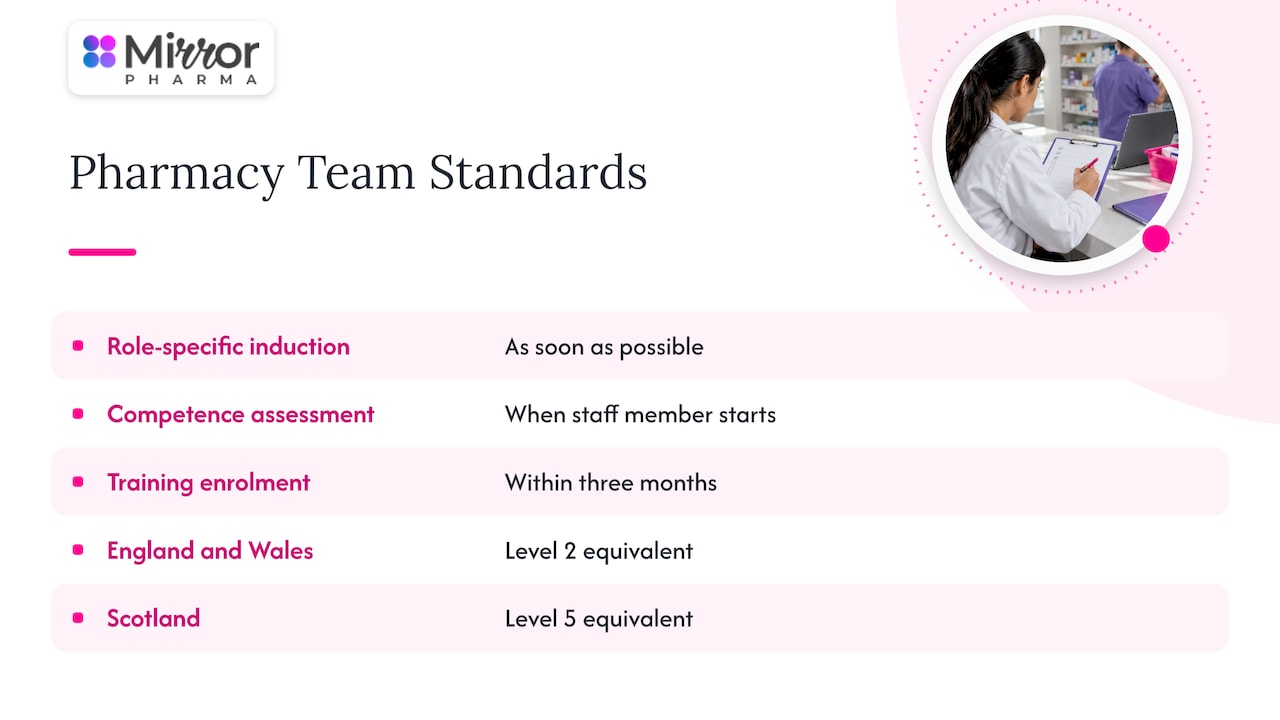
The GPhC’s October 2025 guidance to ensure a safe and effective pharmacy team expects a role-specific induction to be carried out as soon as possible for every new member of the team. It also expects competence to be assessed when someone starts, taking account of their previous education, qualifications and work experience.
The same guidance sets out training expectations for unregistered staff. Those who need training to reach the competency level for their role should enrol on a suitable programme within three months of starting. Staff involved in dispensing or supplying medicines must be competent to a level equivalent to a nationally recognised Level 2 qualification in England and Wales (Level 5 in Scotland), or be training towards it under supervision. These duties fall on registered pharmacies, not on your clinic, but they show the standard of care that suppliers and inspectors have in mind. If you employ non-registered staff to handle orders or deliveries, a comparable discipline is sensible.
A first-week induction plan for clinic staff
The Pharmaceutical Journal’s guide to designing induction pathways suggests a structured path including introductions, a workplace tour, mandatory training, reading standard operating procedures (SOPs), access to systems and shadowing, with mandatory training and system access scheduled for the first week. Adapted for an aesthetic clinic ordering from a pharmacy, that looks like this:
| When | What happens | Sign-off |
|---|---|---|
| Day 1 | Tour, introductions, read the ordering, receiving and storage SOPs, data protection briefing | New starter and line manager |
| Days 1 to 3 | Login to ordering and records systems, shadow the person who receives deliveries | Line manager |
| Days 3 to 5 | Shadow a full cycle: prescription, upload, order, receipt, storage | Lead prescriber or clinic manager |
| End of week 1 | Review: what was unclear, what is still unsupervised | Line manager |
What the induction should cover
A GPhC improvement action plan for a dispensing chemist, published in October 2024, is a useful warning. Inspectors had found new staff carrying out tasks without understanding their accountabilities, the pharmacy’s internal processes or data protection, and without a suitable induction. The fix was a structured programme in which each new starter reads the SOPs on day one, covering responsibilities, data protection, and which tasks they may or may not carry out without a pharmacist present.
For a clinic, the equivalent day-one content is:
- Who is accountable for ordering, and who may sign for deliveries.
- Which tasks need a prescriber present or a prescription in place.
- How client information is handled, stored and shared.
- What to do with damaged, incorrect or missing deliveries.
- Safeguarding and escalation routes in the clinic.
- Storage, cold chain, expiry checks and sharps handling.
Training on systems and online ordering
Systems training works best when it happens close to the change. Community Pharmacy England advises on electronic prescription service (EPS) systems that training is most effective when delivered close to a new system being introduced, a new starter arriving or a new pharmacy opening. It also recommends follow-up once staff are using the system regularly, and using quieter periods for sessions. EPS is a pharmacy system, not a clinic one, but the sequencing translates: train when someone first needs the tool, then return after a few weeks when real questions have appeared.
Our how-to videos are a handy part of that, since a new starter can watch the ordering steps before they sit with a colleague.
Shadowing and supervised practice
Supervision should be explicit, not assumed. The NMC’s standards to support learning and assessment in practice require that at least 40% of a student’s time giving direct care in the practice setting is spent being supervised by a mentor or practice teacher, and that only a registered professional of the same discipline may sign a student off as proficient. Those rules apply to nursing students, not to your clinic as such, but the principle is worth borrowing: decide how much supervision a new starter needs, and let only a suitably qualified colleague sign off competence.
The GPhC’s foundation training manual adds a point on integrity. A designated supervisor should sign a final declaration only when the trainee has actually met the standard, and not to hit a date. The same applies to any sign-off in your clinic: a date on a calendar is not evidence of competence.
Our perspective
We supply prescription aesthetic medicines and consumables only to trained practitioners and prescribers, so onboarding is where our relationship with a clinic starts, not an obstacle before it.
What we see is that the clinics that settle in quickest treat verification as a shared task. They register all their prescribers at once, agree who uploads prescriptions, and rehearse an order before it matters. The ones that struggle usually have a good clinician and no written routine.
That is why our service is built around a smooth online ordering experience, extended order cut-off times so that practitioners can plan deliveries around real client diaries, strict verification for practitioner and prescriber access, and fulfilment by a dedicated team of healthcare professionals. We would rather ask a clinic a question at the start than have a prescription held up at the point of treatment.
Our advice to any clinic owner: write the routine down, train everyone who touches an order on it, and review it when staff or systems change. It is not glamorous, but it protects your clients and your registration.
Rizwan
Keeping records and reviewing whether it works
Onboarding is not finished when the first order lands. The October 2025 GPhC guidance expects owners to keep complete and accurate training records for all staff, accessible to those who need them, and to be able to demonstrate that learning and development is taking place. It also expects the essential elements of training for each role to be identified, regularly reviewed and reassessed as circumstances change, with any changes made in a timely manner.
For a clinic, a simple review cycle covers this:
- Training log. One record per team member: induction date, what was covered, who signed it off, and when refreshers fall due.
- Supplier file. The registration check, documents received and the date you last reviewed them.
- Order audit. Every quarter, sample a handful of orders and trace each from prescription to batch record. Look for missing fields, late uploads or delivery problems.
- Trigger reviews. Reopen the process whenever a new prescriber joins, a system changes, a supplier changes or a regulator updates its guidance.
The guidance also expects owners to encourage and enable staff, especially those in training, to reflect on their performance and identify development needs, and to keep a tailored approach to learning going throughout employment. In a small clinic that can be a ten-minute monthly conversation. Ask what slowed people down, what they were unsure of and what they would change.
Common onboarding problems and how to avoid them
- One person holds all the knowledge. If only the clinic manager understands the ordering routine, absence stops supply. Cross-train at least two people.
- Prescriptions uploaded incomplete. Use a checklist at the point of prescribing, not after the order is rejected.
- Storage is an afterthought. Confirm fridge capacity, monitoring and who checks it before products arrive.
- Consumables forgotten. Needles, syringes and disposal items should be on the same planning list as the medicines.
- Records scattered. Keep supplier, training and batch records in a place an inspector can be shown quickly.
These are small, unexciting fixes. They are also the ones that make the difference between a clinic that orders calmly and one that is always chasing.
Ordering from Mirror Pharma once you are set up
Once your prescribers are verified, you can order from our ranges for licensed practitioners, including toxins, dermal fillers, skin boosters, polynucleotides, IM/IV vitamins, fat dissolving and weight loss lines, plus needles and consumables. Everything is for qualified aesthetic professionals and prescribers, with verification required. Start with prescriber registration.
FAQ
How long does it take to onboard a clinic with an online pharmacy?
It depends mainly on how quickly your registration details and documents can be verified, so the time is largely in your hands. Having every prescriber’s details, clinic address and storage arrangements ready before you apply avoids most delays. Check the pharmacy’s registration page for its current process.
Do all our staff need to be registered with the pharmacy?
The prescribers and practitioners who will issue prescriptions or take responsibility for orders need to be verified. Other team members, such as reception or stock staff, do not need prescriber status, but they should be named in your internal procedures and trained on their part of the routine.
What should we train new clinic staff on first?
Start with accountability: who may order, who may sign for deliveries and which tasks need a prescriber. Then cover data protection, storage and cold chain, and escalation of problems. The GPhC expects a role-specific induction as soon as possible for new pharmacy team members, which is a sound model for a clinic too.
How often should we review our onboarding process?
Review it whenever a prescriber, system or supplier changes, and audit a sample of orders each quarter. Keep training records up to date throughout, since regulators expect owners to be able to show that learning and development is taking place.
Can a new starter order products on their first day?
Only if their role allows it and they have been inducted and assessed as competent for it. Many clinics let new starters shadow orders for the first week before they handle one alone. Always follow your clinical governance and your regulator’s guidance.
Sources
- GPhC, Guidance to ensure a safe and effective pharmacy team (October 2025)
- GPhC, Standards for registered pharmacies (June 2018)
- GPhC, Improvement action plan, Medicare Dispensing Chemist (October 2024)
- GPhC, Foundation training manual 2024/25
- Community Pharmacy England, Enhancing EPS or preparing for it
- The Pharmaceutical Journal, How to design optimal induction pathways for pharmacy professionals
- NMC, Standards to support learning and assessment in practice