

For licensed practitioners, a prescription is more than an instruction to supply a medicine. It is health data about an identifiable person, so it is protected by UK GDPR, the Data Protection Act 2018 and the common law duty of confidentiality. Your duties are to have a lawful basis, tell patients what you do with their data, keep prescriptions and records secure, keep them no longer than necessary, and act fast when something goes wrong. This guide sets out each duty for qualified aesthetic professionals, prescribers and clinics. Mirror Pharma supplies prescription aesthetic medicines only to verified practitioners and prescribers, so handling prescription data properly is part of how we work with you.
TL;DR
- Prescription data is health data, which UK GDPR treats as special category data. You need a lawful basis for ordinary personal data and a second condition for health data.
- Confidentiality law applies as well as data protection law. Consent is needed before sharing information a patient would not reasonably expect you to share, unless a legal exception applies.
- Store prescriptions and records securely, keep them no longer than necessary, and never leave them where unauthorised people can see them.
- Report a breach that risks people’s rights and freedoms to the ICO within 72 hours of becoming aware of it.
- Keep your own prescriber verification and documentation tidy, because those records are personal data too.
Table of Contents
- Which laws protect prescription data
- Lawful basis: what you need before you process
- Privacy information your patients should receive
- When consent is required for sharing
- Who may see prescription records
- Securing paper and electronic prescriptions
- How long to keep prescription records
- What to do after a breach
- Prescriber verification and your own data
- Ordering prescription aesthetic products with verified access
- Perspective
- FAQ
- Sources
Which laws protect prescription data
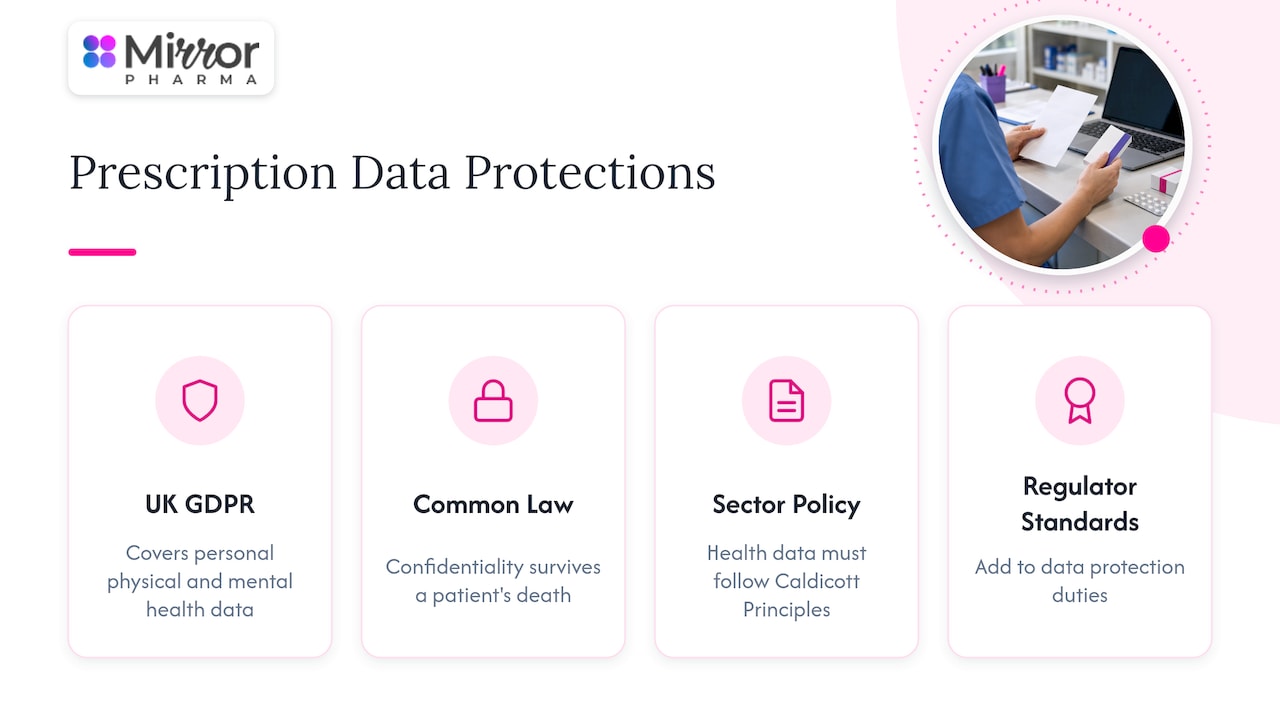
Three layers apply, and a practitioner needs all of them in mind.
UK GDPR and the Data Protection Act 2018. These cover all personal information, including data about a person’s physical or mental health. The Information Commissioner’s Office (ICO), the UK data protection regulator, enforces them. The General Pharmaceutical Council’s November 2025 confidentiality guidance states that pharmacy professionals must comply with this legislation, the Human Rights Act 1998 and the common law duty of confidentiality.
The common law duty of confidentiality. This is a separate duty. The same GPhC guidance says data protection requirements sit alongside it and do not replace it. It also treats confidentiality as a duty that survives a patient’s death.
Sector policy. In the NHS, NHS England’s data protection policy, published on 24 February 2026, requires lawful, fair and transparent processing. It asks for an appropriate policy document covering special category data and says health data must also follow the Caldicott Principles. Private aesthetic practice is not the NHS, but the policy shows what regulators expect from health organisations.
If you are a prescriber or pharmacist, your professional regulator’s standards add to this. Your own data protection officer, or your professional body, can confirm how they apply to your setting.
Lawful basis: what you need before you process
UK GDPR works in two stages for health data. You need a lawful basis under Article 6 for the personal data, and a condition under Article 9 for the health information. Community Pharmacy England’s GDPR guidance explains this two-stage approach for pharmacy data.
The BMA’s 2024 guidance on GPs as data controllers gives a useful worked pattern:
| Purpose | Article 6 basis | Article 9 condition |
|---|---|---|
| Direct patient care | 6(1)(e) | 9(2)(h) |
| Legally required disclosure | 6(1)© | 9(2)(h) |
| Medical research | 6(1)(e) | 9(2)(j) |
These are the bases a GP practice relies on. A private clinic’s lawful basis depends on its own circumstances, so record your reasoning in your privacy documentation and take advice from your data protection officer where unsure.
A point that often confuses new clinics: GDPR consent is not usually the basis for processing prescription data. Community Pharmacy England’s FAQs say asking for consent is not meaningful, because the data has to be processed for patient safety and professional responsibilities. Patients still need clear privacy information, and they still agree to the treatment itself.
Privacy information your patients should receive
A privacy notice must state who you are, how to reach your data protection officer if you have one, why you use the data and your legal basis. The BMA guidance quotes the ICO to make the point that providing privacy information means more than putting a notice on a website. In a clinic, that means handing it over or pointing to it at consultation, and answering questions.
Patients also have rights. Using the NHSBSA prescription services privacy notice as an example of how these are expressed, people can ask for a copy of the information held about them, ask for corrections, and in some circumstances ask for deletion. Build a routine for handling these requests so they are answered consistently.
When consent is required for sharing
The GPhC guidance says to get consent before sharing confidential information unless one of the exceptions applies. These are:
- disclosure is required by law
- disclosure is justified in the public interest
- seeking consent is impracticable
- seeking consent risks serious harm
- seeking consent would prejudice the purpose of the disclosure
Where the reason for sharing is one the patient would not reasonably expect, explicit consent is needed. The patient must understand what will be disclosed, why, to whom, the consequences of sharing or not sharing, and how to withdraw consent.
Patients may also object to how their information is shared. NHS England Digital’s guidance says they can always ask and object, and that the objection should be discussed with the care organisation because not sharing can affect safe care.
Worked example. A prescriber issues a prescription for a patient and the clinic sends it to a supplying pharmacy. The patient would reasonably expect that. Passing the same patient’s details to a marketing partner is not something they would expect, so it needs explicit consent and is likely to need its own lawful basis as well.
Who may see prescription records
Access should be limited to people with a reason to see the record. The ICO’s statement on the London Clinic breach is a clear reminder: accessing someone’s medical records without cause or consent can be a criminal offence, and the ICO can prosecute and fine the person responsible in court.
Practical controls for a clinic:
- Give each team member their own login and never share credentials.
- Restrict records to staff who need them for care or supply.
- Review who has access when roles change or someone leaves.
- Keep an audit trail where your system allows it.
The NHS Counter Fraud Authority’s guidance on prescription forms, published in August 2025, applies the same idea to NHS settings. Rooms holding prescription form stocks should have restricted access, with strictly controlled keys and a full audit trail. For electronic prescriptions, smartcards and passcodes must not be shared, and prescribers should be strongly authenticated through NHS Care Identity Service 2.
Securing paper and electronic prescriptions
The GPhC requires all reasonable steps to protect the confidentiality and security of information you receive, access, store, send or destroy. In practice that covers:
- storing prescriptions and records securely, and for no longer than necessary
- keeping data accurate and up to date
- preventing accidental disclosure
- not leaving confidential information where the public or unauthorised people can see it
- using records only for purposes the patient would reasonably expect or another lawful purpose
NHS England’s policy adds technical and organisational measures proportionate to the risk, including protection from cyber-attacks, internal misuse and accidental loss. For a small clinic this usually means encrypted devices, strong passwords, a lockable cabinet for paper and a clean-desk habit in consulting rooms.
Email deserves particular attention. A May 2026 South West Community Pharmacy Bulletin reminds contractors that emails containing patient-identifiable information must be sent from a secure address, or they could be a GDPR breach. It also reports that the 2026 Data Security and Protection Toolkit added a question on multi-factor authentication for clinical IT systems. Those requirements are written for NHS contractors, but multi-factor authentication is a sensible control for any clinic.
How long to keep prescription records
Keep records only as long as you need them. The NHSBSA notice shows the logic at national level: it destroys a prescription no later than 24 months after the month it was received, and anonymises prescription and pharmacy service information no later than 11 years after processing. Your own period depends on your regulator, insurer and the type of record, so set it in a written retention schedule and apply it consistently.
Documentation you collect to support supply is covered by the same thinking. Our guide to documentation kept with orders sets out what UK practitioners keep and why.
What to do after a breach
A breach can be as ordinary as a prescription left in a public place or details sent to the wrong person. Act in this order:
- Contain it. Retrieve or recall the data and stop further disclosure.
- Record it. Every breach goes in your log, whatever its size.
- Assess the risk. Consider what health data was involved, where and when.
- Report to the ICO within 72 hours of becoming aware if there is a risk to people’s rights and freedoms. The ICO notes this is often the case with sensitive medical information.
- Tell the patient without undue delay if the risk is high.
NHS England Digital’s breach guidance uses personal information lost in a public place as an example of a breach that should go to the ICO. Community Pharmacy England’s toolkit guidance says an ICO notification should describe the breach, including the number of people and records affected, give the data protection officer’s contact details, describe the likely consequences and the steps taken, and supply any missing information later without delay.
Deliberately altering or destroying records to avoid disclosure in response to a subject access request may be a criminal offence, so never tidy a record after a request arrives.
Prescriber verification and your own data
Supply of prescription-only medicines depends on checking who is prescribing. That produces records about prescribers and patients, and each needs the same care. Our guides on prescriber verification in the UK and the prescription upload process explain what a practitioner provides. Our privacy and cookies policy describes how we handle personal data on our own site.
Ordering prescription aesthetic products with verified access
Mirror Pharma is an online pharmacy supplying prescription aesthetic medicines, vitamins, weight loss products, consumables and more to healthcare professionals and aesthetic clinics. Access requires full verification, and orders are fulfilled by a dedicated team of healthcare professionals. Qualified practitioners can browse toxins, dermal fillers and IM/IV vitamins once verified. Extended order cut-off times help clinics keep their treatment schedules.
Perspective
Prescription data protection is easiest when it is built into the supply routine rather than bolted on afterwards. Every order from a licensed practitioner involves identity checks, prescription details and records, and each of those is personal data that deserves a clear purpose and careful handling.
That is why we require strict verification for practitioner and prescriber access. Knowing who is ordering, and that they are entitled to, protects patients and keeps the supply chain trustworthy. Our team of healthcare professionals handles fulfilment with that responsibility in mind.
Our advice to qualified aesthetic professionals is simple: write down your lawful basis, give patients clear privacy information, limit access, set a retention schedule and rehearse your breach steps before you need them.
Rizwan
FAQ
Is prescription information special category data?
Yes. UK data protection law covers all personal information, including data about a person’s physical or mental health, and health data needs an additional Article 9 condition. Licensed practitioners should record which condition they rely on in their privacy documentation.
Do I need patient consent to process prescription data?
Not usually under GDPR. Community Pharmacy England’s guidance says consent is not meaningful for data that must be processed for safety and professional duties. Patients still need privacy information, and the common law duty of confidentiality still governs what you may share.
How quickly must a breach be reported?
Report to the ICO within 72 hours of becoming aware if the breach risks people’s rights and freedoms. Where the risk to individuals is high, tell them without undue delay. Record every breach, including those you do not report.
Can someone access a patient’s records without permission?
Only with a legitimate reason such as care or a legal requirement. The ICO has said that accessing records without cause or consent can be a criminal offence, so restrict access to those who need it.
Sources
- GPhC: In practice, guidance on confidentiality (November 2025)
- NHS England: Data protection policy
- Community Pharmacy England: GDPR guidance, Part 1
- Community Pharmacy England: GDPR FAQs, Part 4
- BMA: GPs as data controllers under the UK GDPR
- NHS England Digital: Use and share information with confidence
- NHSBSA: NHS Prescription and Pharmacy Services Privacy Notice
- ICO statement on the London Clinic data breach
- NHS Counter Fraud Authority: Management and control of prescription forms
- South West Community Pharmacy Bulletin, May 2026
- NHS England Digital: Personal data breaches and related incidents
- Community Pharmacy England: Data Security and Protection Toolkit guidance