

Cold chain storage is the temperature-controlled segment of a supply chain that keeps products within a defined thermal envelope from manufacture to point of use. For licensed practitioners and clinical supply managers, the practical bottom line is this: documented, validated temperature control and traceable monitoring are not optional extras — they are regulatory requirements under Good Distribution Practice (GDP) and HACCP, and failure to maintain them can render a product unusable without warning.
The three temperature classes you will encounter most often are:
- Refrigerated (2–8°C): vaccines, insulin, most biologics and many dermal fillers
- Frozen (approximately −20°C): certain plasma products, some diagnostic reagents, frozen food
- Ultra-low temperature (ULT, −70°C and below): mRNA-based products, some cell and gene therapies
Every one of those classes demands the same three non-negotiable controls:
- Validated storage equipment with calibrated temperature monitoring
- Calibrated data loggers with a traceable audit trail
- Documented chain of custody at every handover point
Key takeaways
A compliant cold chain requires validated storage, calibrated monitoring, documented chain of custody, and a tested excursion response process at every stage from manufacture to point of use.
| Point | Details |
|---|---|
| Temperature classes | Know your product’s class: 2–8°C refrigerated, −20°C frozen, −70°C ULT — tolerances vary by product. |
| Packaging qualification | Use ISTA-qualified shippers with the vendor’s pack-out diagram; pre-conditioning is mandatory, not optional. |
| Monitoring as evidence | Calibrated, tamper-evident temperature logs are regulatory evidence under GDP and HACCP, not just operational data. |
| Excursion response | Quarantine first, contact the manufacturer second — do not destroy product without written manufacturer confirmation. |
| Mirror Pharma | Supplies temperature-sensitive injectables and clinical products to verified practitioners in the UK with storage conditions stated on every listing. |
Table of Contents
- How cold chain storage works from manufacture to point of use
- Temperature classes and what they mean in practice
- Core technologies and equipment for temperature-controlled storage and transport
- How to specify and qualify cold-chain packaging
- Temperature monitoring, data logging and chain-of-custody
- Regulatory and standards frameworks for pharmaceutical and food cold chains
- How pharmaceutical and food cold chains differ in practice
- Day-to-day best practices for teams managing cold chain storage
- Economic and environmental impacts of cold chain operations
- Operational insights practitioners often miss
- A note from Mirror Pharma on this guide
- Mirror Pharma: temperature-sensitive supply for qualified practitioners
- Sources
- FAQ
How cold chain storage works from manufacture to point of use
The cold chain is not a single event — it is a sequence of linked stages, each with its own actors, risks and documentary obligations. A break at any stage can compromise the entire chain.
Manufacture and final pack. The manufacturer releases the product within its validated thermal envelope and provides storage and handling instructions. At this stage, the manufacturer is responsible for confirming the product’s stability data and acceptable excursion limits.
Cold storage at origin. Product moves into a refrigerated warehouse or ULT freezer bank. The warehouse operator holds GDP or equivalent certification and maintains continuous temperature logs. Stock rotation (first-expiry, first-out) is documented here.
Transport to intermediate hub. A third-party logistics (3PL) provider or refrigerated courier collects the consignment. Handover documentation — including a signed temperature log and chain-of-custody record — transfers responsibility. This is one of the highest-risk moments: door-open time, loading dock temperature and vehicle pre-conditioning all affect the thermal profile.
Intermediate storage and cross-docking. At a hub or distribution centre, product may be held briefly before onward dispatch. Even short dwell times require temperature monitoring; a gap in the log here is an audit failure.
Last-mile delivery. Temperature-controlled vans or validated passive shippers carry product to the clinic, pharmacy or end-point. The CDC’s vaccine cold-chain guidance is explicit that reliable storage equipment, trained staff and accurate inventory management are all required at this stage — not just a cold box.
Point of use. The clinician or practitioner receives the consignment, checks the temperature indicator or logger reading, and signs the delivery record. Any anomaly triggers quarantine before the product is used.
Key vulnerability points across all stages:
- Handovers between parties (unsigned or undated records)
- Door-open time during loading and unloading
- Pre-conditioning failures (a warm shipper placed in a cold environment without pre-conditioning)
- Vehicle refrigeration faults discovered mid-route
- Inadequate pre-conditioning of passive shippers before pack-out
Documentary evidence must be retained at each stage. Handover records should be signed and timestamped by both parties, and temperature logs must be continuous — a gap is treated as a potential excursion under GDP audit.
Temperature classes and what they mean in practice
Understanding which class your products fall into is the first step in specifying the right storage and transport solution.
The critical concept is time at temperature, not just temperature alone. A product held at 9°C for two minutes during a handover behaves very differently from one held at 9°C for six hours. Manufacturers’ stability data defines acceptable excursion limits — typically expressed as a maximum cumulative time outside the target range — and those limits are what GDP auditors check against your temperature logs.
A few practical points worth noting:
- Tolerances within a class vary by product. Some vaccines tolerate brief excursions to 12°C; others do not. Always consult the Summary of Product Characteristics (SmPC) or manufacturer’s data sheet.
- Frozen products that thaw and refreeze are almost always compromised. Unlike a brief refrigerated excursion, a freeze-thaw cycle is rarely recoverable.
- CRT products are often overlooked in cold-chain planning, but a vehicle cab in summer can exceed 35°C, which takes a CRT product outside its envelope just as surely as a fridge failure.
Core technologies and equipment for temperature-controlled storage and transport
The choice between active and passive systems is the first decision in any cold-chain specification. Active systems use powered refrigeration — refrigerated warehouses, ULT freezer banks, reefer trailers and temperature-controlled vans — and are suited to large volumes, long durations and fixed routes. Passive systems use validated insulated shippers, phase-change materials (PCMs) or dry ice and are the standard approach for small-package medical transport where powered refrigeration is impractical.
Active equipment:
- ULT freezers: typically −80°C capable, with cascade compressor systems and independent alarm circuits. Require dedicated power supply and backup.
- Pharmaceutical refrigerators: purpose-built units with forced-air circulation to eliminate hot and cold spots; not domestic fridges.
- Refrigerated storage rooms (cold rooms): for bulk storage; require validated mapping to confirm temperature uniformity across the entire volume.
- Reefer trailers: temperature-controlled semi-trailers with integral refrigeration units; used for pallet-scale pharmaceutical and food distribution.
- Temperature-controlled vans: smaller vehicles with integral or plug-in refrigeration; the standard for refrigerated courier UK last-mile delivery.
Passive equipment:
- Validated insulated shippers (polystyrene, polyurethane or vacuum-insulated panel construction)
- PCM packs (water-based, paraffin or proprietary formulations, each with a specific melt point)
- Dry-ice shippers for ULT payloads
- Validated cool boxes for short-duration clinical transport
Monitoring stack:
The monitoring layer sits on top of the physical equipment and is what creates the auditable record. A compliant stack typically includes local data loggers inside each storage unit or shipper, integrated telematics in vehicles (GPS, door sensors, reefer unit status), a cloud dashboard with configurable alarm thresholds, and automated alert routing to a named responsible person. Telematics and continuous data logging — combining GPS, multiple internal sensors and door-open events — are now core to GDP and HACCP compliance, not a premium add-on.
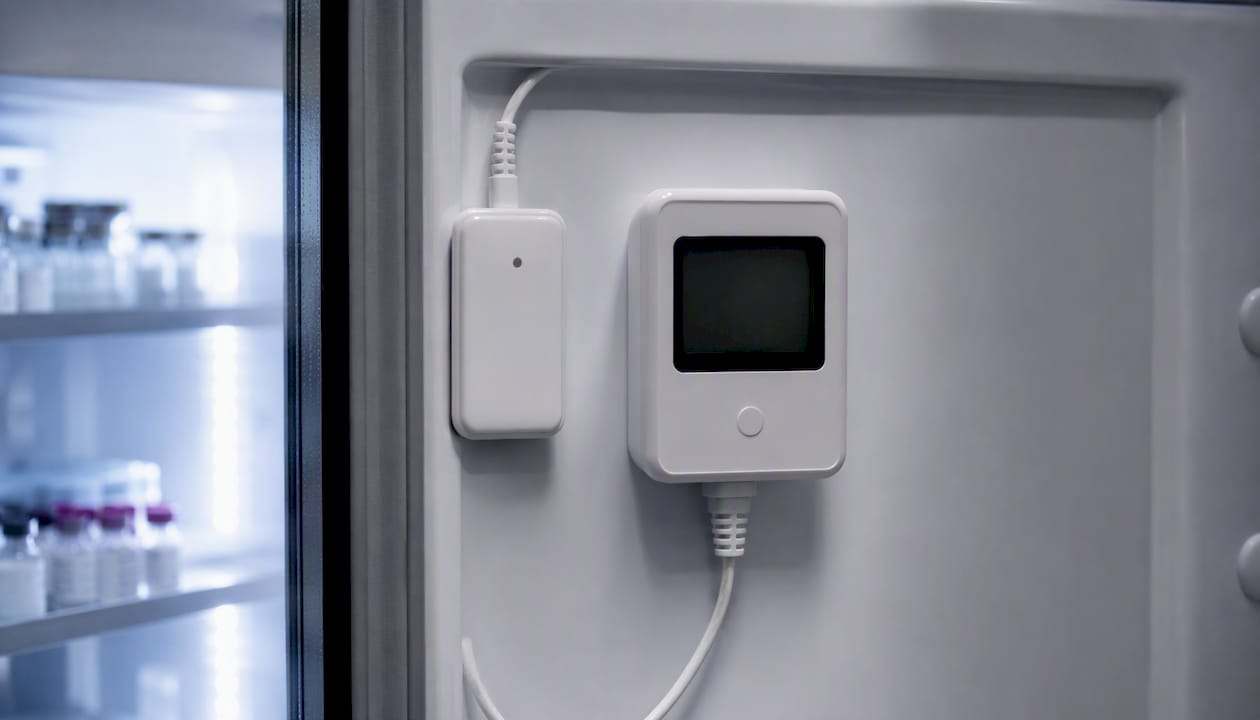
Pro Tip: Match your monitoring system’s response time to your product’s thermal inertia. A small vial of a biologic has almost no thermal mass and will reach ambient temperature within minutes of a fridge door being left open. A large frozen pallet has significant inertia and may take hours to warm. Specifying a 15-minute alarm interval for a small-vial fridge is not conservative — it is too slow. Set alarm thresholds and response times based on the product’s actual thermal mass, not a generic default.
How to specify and qualify cold-chain packaging
Packaging qualification is where many practitioners get caught out. Buying an insulated shipper from a catalogue is not the same as using a qualified system. A qualified cold-chain packaging system is one that has been tested against a defined thermal profile for a specific duration, with documented results showing it maintained the target temperature range throughout.
Qualification language you need to know:
- Pre-qualified shipper: a system the vendor has already tested and for which they supply a qualification report, pack-out diagram and pre-conditioning instructions. You use their data rather than running your own chamber tests.
- ISTA profiles: the International Safe Transit Association publishes test protocols for temperature-sensitive shipments. ISTA-7E is the most widely cited profile for pharmaceutical cold-chain packaging; it simulates a range of ambient temperature conditions and transit durations.
- Chamber testing: laboratory simulation of a transit lane’s temperature profile, used to generate the qualification data.
- Pack-out diagram: a precise, illustrated instruction showing exactly how coolant, PCMs and payload must be arranged inside the shipper. Deviating from it invalidates the qualification.
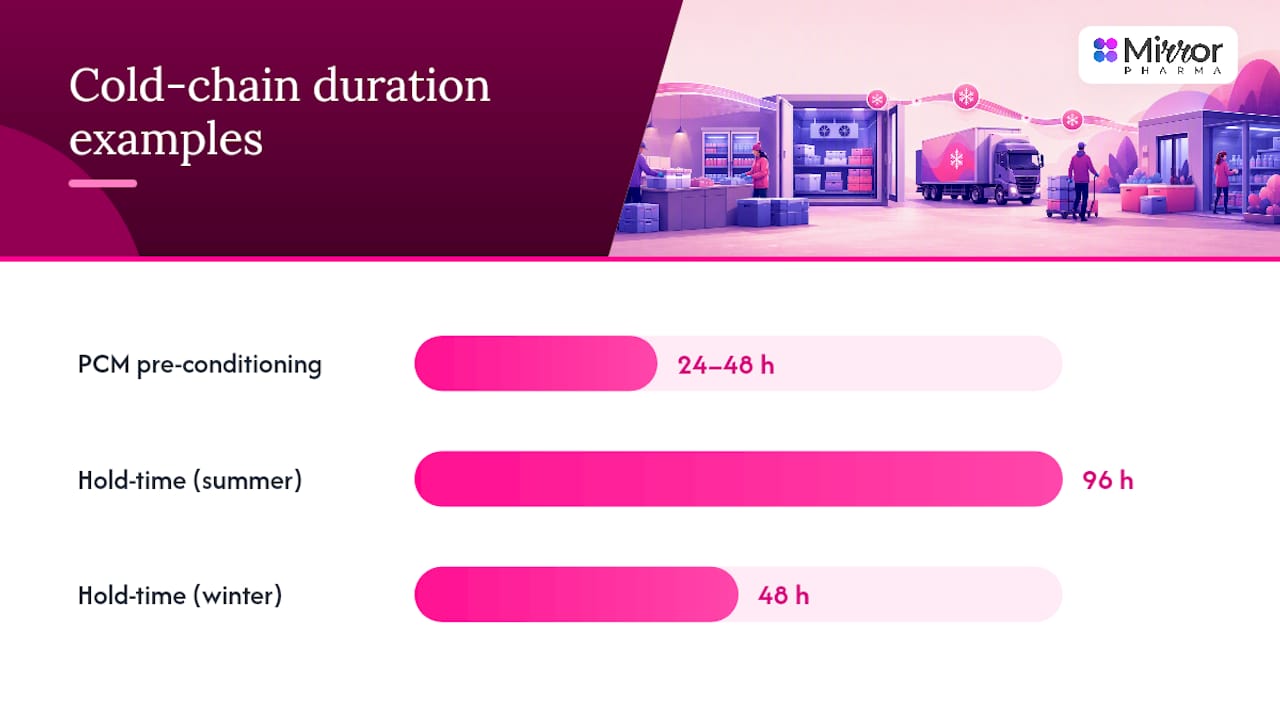
- Hold-time chart: shows how long the system maintains the target range under different ambient conditions. A system qualified for 96 hours at summer ambient may only hold 48 hours at winter ambient — or vice versa, depending on the coolant type.
Practical qualification steps:
- Characterise the payload: mass, thermal properties, minimum and maximum acceptable temperatures.
- Define the lane: origin, destination, transit duration, expected ambient temperature range (seasonal worst case).
- Select a pre-qualified shipper whose qualification envelope covers your lane, or commission chamber testing for a bespoke solution.
- Confirm pre-conditioning requirements: PCM packs often need 24–48 hours at a specific temperature before use.
- Follow the pack-out diagram exactly and document each pack-out.
Documents to request from any packaging vendor:
- Chamber qualification report (showing time, temperature and ambient profile)
- Qualification certificate with test dates and applicable ISTA profile
- Pack-out diagram (version-controlled)
- Hold-time chart for relevant ambient profiles
- Handling and reconditioning instructions
- Statement of acceptable payload mass range
Pack-out checklist for each dispatch:
- Insulation type and thickness confirmed against diagram
- PCM mass and melt-point specification verified
- Coolant pre-conditioning temperature and duration recorded
- Internal arrangement matches diagram (payload position, buffer layers)
- Lid seal and closure method confirmed
- Logger placed at the specified position within the shipper
Temperature-controlled packaging combines insulation, PCMs and vacuum-insulated panels (VIPs); the right combination depends on temperature range, transit duration and payload size, and each combination affects both the qualification scope and the monitoring approach you need.
Temperature monitoring, data logging and chain-of-custody
Monitoring is not just about triggering alarms. Under GDP and HACCP, the temperature record is evidence — it is what you present to an auditor, what you use to calculate remaining shelf life after an excursion, and what you rely on when a manufacturer asks for event data before confirming whether a product can still be used.
Types of monitoring devices:
- Standalone data loggers: battery-powered, placed inside storage units or shippers; downloaded via USB or Bluetooth after transit. Simple, low cost, widely used for passive shippers.
- RFID and NFC tags: single-use or reusable tags that log temperature and transmit on scan; useful for high-volume parcel flows.
- Integrated telematics: vehicle-mounted systems combining GPS, multiple internal temperature probes, door sensors and reefer unit status; transmit continuously to a cloud platform.
- GPS-linked sensors: real-time location and temperature data; enable route-level excursion mapping.
What a compliant record looks like:
- Timestamped readings at intervals appropriate to the product’s thermal inertia (typically every 5–15 minutes)
- Calibration certificate for each logger, traceable to a national measurement standard, with a stated measurement uncertainty
- Tamper-evident seal or digital hash to confirm the record has not been altered
- Readable audit trail showing who downloaded the data, when and under what reference
Excursion handling: step-by-step
- Identify the excursion from the logger or alarm system; note the time, duration and magnitude.
- Quarantine the affected product immediately and label it “Do not use — under investigation.”
- Do not destroy the product. A short, documented excursion may be within the manufacturer’s stated stability limits.
- Contact the manufacturer or their medical information line with the full excursion data (time, temperature, duration, product batch number).
- Capture all stability data and the manufacturer’s written response.
- Complete an excursion event report and retain it with the batch record.
- Release or dispose of the product only on the basis of the manufacturer’s written confirmation.
GDP guidance requires full documentation and traceability for temperature-sensitive shipments, including digital logs of excursions and an auditable chain of custody. The same records feed into remaining-shelf-life calculations: if a product has experienced a cumulative excursion of, say, four hours above 8°C, the manufacturer’s stability data will specify whether and how that reduces the remaining usable life.
Regulatory and standards frameworks for pharmaceutical and food cold chains
Knowing which framework applies to your operation is not optional — it determines what documentation you must hold, what equipment you must validate, and what an inspector will look for.
Mandatory frameworks:
- Good Distribution Practice (GDP): the EU and UK regulatory standard for the wholesale distribution of medicinal products. Covers storage conditions, transport, temperature monitoring, documentation and personnel training. The MHRA enforces GDP in the UK; the gov.uk GDP guidance is the primary reference for UK-based practitioners and distributors.
- HACCP (Hazard Analysis and Critical Control Points): the food-safety framework requiring identification of critical control points, including temperature, throughout the supply chain. Mandatory for food businesses in the UK under retained EU food hygiene regulations.
- WHO vaccine cold-chain guidance: the World Health Organization publishes detailed technical specifications for vaccine storage and transport, including equipment performance standards and temperature monitoring requirements. Particularly relevant for immunisation programmes and any practitioner administering vaccines.
- MHRA guidance: the Medicines and Healthcare products Regulatory Agency publishes specific guidance on vaccine storage and incident reporting for UK practitioners, available via gov.uk.
Packaging and qualification standards:
- ISTA test profiles: the International Safe Transit Association’s protocols, including ISTA-7E, are the most widely cited qualification framework for pharmaceutical cold-chain packaging. Vendors who supply pre-qualified shippers should reference the specific ISTA profile their qualification covers.
- ISO 31511: addresses contactless refrigerated delivery systems and is relevant for automated or unmanned cold-chain delivery operations.
- Other relevant ISO standards cover temperature measurement, calibration and cold-room performance mapping.
Calibration and measurement traceability:
Calibration certificates for temperature monitoring equipment must be traceable to a national measurement standard (in the UK, the National Physical Laboratory). Acceptable measurement uncertainty depends on the temperature class: for a 2–8°C product, a logger with ±0.5°C uncertainty is generally acceptable; for a ULT product, tighter tolerances may be required. Certificates should state the calibration date, the standard used and the measured uncertainty — not just a pass/fail result.
Where to find authoritative guidance quickly:
- gov.uk GDP guidance: primary reference for UK pharmaceutical distribution
- WHO cold-chain resources: vaccine-specific technical guidance
- ISTA website: test profile specifications and qualified shipper registry
- ISO online browsing platform: ISO 31511 and related standards
How pharmaceutical and food cold chains differ in practice
The two sectors share the same physical infrastructure — refrigerated warehouses, temperature-controlled vehicles, data loggers — but the regulatory expectations, documentation requirements and consequences of failure diverge significantly.
Temperature strictness and excursion tolerance:
Pharmaceutical cold chains typically operate within narrow, product-specific bands defined by the SmPC and validated by the manufacturer. A 2–8°C product that reaches 9°C for more than a defined period may require manufacturer consultation before use. Food cold chains operate under broader temperature bands (for example, chilled food at or below 8°C under UK food hygiene regulations, with a target of 5°C or below for most chilled products), but spoilage risk is immediate and visible — a failed food consignment is usually obvious, whereas a compromised biologic may look identical to an intact one.
Documentation and audit expectations:
| Dimension | Pharmaceutical (GDP) | Food (HACCP) |
|---|---|---|
| Regulatory body (UK) | MHRA | Food Standards Agency / local authority |
| Documentation standard | Full batch traceability, signed chain of custody, excursion event reports | HACCP plan, critical control point records, corrective action logs |
| Excursion response | Quarantine, manufacturer consultation, written release or disposal | Corrective action, discard if safety compromised, record |
| Validation requirement | Equipment qualification, packaging qualification, staff training records | HACCP verification, equipment calibration, supplier audits |
| Sample retention | Retained samples per batch for reference | Not typically required for routine food products |
Operational contrasts:
- Pharmaceutical products carry batch numbers and expiry dates that must be cross-referenced against temperature records. An excursion may trigger expiry recalculation.
- Food products rely more heavily on visual and organoleptic checks alongside temperature records, but high-value or high-risk foods (shellfish, ready-to-eat products) approach pharmaceutical-level documentation.
- Labelling requirements differ: pharmaceutical products must carry storage condition statements on the label; food products carry “use by” or “best before” dates that assume correct storage.
Audit tip for clinical and pharmacy settings: During a GDP inspection, auditors will ask to see the temperature log for the last three months alongside the calibration certificate for each logger. Have both ready in a single folder, cross-referenced by equipment ID. If you cannot produce a calibration certificate for a logger currently in use, that logger’s data is inadmissible — and any product stored during that period is potentially at risk.
Day-to-day best practices for teams managing cold chain storage
The gap between a compliant cold chain on paper and one that holds up under inspection is almost always operational discipline, not equipment specification.
Daily checks:
- Record minimum and maximum temperatures from each storage unit at the start of the working day; reset the min/max display after logging.
- Check logger battery status and confirm the logger is actively recording.
- Inspect door seals for damage or debris that prevents a full seal.
- Confirm no product is stored in door shelves (temperature fluctuation is highest there).
- Check that all stored items are labelled with batch number, expiry date and storage condition.
Weekly checks:
- Download and review logger data for the full week; flag any excursions, however brief.
- Rotate stock to first-expiry, first-out order and remove any expired items.
- Inspect the interior of storage units for ice build-up, condensation or physical damage.
- Confirm alarm system is functional by triggering a test alarm and verifying the alert reaches the responsible person.
Pre-dispatch checks:
- Confirm the shipper qualification covers the planned transit duration and ambient temperature forecast.
- Verify PCM pre-conditioning has been completed for the required duration and temperature.
- Complete the pack-out according to the vendor’s diagram and photograph or document the pack-out.
- Place the logger at the specified position and confirm it is recording before sealing.
- Complete the chain-of-custody document and ensure the recipient’s contact details are on the consignment.
Common red flags that indicate systemic problems:
- Frequent door-open alarms during out-of-hours periods (suggests unauthorised access or a faulty door seal)
- Unexplained gaps in telemetry data (logger battery failure, connectivity loss or tampering)
- Poor pack-out discipline (coolant packs placed directly against product, lid not fully sealed)
- Inadequate pre-conditioning records (PCM packs used straight from ambient storage)
Staff roles and training: Every person who handles temperature-sensitive product — from the person who receives a delivery to the practitioner who removes a vial from the fridge — needs documented training. GDP requires training records to be held and updated. For licensed practitioners, training should cover excursion recognition, quarantine procedures and escalation chains. A practical recommendation is to review and re-document training at least annually, and whenever a significant process change occurs.
Economic and environmental impacts of cold chain operations
Cold chains are expensive to run and carry a significant environmental footprint — two facts that are easy to overlook when the focus is on compliance.
Cost drivers:
- ULT freezers consume substantially more energy than standard refrigeration, and that cost compounds across a large storage estate.
- Refrigerated transport adds cost at every stage: vehicle capital, fuel, maintenance and the driver time required for pre-trip equipment checks.
- Packaging is a major variable cost. A single-use validated shipper for a 48-hour pharmaceutical transit can cost considerably more than the packaging for a comparable ambient consignment.
- Excursion-related waste is the hidden cost. A compromised batch that cannot be released represents not just the product value but also the logistics, packaging and handling costs already incurred.
Sustainability options practitioners and logistics managers can act on:
- Reusable shippers: several vendors now offer qualified reusable insulated shippers with documented reconditioning procedures. The upfront cost is higher, but total cost of ownership over multiple trips is lower, and the packaging waste reduction is significant.
- Lower-carbon refrigerants: newer refrigeration systems use refrigerants with lower global warming potential than legacy HFC systems. When specifying new equipment or renewing a 3PL contract, ask for the refrigerant type and its GWP rating.
- Route optimisation: reducing unnecessary mileage cuts both cost and emissions. For refrigerated courier UK operations, consolidated delivery runs reduce the number of vehicle movements per consignment.
- Reduced over-specification: matching packaging qualification to actual lane data rather than a generic worst-case profile reduces material use and cost without increasing risk.
Questions to ask a supplier to assess their sustainability credentials:
- Do you offer qualified reusable shippers, and what is the documented reconditioning process?
- What percentage of your packaging materials contain recycled content?
- Do you publish a carbon footprint figure for your cold-chain logistics operations?
- What refrigerant types do your vehicles and storage facilities use?
Operational insights practitioners often miss
Three areas where real-world cold-chain performance diverges from what the qualification data suggests.
Qualified durations are conditional, not guaranteed. A shipper validated for 96 hours under ISTA-7E will hold that duration only if the pack-out is executed exactly as specified, the PCMs are pre-conditioned correctly, and the ambient temperature profile matches the test conditions. Pre-qualified shippers commonly demonstrate 36–48+ hours of protection under standard ISTA profiles, but field performance can fall short of chamber performance when any of those conditions are not met. The most common failure mode is incorrect pre-conditioning: a PCM pack that has not reached its target temperature before pack-out will exhaust its latent heat capacity earlier than the qualification data predicts.
Monitoring records are regulatory evidence, not just operational data. Telemetry records support remaining-shelf-life calculations and provide the documentary defence if a product’s integrity is challenged. An auditor who sees continuous, calibrated, tamper-evident temperature data for a consignment has everything they need to confirm the cold chain was maintained. An auditor who sees gaps, uncalibrated loggers or missing chain-of-custody signatures has grounds to quarantine the entire batch.
| Scenario | Chamber performance | Field risk factor |
|---|---|---|
| Correct pack-out, correct pre-conditioning | Full qualified duration achieved | Low |
| Incorrect PCM pre-conditioning | Duration reduced (magnitude depends on PCM mass) | Medium to high |
| Payload mass outside qualified range | Thermal inertia changes; duration unpredictable | High |
| Ambient temperature outside test profile | Duration may be shorter or longer than qualified | Medium |
Three overlooked checks that prevent the most common field failures:
- Pre-conditioning verification: confirm the PCM pack temperature with a calibrated probe immediately before pack-out, not just by timing. A cold room that runs slightly warm will not pre-condition PCMs to the correct temperature in the expected time.
- Shock and tilt risk: some passive shippers rely on a specific internal geometry to maintain thermal performance. A shipper placed on its side during transit may allow coolant to shift, creating a direct conduction path to the payload. Check vendor guidance on permitted orientations and mark the shipper accordingly.
- Coolant mass verification: weigh PCM packs before use. Packs that have been partially used, damaged or incompletely recharged will not deliver the qualified performance. A simple pre-dispatch weigh-check takes under a minute and catches this before the consignment leaves.
A note from Mirror Pharma on this guide
This article is written for licensed practitioners and clinical supply teams who handle temperature-sensitive pharmaceutical products. Cold-chain compliance is a shared responsibility across the supply chain, and the guidance here reflects the regulatory frameworks — GDP, HACCP, WHO and MHRA — that govern UK pharmaceutical distribution.
Mirror Pharma operates as a verified supplier of prescription and non-prescription medical products to qualified healthcare professionals and aesthetic practitioners. If you have supply-chain queries about the storage and dispatch of temperature-sensitive products, or need to discuss procurement logistics for your clinic, the Mirror Pharma team is available to assist qualified purchasers. All products are supplied in compliance with applicable regulatory requirements, and storage conditions are stated on each product listing.
This guide is general educational information for licensed practitioners. It does not constitute regulatory or legal advice. For product-specific stability and excursion guidance, always consult the manufacturer’s documentation or your regulatory affairs team.
Mirror Pharma: temperature-sensitive supply for qualified practitioners
Licensed practitioners sourcing injectable vitamins, infusion therapies and other temperature-sensitive clinical products need a supplier whose dispatch process matches the cold-chain standards this guide describes. Mirror Pharma supplies qualified healthcare professionals and aesthetic practitioners across the UK with prescription and non-prescription medical products, dispatched with storage conditions clearly stated and extended order cut-off times that reduce the risk of products sitting in an uncontrolled environment over a weekend.
Products such as Glutathione Tationil 600mg/4ml and Colecalciferol (Vitamin D) 300,000iu/ml are listed with their storage requirements, and the Mirror Pharma team can discuss supply logistics for your clinic’s specific needs. All purchases require professional verification. To browse the full range and place an order, visit the Mirror Pharma shop — for licensed practitioners only.
Sources
The following primary sources are the authoritative references for cold-chain compliance. Consult them directly when preparing for a GDP or HACCP audit, qualifying packaging, or responding to a regulatory query.
- The vaccine cold chain — CDC
- Passive vs active systems — Hydropac
- Temperature-controlled packaging explained — PharmaSource
When using these sources during an audit or qualification exercise, cross-reference the publication date against your current regulatory framework — GDP guidance is updated periodically, and the version in force at the time of your audit is the one that applies.
This article is general information, not a substitute for advice from a qualified doctor. Consult a qualified healthcare professional about your own circumstances before acting on anything here.
FAQ
What is the difference between cold storage and a cold chain?
Cold storage is a single temperature-controlled environment — a fridge, freezer or cold room. A cold chain is the end-to-end system that maintains a product’s thermal envelope across every stage from manufacture to point of use, linking multiple storage and transport steps with documented handovers and continuous monitoring.
What is the purpose of a cold chain?
A cold chain preserves the potency, safety and quality of temperature-sensitive products by keeping them within a defined thermal envelope throughout storage and transport. For pharmaceuticals, vaccines exposed to incorrect temperatures may lose potency irreversibly, making an intact cold chain a patient-safety requirement, not just a regulatory one.
How do you maintain a cold chain effectively?
Maintaining a cold chain requires validated storage equipment, calibrated data loggers with traceable calibration certificates, documented chain-of-custody records at every handover, and a tested excursion response process. GDP requires full documentation and traceability for temperature-sensitive shipments, including digital excursion logs and signed handover records.
What are the two main types of cold chain systems?
Active systems use powered refrigeration — refrigerated warehouses, reefer trailers and temperature-controlled vans — suited to large volumes and long durations. Passive systems use validated insulated shippers, PCMs or dry ice and are the standard approach for small-package pharmaceutical transport where powered refrigeration is impractical.
What happens if a cold chain is broken?
The immediate step is to quarantine the affected product and label it “Do not use — under investigation.” Do not assume automatic destruction: a short, documented excursion may fall within the manufacturer’s stated stability limits. Contact the manufacturer with the full excursion data and wait for written confirmation before releasing or disposing of the product.